Local AI Hardware Scales From Laptops to Deskside Clusters at GTC Berlin
NVIDIA's GTC Berlin lineup spans RTX Spark laptops, DGX Spark clusters and DGX Station for teams, with new local coding and inference models.
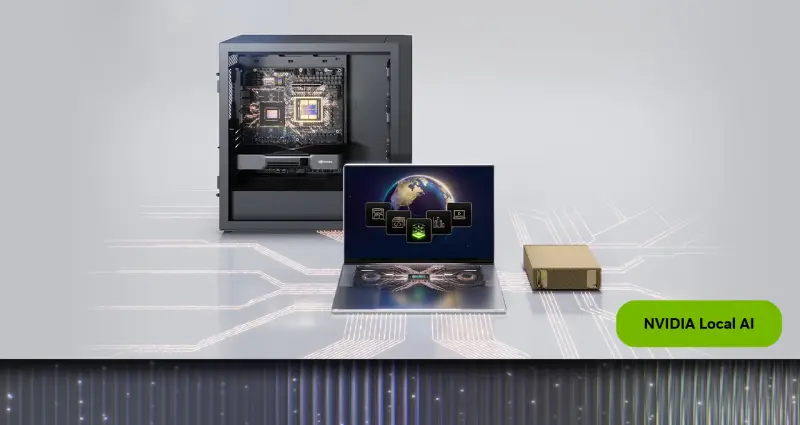
The most useful thread in NVIDIA's GTC Berlin announcements isn't any single chip. It's the idea that agent workloads can stay on hardware a person or team controls. NVIDIA now covers that range with three tiers: RTX Spark for personal agents on Windows PCs, DGX Spark for developers building on Linux, and DGX Station for enterprise teams running heavier workloads, with a Windows version due in December.
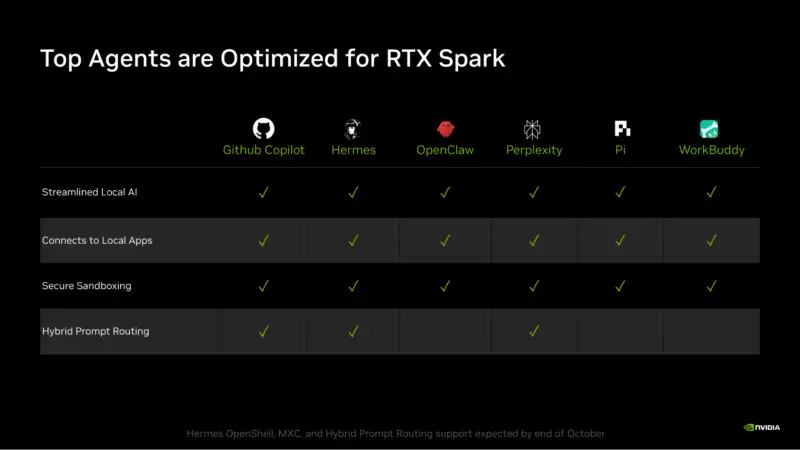
RTX Spark puts personal agents on Windows laptops
RTX Spark pitches itself as a new base for the PC, combining personal agents, accelerated content creation and 1440p gaming at 100 frames per second. The specs are up to 128GB of unified memory and 1 petaflop of AI compute. Early reviews have focused on portability and efficiency. CGMag called it "A dream machine for serious creators," The Verge described it as "Designed for the future of AI," and PCMag called it "An extremely capable, surprisingly portable and efficient machine."
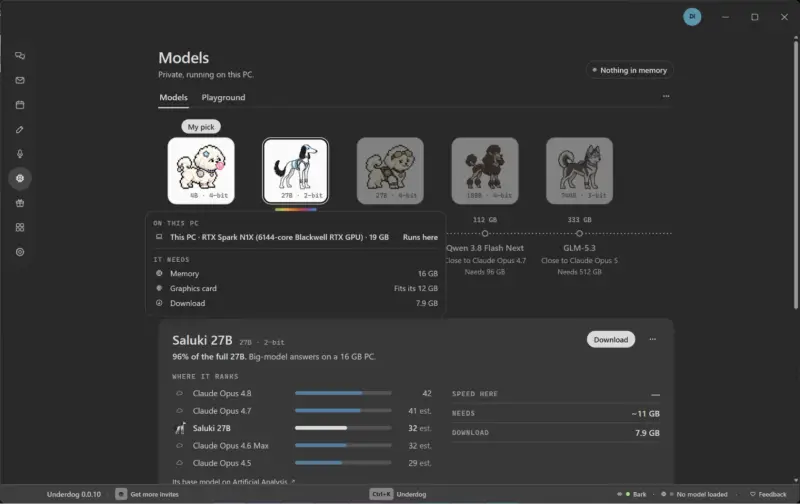
The software piece that matters most here is Underdog, a desktop agent built for fully local, private AI. Underdog runs models entirely on the device through its Husky model-specific inference engine, so personal agents can finish tasks without user data leaving the PC. It's available for download now.
Many RTX Spark laptops ship with an unlocked bootloader, which lets developers and enthusiasts build and customize local agents at the system level. I read that detail as more telling than it looks. It signals that tinkerers and robotics builders are part of the target, not only end users.
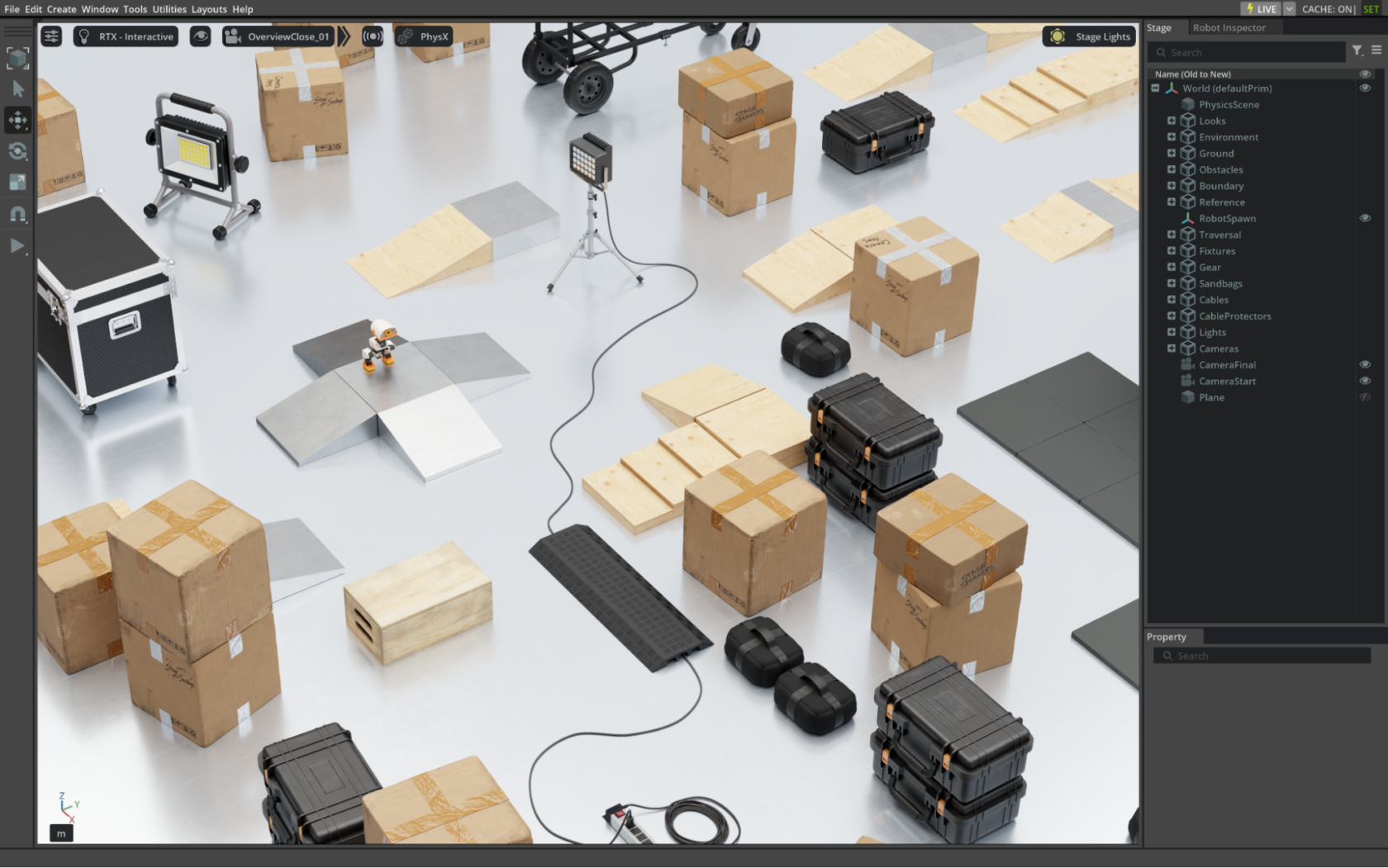
During the GTC keynote, Jensen Huang showed AI agents on RTX Spark helping train Hugging Face's Microduck robot with NVIDIA Isaac Lab, Hermes Agent and Nemotron 3.5 Bolt 74B. It was a demo, so the keynote doesn't provide training times or results. Treat it as a capability signal rather than a measured outcome.
RTX Spark laptops are available today from ASUS, Dell Technologies, HP, Lenovo, Microsoft and MSI, with Acer coming soon.
DGX Spark moves from a single box to an eight-node cluster
New DGX Spark 64GB systems start rolling out from partners on Friday, Oct. 23. They can run Nemotron 3.5 Bolt 74B (24GB), Qwen3.8 27B and Gemma 4 26B-A4B. For heavier work, developers can link multiple units through built-in NVIDIA ConnectX-7 networking and the NVIDIA Sync Cluster Assistant. That setup is meant for larger coding models such as Qwen 3.8 Flash Next, DeepSeek v4 Flash 0731 and GLM 5.3 Flash.
Clusters now scale to eight units in manual configuration. That allows larger models, longer contexts, concurrent agents and distributed development. The stated sweet spot is a small team sharing one cluster as a backend, with each developer running concurrent sessions against the same model. At full size, the cluster offers 1TB of unified memory, which NVIDIA positions as enough for frontier-class models like GLM 5.3. The source doesn't say how throughput scales past a few nodes, so benchmark that before you size a cluster around it.
NVIDIA Sync Model Launcher arrives later this month. It downloads a model and a matching container, connects the model to OpenCode, and loads DGX Spark Skills for troubleshooting, device maintenance and access to documentation. The October software update adds a Wi-Fi Assistant for switching networks in appliance mode and refreshes DGX Spark Skills. DGX Spark systems are sold directly from Acer, ASUS, Dell Technologies, GIGABYTE, HP, Lenovo, MSI and NVIDIA.
DGX Station brings shared inference to the desk
DGX Station offers 748GB of coherent memory and up to 20 petaflops of AI performance. NVIDIA says it can run advanced models like GLM 5.3 and serve more than 30 users at speeds comparable to cloud models. NVIDIA Sync now supports DGX Station, which simplifies connections between two Linux-based systems.
For IT teams, the more important news may be management. Absolute Security, Splunk by Cisco, Fleet Device Management, Microsoft Intune, Perforce Puppet, Progress Software Chef and Tanium now integrate with DGX Station. Together they cover enterprise setup, management and conformity processes. NVIDIA's pitch is faster approvals, lower deployment risk and less time to first token. Those are operational claims, and they'll only be proven in real rollouts.
DGX Station for Windows, expected from system makers in December, pairs NVIDIA RTX PRO GPUs with agents whose LLMs run on NVIDIA GB300 systems, all in one machine. Engineers can run local models and agents inside Windows-native software. The announced manufacturing application support includes nTop, Dassault Systèmes, Keysight Technologies, MathWorks, Rockwell Automation, Siemens, Synopsys, Unity and Altera, for AI-guided design, simulation, validation and engineering automation. Agents can run on premises through Hermes Agent, Perplexity or Aible.
Robotics teams get dedicated compute for post-training, simulation and evaluation, which shortens iteration cycles when they don't have to wait for shared infrastructure. NVIDIA released three open source reference workflows for DGX Station built on Isaac Lab, Isaac Lab-Arena and Cosmos. Developers can use them to refine GR00T 1.7 models with reinforcement learning, train dexterous manipulation skills and post-train Cosmos world models for synthetic data generation.
NVIDIA Cloud Functions is entering early access on Linux-based DGX Station. Teams can register local model endpoints in a shared catalog and reach them through one OpenAI-compatible entry point. Developers can swap the model behind an endpoint without touching application code, and teammates can use shared models without machine access. In practice, that turns a single station into a locally controlled inference service for a team.
NVIDIA is also previewing DSX OS on DGX Station to simulate AI factory operations before full infrastructure exists, and a demo will show DGX Station systems powering a local token factory for more than 30 developers. DGX Station systems are shipping now from ASUS, Dell Technologies, GIGABYTE, HP, MSI, Supermicro and Exxact. DGX Station for Windows is expected to ship later this year from ASUS, Dell Technologies, GIGABYTE, HP, MSI and Supermicro.
Recursive Flint: a small mixture-of-experts coding model
Recursive Superintelligence released Recursive Flint, a local model built for coding. It's a 40-billion-parameter mixture-of-experts model with 2.5 billion active parameters, which keeps per-token compute close to a small dense model. The release names SWE-Bench Pro v2, Terminal-Bench 2.1 and SWE-bench Verified as agentic coding benchmarks where the model performs well. The source doesn't publish scores, so check the lab's own numbers before drawing comparisons.
Flint came out of Recursive's Eureka Machine, a system for large-scale automated AI research that proposes ideas, implements them, runs experiments and uses the results to pick the next step. That loop produced specialized kernels that raised Flint's generation speed on RTX Spark by 55% without changing the model's weights. That's a notable result, though it's a single hardware configuration, so independent measurements would be worth seeing.
The open weights are on Hugging Face under the Apache 2.0 license. Developers can run Flint on RTX Spark, DGX Spark, GeForce RTX and RTX PRO GPUs. For post-training, NeMo Automodel handles supervised fine-tuning and LoRA, and NeMo RL handles group relative policy optimization.
Day-zero model support and smaller checkpoints
NVIDIA is adding day-zero support for Nemotron Bolt E4B, GLM, DeepSeek, Qwen, MiniMax, Liquid AI's LFM2.5-24B-A2B and the FLUX.3 Klein diffusion model. Nemotron Bolt E4B packs multi-turn conversation and agentic skills into as little as 4GB of memory, aimed at fast local voice assistants, interactive game characters and embedded interfaces. It runs on GeForce RTX GPUs, Jetson devices, and RTX and DGX Spark, and releases Friday, Oct. 23.
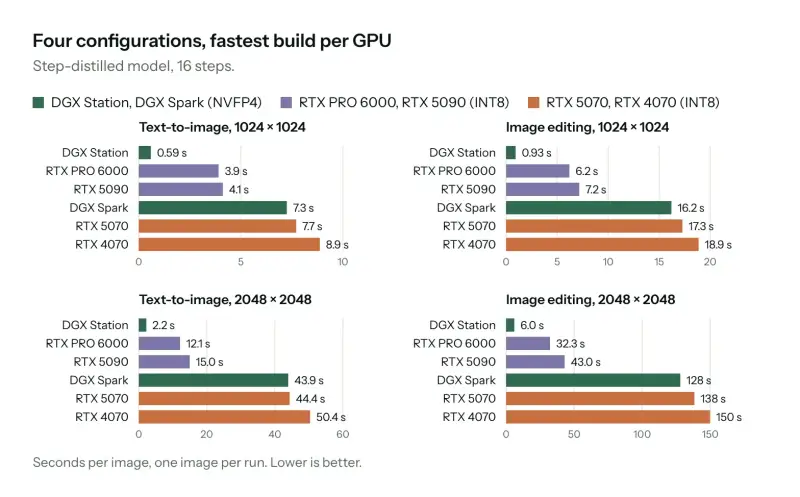
FLUX.3 Klein is a 5.6-billion-parameter open weights model for image generation and editing. NVIDIA-optimized builds run on GeForce RTX GPUs with as little as 8GB of VRAM and produce a 1-megapixel image in about four seconds on an RTX 5090.
MiniMax M3.1 Flash is a new open model aimed at DGX Station and DGX Spark for long-context work. Liquid AI's LFM2.5-24B-A2B activates just 2 billion of its 24 billion parameters per token, which makes it practical for private, tool-calling agents on PCs.
NVIDIA also released a collection of checkpoints quantized for memory efficiency on local hardware. Each stays close to full-precision accuracy and leaves room for KV cache. The first entries are Qwen3.8-Flash-Next-FP4-Local, which fits on a single DGX Spark 128GB or RTX PRO 6000, and GLM-5.3-Flash-FP4-Local, which runs across two systems. Developers can post-train on day zero with NeMo AutoModel on both DGX Spark and RTX Spark.
Inference engine gains
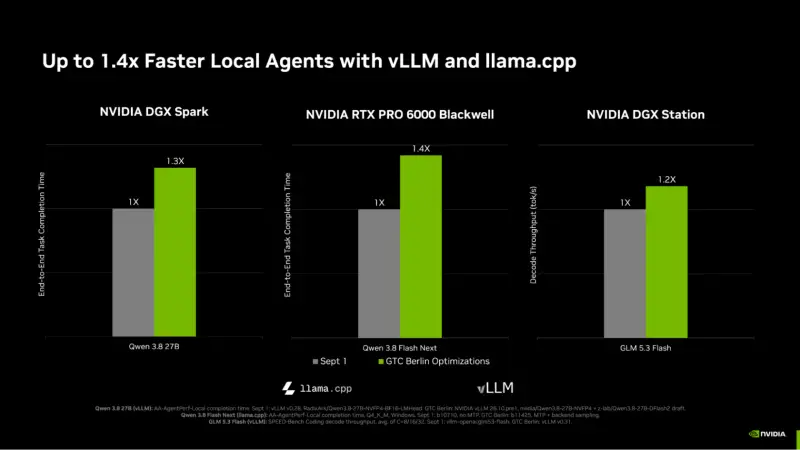
NVIDIA is working with the llama.cpp and vLLM communities on agentic workloads. In llama.cpp, new multi-token prediction (MTP) speculative decoding for Qwen 3.8 Flash Next makes end-to-end agentic tasks up to 1.4x faster on RTX PRO 6000 Blackwell. In vLLM, faster speculative decoding and new FlashInfer prefill kernels for Qwen's linear-attention layers make agentic tasks with Qwen3.8 27B up to 1.3x faster on DGX Spark. On DGX Station, GLM 5.3 Flash reaches up to 1.2x higher throughput.
NVIDIA's local AI inference recipes cover these optimizations. The next few months will show whether these speedups hold outside demos, whether DGX Station for Windows lands in December as planned, and how multi-node DGX Spark clusters behave when teams push past a handful of concurrent agents.


