Musk Says Hiring Jensen Huang Would Be an Honor, and Terafab Explains Why
Elon Musk replied that hiring former Nvidia CEO Jensen Huang would be "an honor." Huang's chip expertise maps neatly onto Musk's Terafab fab project.
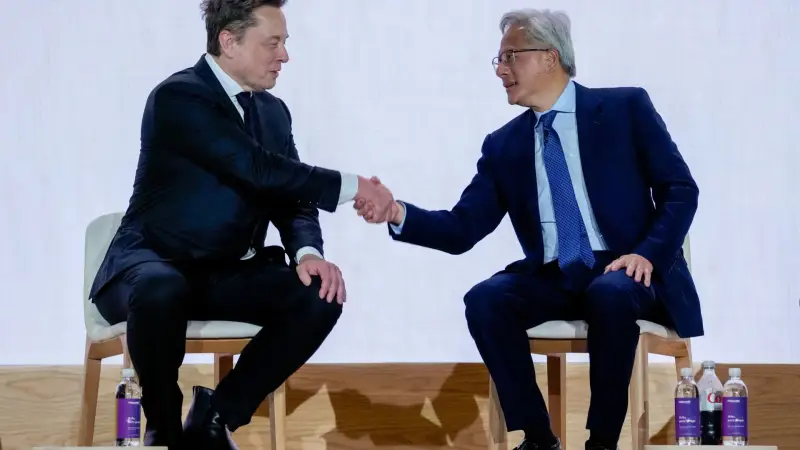
Elon Musk's answer to a random X post was a single line: "That would be an honor." The post asked him to hire Jensen Huang, and Musk's reply came before Nvidia's board had moved against its chief executive. Huang has since resigned as Nvidia CEO. Musk hasn't said whether the reply was a real offer, and it's unlikely he'll clarify anytime soon. Still, the exchange is worth reading closely, because the logic behind it is more interesting than the gossip around it.
Why the pitch makes technical sense
Huang built Nvidia into the company that currently sets the pace for AI accelerators. He knows how a chip company works from the inside: the design teams, the supplier relationships, the long timelines between a decision and silicon in volume. That's the kind of experience a newcomer to semiconductors can't buy off the shelf. Manufacturing, in particular, is where first-time entrants usually stumble.
Musk's interest in that gap is not new. He first mentioned Terafab in November 2025, and the project has since moved from announcement to physical build-out, with construction on the facility underway. Huang himself warned about the difficulty early on, saying that "the engineering, the science, and the artistry of doing what TSMC does for a living is extremely hard." He wasn't being dismissive. He was describing the exact problem a Terafab team will face, and he's one of very few people who has watched a fabless company wrestle with it at scale.
What Terafab is aiming for
The numbers Musk has put on the table are ambitious. Terafab targets volume chip production in the second half of 2028, and Musk has said the site aims for a capacity of one million wafers a month by 2032. Reporting on the project has also described plans for a large amount of manufacturing space, with an initial capital investment in the range of $16.8 billion. Those are figures reported in coverage of the project, and they're worth holding loosely until the fab is producing wafers.
The timeline is the part I'd watch most closely. Fab schedules slip for reasons that have little to do with ambition: tool delivery, yield ramps, process qualification, and the staffing of experienced process engineers. Musk has said suppliers including ASML will expedite shipments, which signals he understands the bottleneck. Whether that's enough to hit 2028 is an open question, and nobody outside the project can answer it yet.
Terafab also doesn't sit alone. Tesla has laid out an AI accelerator roadmap that depends on in-house silicon, and SpaceX has said it may eventually produce its own GPUs. Taken together, these plans describe a company that wants more control over the chips its products rely on. That's a reasonable strategy when accelerator supply is tight and expensive. It's also a strategy that requires a lot of expertise, and that's where the Huang question becomes relevant.
What Huang still has going for him
Huang's resignation removes him from Nvidia's board and leadership, but it doesn't remove his stake. Reporting indicates that he and his wife, Lori, jointly hold roughly 800 million Nvidia shares through various trusts and LLCs, and that Huang personally owns around 70 million. That's a financial position few executives will ever match, and it means he doesn't need a job to stay wealthy. It also means that any move he makes will be scrutinized as a statement about Nvidia's future, not just his own.
The personal matters that led to his departure are a different story, and they don't bear on whether his engineering knowledge is useful. Still, any company considering a senior hire at this level would weigh governance, reputational risk and board-level diligence heavily. A reply on X doesn't account for any of that. Musk's company would need to do the same work any hiring committee does before extending an offer.
What the reply actually tells us
My read is that the exchange says more about Musk's ambitions than about Huang's plans. We still don't know what Huang intends to do next, and nothing public suggests he's looking for a fab project or any particular employer. A stated willingness to hire, offered in a few words to a stranger's post, is a low-cost signal. It's not a negotiation.
That said, the underlying idea holds up. If Terafab is going to challenge incumbents, the scarce resource won't be capital alone. It'll be people who have shipped complex accelerators at volume and who understand the distance between a design that works on paper and a yield that makes money. Huang is one of those people, and any entrant trying to close that gap would be right to notice.
The thing to watch is not whether Huang joins anyone. It's whether Terafab hits its 2028 volume target without a leader of that caliber at the top. If it does, the question of who built the process expertise will matter less. If it slips, the hiring pool for fab-level talent will look a lot more important, and a few words on X will start to read like a preview of the real search.