Why Jensen Huang's Exit Hits Neoclouds' Financing First
Huang's resignation matters most to neoclouds, whose debt depends on Nvidia's backstops. Lenders now have to price how much that guarantee is worth.
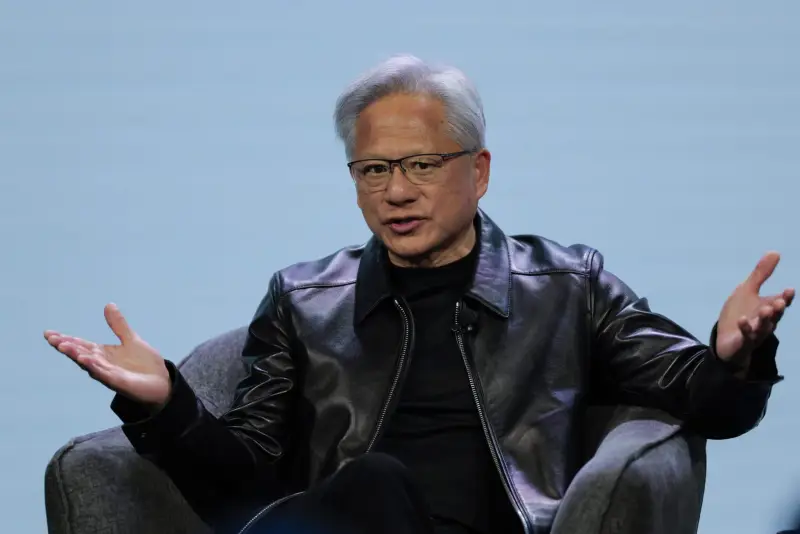
Most coverage of Jensen Huang's departure from Nvidia has focused on the company's stock and the people who hold it. For the neoclouds, the more pressing question is what happens to the credit behind their data centers. Here's the thing: their business model rests less on the chips they rent out than on the promises Nvidia makes to the banks and funds lending against those chips.
What changed at the top
Nvidia said Thursday that Huang resigned as president, CEO and board member, effective immediately. His exit followed his admission of an extramarital affair and a board investigation into the matter. CFO Colette Kress is now interim CEO, and the board named Harvey Jones its first chair.
The abruptness matters. Huang built Nvidia around his personal authority, and the company's position in AI training was tied to his decisions and public profile. Investors reacted quickly. Nvidia lost about $450 billion in market value in the days after the affair came to light, before Thursday's drop.
How Nvidia props up the neoclouds
Nvidia designs the chips that most AI models are trained on, and Taiwan's TSMC manufactures them. Neoclouds such as CoreWeave and Nebius buy those chips by the hundreds of thousands, fill data centers with them and rent the computing power to AI labs and other companies. They compete with Amazon, Google and Microsoft, which have deeper balance sheets and more diversified revenue.
Nvidia doesn't only sell to these companies. It also invests in them. At the end of June, it held about $329 million in Nebius shares. It has also taken on a guarantor role. In July, Nvidia began offering to rent back unused GPU capacity from neocloud partners at a fixed rate, a floor designed to make banks more comfortable lending. Later, it joined a $500 billion financing platform with six institutional partners, and it may backstop up to $125 billion of that.
Joe Kaiser, who founded Switchyard Partners this year after serving as CEO of Mercato Partners, which managed about $1.5 billion, argues that this backstop is the real asset. "The chip isn't what puts them at risk, but it's the financial backstop that allows CoreWeave or Nebius to go get those hundreds of millions of dollars of debt from Blackstone and Brookfield," he said. His point is that a lender sees a written commitment from Nvidia and prices the loan accordingly, which lowers both risk and interest rates.
That structure works well when the guarantor is stable. CoreWeave carried $35 billion in debt at the end of June, and lenders had already grown wary of businesses that depend entirely on AI demand before Huang stepped down. A guarantee that was priced in one way last week may now look different. "If the capital providers now say that Nvidia guarantee is not worth what it was worth a week ago, that puts those neocloud businesses at risk," Kaiser said. "At the end of the day, this is a heavy-asset, infrastructure-based industry."
Winners and losers
Kaiser sees OpenAI and SoftBank's SB Energy as likely beneficiaries of Nvidia's backstops, with CoreWeave and Nebius close behind. He pointed to reported talks over a $250 billion backstop that would help OpenAI lease an Ohio data center campus SB Energy is developing.
The market's first reaction was blunt. CoreWeave dropped about 9% on Thursday, giving back part of a 25% rally from the day before. Nebius fell 16%, though it also issued weak full-year guidance the same day, so the drop isn't purely about Huang. Neocloud stocks are volatile to begin with, and the two events landed together, which makes them hard to separate.
Nvidia's grip on AI training looks safer than its stock price suggests. Kaiser doesn't expect the company to lose that position for at least two or three years, because customers built on its CUDA software will find switching "really hard." The contest is shifting toward inference, the work of running models after they're trained. Kaiser said inference now accounts for more AI compute than training does, and that's where buyers are weighing Nvidia's general-purpose chips against cheaper hardware built for specific jobs. Qualcomm is pitching robotics, and Cerebras, Etched, Google's TPUs and Amazon's Trainium are all competing for inference workloads.
That's where Huang's departure could matter most. "If Nvidia no longer has Jensen as its rainmaker, did that just tip the scale towards using specialized chips?" Kaiser asked. He thinks specialist chipmakers are the bigger opportunity, and he expects AMD and Broadcom to gain ground as buyers look for alternatives. Google and Amazon could benefit twice: by selling their own chips to labs such as OpenAI and Anthropic, and by using their balance sheets to stand in for Nvidia's guarantees. "The Googles and others can step into that Nvidia backstop arrangement," he said.
TSMC looks less exposed. Kaiser estimated that about two-thirds of its capacity goes to Nvidia, but he said it could move that volume to other customers "in pretty short order."
A leadership model under pressure
Kaiser described Huang's management style as a hub-and-spoke model, with a small group of executives reporting directly to the CEO. He pointed to reports that Huang had more than 60 direct reports. Without him, he argued, Nvidia faces a "leadership vacuum and vision vacuum."
His comparison is Intel after Andy Grove stepped down as CEO in 1998. Grove and Huang both ran companies with an iron-fisted, highly disciplined style, Kaiser said. Intel kept growing revenue after Grove left, but it lost margin and "didn't adapt as well" as chip demand shifted toward new uses. "Intel is the roadmap here to what might be ahead for Nvidia," Kaiser said.
The comparison has limits. Nvidia's revenue isn't in decline, its CUDA ecosystem is far stickier than Intel's historical x86 lock-in, and Kress is a known operator inside the company. What the analogy does capture is the risk of a company whose strategy has been closely tied to one person's judgment and relationships.
Kaiser also argued that Huang had become the industry's main public face for data centers. With that voice gone, he said, the case for giant single-site facilities gets weaker. "This is just more push for distributed edge compute," he said, "away from these mega monolithic data centers."
That's a forecast, not a settled fact, and it's worth watching. For developers and buyers, the near-term questions are concrete: whether lenders keep pricing Nvidia's backstops the same way, whether neoclouds can raise debt on their own merits, and whether inference workloads start moving to other silicon. The answers will show up in loan terms and capacity contracts long before they appear in a chip roadmap.


