Does One Protest Marcher Matter More Than an Afternoon of AI Safety Research?
A back-of-the-envelope model puts one marcher's effect on AI risk press coverage at roughly 8 hours of safety research, with wide error bars.
Here's the question a planned London protest raises: is an afternoon on the street worth more to AI safety than an afternoon in the lab? A rough model, built on crowd sizes, press coverage and a few judgment calls, suggests a single marcher adds about as much as eight hours of external safety research. That number is shaky, but the reasoning behind it is worth walking through.
The setup
The March Against AI Extinction runs for three hours, excluding travel. It starts at All Souls' Place in London's W1B postcode and ends at Downing Street on Saturday 21 November, 12 to 3pm. The protest's main output is press coverage of AI existential risk, which then feeds into public and political attention. So the comparison needs an exchange rate between coverage and research.
The model here sets that rate by judgment. A 1% increase in external AI safety research over six months is treated as equally valuable to a 1.5% increase in AI x-risk coverage over the same period. In formula terms, impact is 1.5 times the log of research hours plus the log of press coverage. The plan follows from that: estimate how much one marcher raises coverage in percentage terms, divide by 1.5 to get the equivalent research gain, then convert that into hours.
How much does one marcher add?
The crowd forecast is 670 people. A February march drew somewhere between 300 and 500, and this one should be larger given the extra attention. The event page has 1,200 sign-ups, and assuming half of them show up gives roughly 670. One extra person therefore raises the crowd by about 0.15%.
The key unknown is how coverage scales with crowd size. If coverage grows as crowd size raised to some exponent ε, then a 0.15% bigger crowd produces ε × 0.15% more coverage. The estimate here is ε ≈ 0.49. That implies one marcher adds about 0.073% to this march's coverage.
That elasticity comes from seven earlier AI x-risk protests between June 2025 and October 2026. For each one, the author pulled reported crowd sizes, collected the coverage found through web searches, and scored each piece by estimated readership, weighted for audience type and tone. A hostile framing counted for half, and a reused wire photo illustrating an unrelated story counted for a fifth. The fit without the smallest protest gives ε ≈ 0.49, with a 90% bootstrap interval running from about −0.05 to 0.94. Counting outlets instead of scoring them gives 0.73, and including every protest gives 1.46. The scoring pattern is revealing: one large outlet, such as a major business or financial publication, can dominate a protest's total, so a 35-person rally with local TV coverage can score about as high as a 170-person protest covered by a national broadcaster. Crowd size only weakly predicts whether that one big hit happens.
The exponent also has an external check. A study of 4,582 Brussels protests from 2003 to 2010 found that crowd size raised both the odds of evening news coverage (roughly N^0.55) and the seconds of airtime per covered protest (roughly N^0.16). Combining these gives an elasticity near 0.6 for seconds of national coverage, close enough to the 0.49 used here to be reassuring, though the two measure different things.
From one protest to all AI x-risk coverage
This march isn't the only driver of AI x-risk coverage. Warning shots, high-profile resignations, open letters and statements all compete for space. The model assumes protests will make up at least 3% of that coverage over the next six months. With roughly three to six major AI protests a year, about one to three of them should fall in any six-month window, and this march is assumed to take about 30% of that protest coverage. That puts it at about 0.9% of all AI x-risk coverage.
Multiplying the two figures gives the total effect: 0.073% × 0.9% ≈ 0.00066% more total coverage from one extra marcher. Dividing by 1.5 converts that to about 0.00044% more research.
What that buys in research hours
External AI safety research is measured in full-time equivalents. A 2025 count by McAleese found about 1,100 FTE, split between 600 technical and 500 non-technical roles. That count leaves out academics, independent researchers and fellowship programs such as MATS and Astra, and it predates growth of roughly 25% a year. Accounting for both, the model estimates an average of about 1,900 FTE over the next six months. At 40-hour weeks, that's about 1.9 million hours.
A 0.00044% increase in 1.9 million hours is about 8 hours of research. Attending the march takes about 4 hours including the walk, so an average marcher comes out ahead by a factor of two on this model.
Where the averages break down
The average-marcher assumption flatters some people and shortchanges others. A researcher at the march can speak, talk to journalists, write about the day afterwards and lend credibility to the cause. The model guesses that a researcher's impact is at least three times the average marcher's. Attendance also scales in a way lab work doesn't. Bring three friends, and a researcher's contribution is roughly 48 hours of research, about a working week. Technical research rarely lets you multiply your output that way by pulling in a few people for an afternoon.
The author is candid that the whole calculation is rough. The judgment call comparing press coverage with research could be off by a large factor in either direction. And the emotional case sits underneath the arithmetic. As the author puts it, things could get worse quickly, and it's hard to know what the right actions are. Writing documents is one answer. Standing in the street with hundreds of strangers and saying this is alarming and shouldn't be happening is another, and the model suggests the second one adds more to the public record than many people expect.
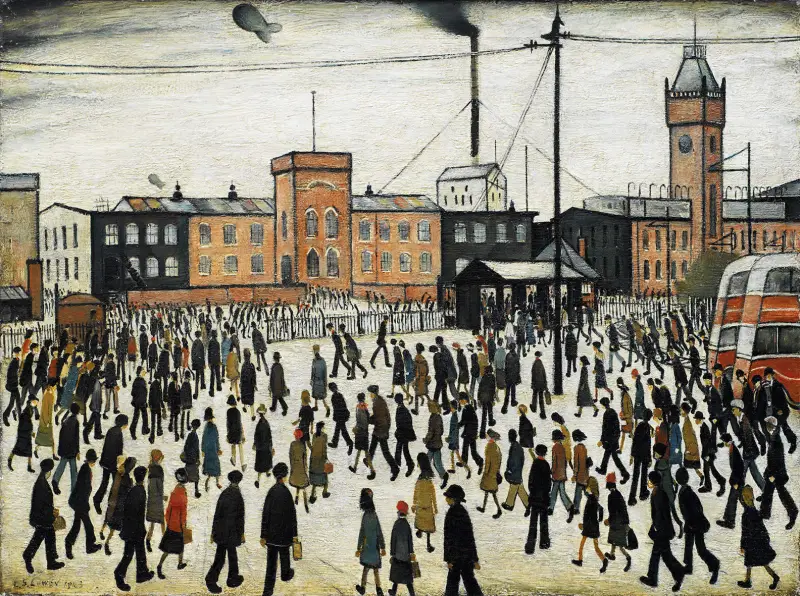
Going to Work (1943) by L. S. Lowry.
If you're weighing the trip, the numbers hinge on three things: whether the crowd reaches the forecast, whether a major outlet picks it up, and how much your presence changes your own output. Watch the crowd count and the coverage over the next few weeks. Those will tell you more than any single estimate.