Mistral Large 4 and Studio Put Open Models to Work on Enterprise Processes
Mistral Large 4 powers Studio's new managed agents, workflows and apps, deployable in cloud, VPC or on-prem with traces and evals built in.

The interesting part of this release isn't the model alone. It's the gap between a capable open-weight model and a process that runs reliably in production, and Mistral is pitching Studio as the layer that closes it. Mistral Large 4, nicknamed Le Chonk, is the model at the center. Studio is the platform that connects it to company data and systems, runs the agents and workflows built on top, and keeps the whole thing inside the infrastructure the customer chooses.

What the model is aimed at
Mistral positions Large 4 across four areas: coding, defensive cybersecurity, reasoning over complex documents, and business tasks. The post doesn't publish benchmark scores or a parameter count, so any claim about how it stacks up against other models has to come from Mistral's separate model materials and independent evaluations. What the post does establish is the scope. The model is meant to be the reasoning engine for work that involves long documents, code and multi-step decisions, not a general chat interface.

That focus matters for how teams will use it. A model tuned for document reasoning and code is most useful when it has access to the right files, tickets and tools, which is where Studio comes in.
Deployment without giving up control
Studio can run in the cloud, in a customer's own VPC, on-premises, or across a mix of those. Customers can also use Mistral-hosted deployments. The pitch is that sensitive data and the processes built around it stay inside the customer's perimeter, and that teams keep full visibility into what their AI systems do and what they learn over time.
That's a meaningful distinction for regulated or data-heavy businesses. Many organizations want the capability of a frontier-class model without sending every request to an external API they don't control. Running the model and the platform in their own environment is the trade they're looking for, even though it adds operational work on their side.

Three building blocks for business processes
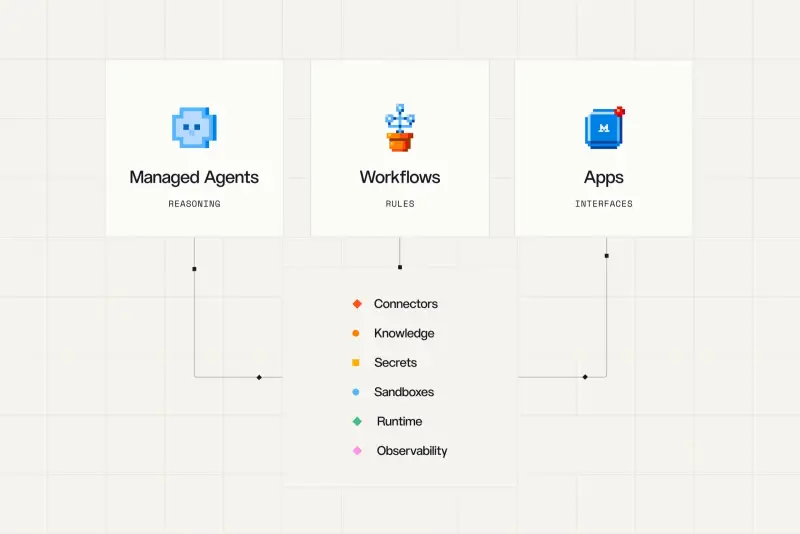
Studio organizes automation around three pieces, and the split is practical. An agent investigates and acts. A workflow coordinates steps, approvals and handoffs. An app gives employees a front end to use both. Studio runs all three on shared infrastructure, connected to enterprise data through connectors and MCP servers.

A new Mistral MCP server lets developers build with Mistral Vibe or the coding agent they already use, test locally, and deploy to their Studio environment with one command. Studio handles hosting and execution from there.

Managed agents that investigate and act
The new managed agents can run complex, multi-step tasks. Developers give them skills that encode team procedures, sandboxes for running code, and subagents to hand off parts of a job. Hooks let teams insert custom logic at specific points in execution, which is how an agent gets wired into existing ticketing, chat or monitoring tools.

Mistral says the runtime draws on the infrastructure behind millions of Mistral Vibe sessions each week. Developers set the boundaries on which tools, data and actions the agent can touch, and the platform handles the rest.

Mistral's own engineering team offers a concrete example. They built an agent to investigate production incidents. When an alert fires, the agent follows the team's runbook, requests approval before any sensitive action, and posts its findings in Slack. Engineers join with context already assembled. Mistral estimates this saves its team hundreds of hours a month.

Workflows that mix fixed rules, agents and people
Workflows define which steps follow deterministic rules, where an agent reasons, and where a person makes the call. Interrupted runs can resume from where they stopped. Teams can describe a process in Mistral Vibe and have it generate, test and deploy a workflow, and the output is code they can read and edit.

This release adds event triggers from enterprise systems and a visual graph that shows each workflow's logic. That graph matters more than it might seem. Once a process has branches, approvals and model decisions in it, the ability to see the structure at a glance is what makes it maintainable.

Mistral's product operations team used a workflow to sort submissions from internal teams and customer feedback. A model classifies each item as a bug or a feature request, and routing rules send it to the right group. Mistral says this saves the team about 35 hours a week.

Apps that meet enterprise requirements
Coding agents have made it fast to build an application. Getting one past security, access and reliability requirements is a different job. Studio provides hosting, authentication and access controls, and teams can build from pre-approved, reusable components. That reduces the amount of new code that needs a full review, which is often where internal tools stall.

Apps can call agents and workflows, pull enterprise documents through search indexes, and draw on shared context in Studio. Developers can deploy with one command to a dedicated link or inside Mistral Vibe.

Mistral's Applied AI team built a staffing app. Staffing a project used to mean matching profiles and past experience against requirements scattered across documents and tools. Now an agent recommends people and explains how each person's background fits the project, and staffing leads get a shortlist with supporting evidence to review. Mistral says this helps it assemble teams faster and surface expertise that might otherwise go unnoticed.

Early adopters and what they're saying
The post names ABANCA, Accenture, Alten, BNP Paribas, Capgemini, CMA CGM and Tata Consultancy Services as customers and partners already running Studio in production. Several quotes stand out because they address specific operational concerns rather than general enthusiasm.

BNP Paribas's Su Yang said the bank runs Studio on its own infrastructure because its AI systems handle some of its most sensitive processes. ABANCA's Jose Jorge Garcia Romaris described running Studio in its own cloud, with inference provided by Mistral, as a way to bring AI into the business while controlling how sensitive customer data is accessed.

CMA CGM's Julien Smadja offered the most specific timing claim: each new process it automates is production-ready in weeks rather than months. Capgemini's Fernando Alvarez pointed to a different gap, saying the observability and evaluation tooling is what turns a promising proof of concept into something a team can operate and measure. Alten's Gualtiero Bazzana made a similar point, noting that most industrial AI projects still stall at the pilot stage.
Taken together, the quotes suggest the buyers care less about raw model capability and more about whether a system can be run, audited and handed to internal teams. Accenture's Gregory Christophe framed it as moving from isolated use cases to solutions that can be orchestrated and scaled.
Observability and evaluation as first-class features
Studio emits OpenTelemetry traces for each step of a run, including model calls, tool use and approvals. That lets teams see where a process slows down or fails, which is the kind of diagnostic work that usually gets bolted on later. Evaluations let teams test changes to prompts, models or tools against their own datasets before anything ships.
The traces and evaluation results stay with the customer, which Mistral frames as preserving the operational knowledge built through use. Teams that adopt agents at scale tend to hit the same question: when behavior changes after an update, can they show what changed and why? Having that record in their own environment is a practical answer.
Customers are already applying this to penetration testing and KYC onboarding, both areas where sensitive data and specialist knowledge can't simply leave the building.
What to watch
The open questions are the ones any enterprise platform faces. Running the full stack in a customer's own environment shifts operational responsibility to the customer, and the post doesn't detail how much infrastructure work that involves. Mistral's claims about build speed and hours saved come from its own teams and customers, so independent measurements will be more useful than the figures here. The model's performance on the four target areas also needs outside evaluation before teams commit to it for high-stakes work.
Still, the direction is clear. The useful unit of enterprise AI is shifting from a single model endpoint to a governed system of agents, workflows and apps. Teams evaluating Studio should start with one process, measure how long it takes to reach production, and check how much of the resulting know-how stays in-house. That's the test that will show whether this platform does what it promises.