DataGPT Turns Chatbot Data Analysis Into Reviewable, Rerunnable Workflows
Prophecy's DataGPT runs data workflows inside ChatGPT, Claude and Copilot, saving each step as versioned code that IT can review and schedule.
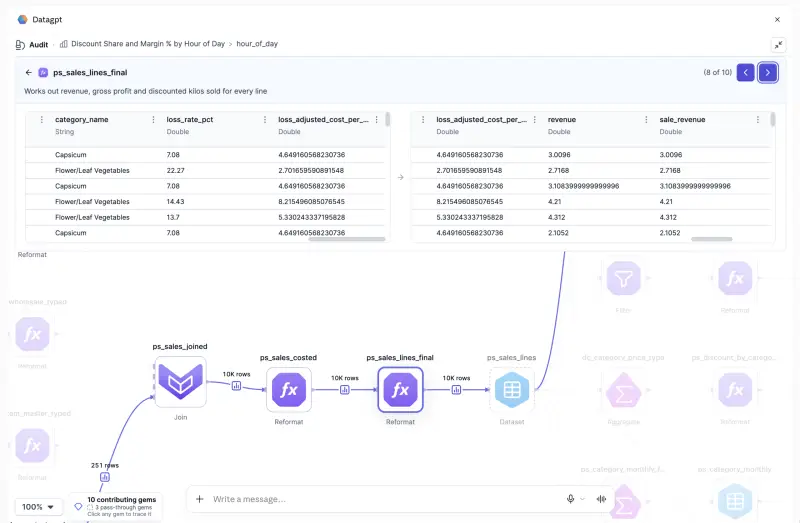
The interesting part of Prophecy's DataGPT isn't the chat interface. It's that the answer comes with the work attached. Every result arrives with a visual map of the steps that produced it, and those steps are stored as open code that someone can inspect, change and rerun. For a category of tool that has mostly delivered answers with no paper trail, that's a meaningful shift.
Why the chat window breaks down for analysts
Anyone who has watched a finance or operations team work with a general-purpose chatbot knows the pattern. An analyst uploads a spreadsheet, describes the job in plain English, and asks the model to reconcile a quarter's worth of transactions. The model writes a script on the fly, runs it, and returns a clean table. The numbers look right. The problem is everything that happened in between.
Prophecy's argument is that most people doing this work can't read the code the model produced, so they accept the output on trust. The logic lives only in the session. Close the chat and it disappears, along with any revenue definitions or approved exceptions the user spelled out along the way. Next quarter, someone has to explain it all again, and the new answer may quietly differ from the old one.
That's the gap DataGPT targets. It's less about whether the model can do arithmetic and more about whether the reasoning survives the conversation. In my read, that's where most of the real risk sits. A wrong number that nobody can trace is harder to catch than a wrong number in a script someone can open and read.
Prophecy points to a January forecast from Gartner that half of organizations will adopt a zero-trust posture for data governance by 2028, as unverified data generated by AI spreads. Whatever you think of that timeline, the direction is clear: teams will need a way to check what their AI-assisted analysis is doing, not just accept it.
How the workflow stays inspectable
Raj Bains, Prophecy's founder and chief executive, frames the problem in terms of developer tooling. Software engineers already have AI that writes code and carries it into production. "Business data users got question answering, and nothing changed," he said. DataGPT is an attempt to give analysts the same kind of pipeline, where the work product is code they can verify and modify.
In practice, a single DataGPT conversation can cover several steps. An analyst might load a messy Excel file, cross-check it against an audit list and against records held in SharePoint or Snowflake, then add a pricing rule for discounted product bundles. Prophecy's own walkthrough ends by setting that whole sequence to run every month without anyone rebuilding it.
Nothing runs on a schedule until a person has reviewed it. DataGPT shows each stage on screen next to its results. If an analyst spots a bad join or a wrong filter, they can fix that stage in place and then approve the full workflow. That review step matters. A scheduled pipeline that nobody checked is just a faster way to repeat a mistake.
Every workflow is backed by open code stored in Git. Reruns execute that code exactly as written and don't call the AI model again, so they carry no added model cost. That detail is worth dwelling on. Many AI data tools charge for each execution, which makes recurring jobs expensive and encourages people to skip automation. Separating the one-time generation step from the repeated execution step changes that math.
Signed-off workflows also feed a knowledge graph that Prophecy builds for each customer, drawing on the company's own business rules and data catalogs. The idea is that approved definitions accumulate over time, so the next analyst starts from what the organization already agreed on rather than from a blank prompt. How well that works in large, messy environments is an open question. Building a useful graph from real business rules is hard, and it depends heavily on how well those rules are documented to begin with.
Where the data goes and who controls it
Prophecy is pitching DataGPT as a way to bring shadow AI under IT's control. The usual problem is that someone uploads a sensitive file to a consumer chatbot without anyone in IT knowing. DataGPT's design changes the path. Uploaded files don't sit inside the chat. They pass through Prophecy to the organization's own data platform, where IT staff and platform operators can see every workflow and manage it like any other production asset.
Scheduled runs execute on whichever platform the customer already uses: Snowflake, Databricks or Google's BigQuery. That choice matters for teams that have already invested in one of those systems and don't want a second place where data gets processed. It also means the governance questions move to familiar ground, such as access controls, lineage and audit logs on the warehouse side.
Still, the setup has tradeoffs. Routing files through a third-party service adds a hop that security teams will want to evaluate. Keeping workflows in Git is good practice, but it assumes someone on the team is comfortable reviewing code, which is exactly the skill Prophecy says most of these users lack. Someone technical will still need to own the repository. And the value of the knowledge graph depends on the quality of the rules that feed it.
Availability, funding and who's using it
DataGPT is available now through the connector marketplaces in ChatGPT, Claude and Copilot. Companies that haven't approved those AI tools can run the same workflows inside Prophecy's own app. Individuals can start with a free account, and administrators can roll the product out centrally across an organization.
Prophecy has raised more than $100 million since it was founded in 2017. Its most recent round was a $47 million Series B extension led by Smith Point Capital in January 2025. The company names SAP, HSBC and Pfizer among its customers. Those are large, regulated, data-heavy organizations, which is consistent with the pitch: the buyers most worried about unverified AI output are the ones with the most at stake if a number is wrong.
The bet here is that the chat interface is the right entry point for analysts, and that the durable product is the layer underneath it, the versioned workflow that survives the conversation. If that holds, the question for teams won't be whether to let analysts use AI on their data, but which AI-generated steps they're willing to put on a monthly schedule. My guess is that the answer will depend less on the model and more on how quickly reviewers can read what it wrote. Watch for how customers handle that review step at scale, because that's where DataGPT's approach will either prove itself or get quietly routed around.