Phaze Turns Idle Workstations Into Shared Compute for People and AI Agents
Phaze, a remote desktop startup from Parsec's founders, raised $8.75M in seed funding led by a16z to let people and AI agents share high-end workstations remotely.
Most conversations about AI agents focus on the model. Phaze is betting that the more practical bottleneck is where the agent does its work. An agent that needs to run design software, render 3D scenes or compile a large codebase needs a machine it can actually operate, and most enterprises don't have a good way to hand one over.
Phaze is a new company from the founders of Parsec Technologies, the remote desktop firm. The startup has launched its platform after raising $8.75 million in seed funding led by Andreessen Horowitz. Index, NextView, Makers and Lerer Hippeau also took part in the round. The product is built for both people and AI agents, and it gives either one remote access to powerful machines, including high-end workstations.
The idle workstation problem
Phaze's pitch rests on two inefficiencies that many enterprises already live with.
The first is the rise of computer-use agents, which operate a machine the way a person would: moving the cursor, clicking through menus, filling in forms. When these agents run on the same screen a worker is using, they interrupt that worker. Automating mundane tasks can end up costing human productivity, which defeats the purpose.
The second is more mundane and more expensive. Engineering and creative teams often need workstations that can cost more than $10,000 each. Those machines earn their price when they're rendering complex 3D graphics or compiling massive codebases. But many IT departments assign one machine per employee, so the hardware sits unused during lunch, meetings, and days off. Multiply that across a team and the idle capacity adds up quickly.
Phaze's answer is to treat those workstations as a shared pool of elastic compute. Anyone in the organization can connect when they need a machine, and administrators can reassign capacity as workloads shift between people and agents. The company says the machines can sit on a desk, in a data center, or in a closet. Location doesn't change how they're used.
How the access layer works
The core of the platform is a high-performance streaming technology that the company says delivers low-latency responsiveness and visual fidelity close to what a user would get on local hardware. That detail matters. Remote desktops have a long history of feeling laggy or blurry, and for GPU-heavy work like 3D modeling, those compromises make the tool unusable. A shared workstation only makes sense if the remote session feels like sitting at the machine.
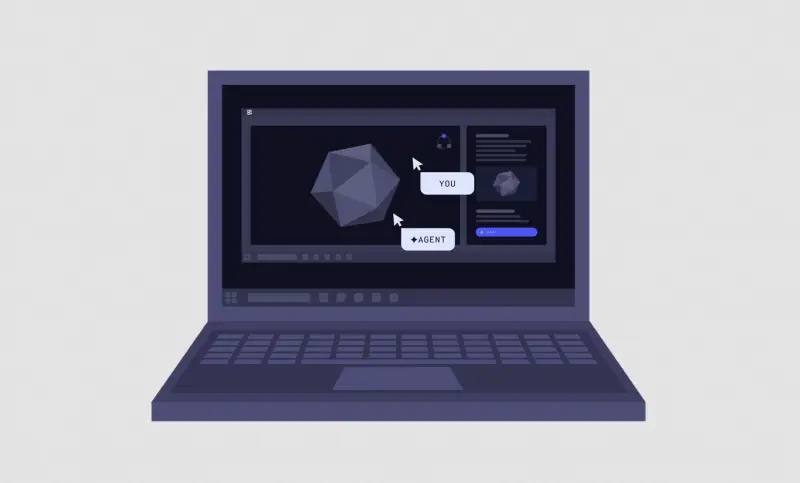
On the agent side, Phaze has built a Model Context Protocol server that lets computer-use agents log into a workstation and operate it like an employee. The agent can navigate the operating system, launch applications and complete tasks directly on the desktop.
This approach sidesteps a familiar limitation. Many agent integrations depend on application programming interfaces, and those can be expensive to build, fragile when vendors change them, and missing for many desktop tools. An agent that can simply use the interface has a broader reach, though it also inherits the messiness of graphical user interfaces, where a button moves or a dialog pops up unexpectedly.
Human and agent handoffs
Co-founder and CEO Benjy Boxer says the platform is also meant for collaboration between people and agents. His example is an IT support bot that starts diagnosing a problem when a new ticket arrives. If the fix goes beyond what the bot is authorized to do, it can pass the live session to a human engineer.
That handoff is the more interesting design choice. Most agent deployments treat human review as an exception path bolted on at the end. Here, the session itself is the unit of work, and it can move between a machine operator that's software and one that's a person without the context being lost. Teams experimenting with agents in IT, QA and support often run into exactly this problem, so a shared session that both sides can enter is a sensible design.
Boxer put the positioning this way: "The computer sitting on your desk shouldn't determine what compute you can access. People need powerful workstations to do their jobs, and now AI agents need computers they can actually operate. We're building the access layer that lets either one connect to the machine they need, wherever it happens to be."
Martin Casado, a general partner at Andreessen Horowitz, argued that the economics are the main draw. "Phaze is turning those machines into shared infrastructure for people and AI agents," he said. He also pointed to the team's background, noting that Boxer and his colleagues have been working in remote access for more than a decade.
What to watch
The idea is easy to state and harder to execute. A few open questions will determine whether Phaze becomes standard infrastructure or a niche tool.
Permissions are the first. Giving an agent a full desktop session means deciding exactly what it can see, install and change. Enterprises will want granular controls, audit trails and clear rules for when an agent must stop and hand off. How well Phaze handles that will matter as much as stream quality.
Economics are the second. Shared workstations only save money if utilization rises enough to offset the cost of the infrastructure and the streaming overhead. Teams will want to see real utilization numbers before they change how they provision hardware, and the company hasn't published those in the material available so far.
Reliability under agent workloads is the third. Agents may run for long stretches, fail in unexpected ways or spawn many sessions at once. A desktop that a person can recover by hand is a different challenge from one that an automated process has to recover on its own.
With the seed round, Phaze plans to put money toward go-to-market work, customer onboarding and a larger engineering team. My read is that the company's bet is well-timed: as agents move from demos into daily operations, the question of where they run will get more attention. The company's next moves should show whether shared workstations become a normal part of how enterprises provision compute for both people and software.