Arista's Q3 Results Point to the Network as a Core AI Infrastructure Layer
Arista's Q3 revenue jumped 58.5% and guidance rose again. The numbers suggest networking is becoming a performance decision in AI clusters, not a commodity purchase.
Most of the AI infrastructure conversation still centers on accelerators and compute. The network tends to get treated as the plumbing you wire up once the expensive decisions are made. Arista Networks' third-quarter report makes that assumption harder to defend, and my read is that the market is starting to price networking as a core part of the system rather than an afterthought.
The numbers behind the jump
Arista posted third-quarter revenue of $3.66 billion, up 58.5% year over year and 20.5% sequentially. That's the fastest growth in the company's history as a public company, and it landed well above the $3.3 billion the company had guided. Adjusted non-GAAP earnings per share came in at $1.20, compared with 77 cents a year earlier. Gross margin was 64%, operating margin was 49.1%, and the company ended the quarter with $14.4 billion in cash and no debt.
Management raised full-year 2026 guidance for the fourth time this year, to about $13.3 billion, which works out to 48% growth. Fourth-quarter revenue is expected between $3.9 billion and $4 billion. The first look at 2027 calls for 38% to 40% growth, to roughly $18.5 billion. Within that, AI networking is projected to double from $3.5 billion to about $7 billion, and campus revenue is expected to grow 60% to about $2 billion. Shares rose about 12% in after-hours trading and settled at a gain of roughly 5% the next day.
Why the network now shapes AI economics
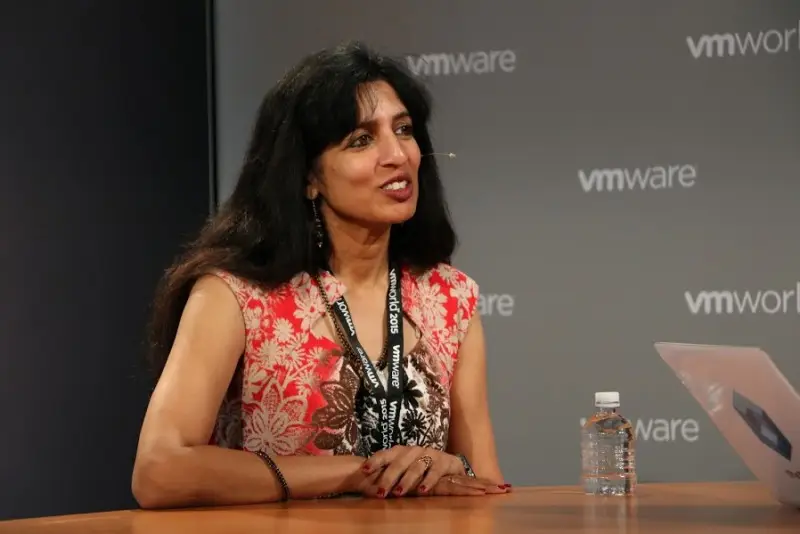
Chief Executive Jayshree Ullal framed the shift in one line: "We believe the industry is shifting from a compute-centric vertical stack to a holistic network-centric approach." The economics back that up. In large training clusters, the network often determines how productive the whole AI factory is. When packets drop or a link fails, expensive accelerators sit idle, and that waste compounds.
Inference makes the problem sharper. Ullal described a move from "highly centralized training compute to disaggregated and distributed inference," with prefill, decode, storage and KV cache spread across different resources. That spreads traffic across more paths and more hardware. "A well-designed network is becoming a foundational cornerstone for optimal token efficiency," she said.
Buyers are following the math. Boards and chief financial officers increasingly measure AI spending by cost per token and accelerator utilization, and both depend heavily on the network. A 5% gain in GPU utilization across a multigigawatt build is worth far more than the switches that produced it. Once a buyer sees that, networking stops being a line item to minimize and becomes a performance decision.
Three reasons Arista gains more than most
Better awareness helps every networking vendor, but Arista's position gives it an edge for three reasons.
Accelerator diversity. Three years ago, Arista was talking about four or five AI customers running 50,000 to 100,000 Nvidia GPUs, often on InfiniBand. Today it reports more than 100 Etherlink customers and expects more than 10 gigawatts of deployment across 10 or more accelerator types by the end of 2027. Nvidia's Spectrum-X Ethernet has won hyperscale business at companies including Meta and Oracle, and it remains a formidable competitor. But Nvidia's networking is tuned around its own full stack. As customers bring AMD, Microsoft's Maia, Meta's MTIA, Qualcomm and Cerebras silicon into production, many will want a network supplier that isn't also selling a competing accelerator. Every new chip family widens the slice of AI networking open to an independent Ethernet vendor. Arista's co-design work with Cerebras and Maia means it's now in the room during system design rather than bolted on afterward.
Scale-across. Power constraints are pushing AI capacity into multiple buildings and regions. Linking those sites demands deep buffers, large routing tables and very high reliability. Ullal said scale-across made up about 30% of AI demand this year and should grow in 2027, with the 7800 platform as the anchor. "There's just no room for error when you're connecting millions of XPUs," she said. This is where Arista's routing experience and its EOS software matter most.
Scale-up. Arista showed rack-scale Ethernet designs at OCP, built on the Ethernet for Scale-Up Networking (ESUN) specification. Trials are slated for 2027 and production for 2028. Ullal drew a parallel to the InfiniBand transition, saying she expects the industry to move from "staring at proprietary UALink or NVLink" to "of course, it's going to be ESUN." If that holds, Arista's addressable market extends inside the rack, a segment it has never served.
Security as a selling point
Chief Technology Officer Ken Duda said Arista is working with Anthropic, Google and OpenAI to bring AI-driven vulnerability discovery into its software pipeline, including through Project Glasswing. The logic is straightforward: as AI finds flaws faster, an operating system with process isolation and hitless patching becomes more valuable. Ullal put the contrast bluntly. Competitors, she said, are "dealing with a game of Whac-A-Mole where they've got thousands of vulnerabilities." President and COO Todd Nightingale called this the "Glasswing and Mythos effect" and tied it to why campus revenue is running so far ahead of the market.
The concerns the quarter didn't settle
The stock had fallen more than 20% in the month before the report, according to Chartmill, so the bears had material to work with.
Deferred revenue. Total deferred revenue was flat at about $6.8 billion. Some read that as a sign of slowing demand. CFO Chantelle Breithaupt pointed to the largest churn in and out of the balance yet, and said year-end deferred revenue will be higher than last year's. Ullal argued that the balance reflects timing, calling demand "a physics problem" and saying Arista is in the best position it has been in during her 18 years there.
Spending and margins. R&D rose to $408.5 million from $278.1 million. Duda attributed the increase to hyperscaler prototypes and liquid cooling. Breithaupt kept the long-term R&D range at 9% to 11% of revenue. Gross margin slipped from 65.2% a year ago, but Ullal held the long-term target at 62% to 64%, including for scale-up products. That's a number to watch as scale-up revenue ramps.
Supply and visibility. Purchase commitments climbed to $11.4 billion and inventory to $3.2 billion. Multiyear agreements now cover silicon, circuit boards and memory. Arista has about two quarters of firm order visibility, and Ullal's answer was that "we have two years of work behind it." That's a plausible framing, but it leans on planning visibility that is harder to audit than backlog.
Ethernet versus InfiniBand, settled or not
For years, the Arista debate has been whether Ethernet could displace InfiniBand. InfiniBand will keep a key role in AI buildouts. My view is that Ethernet's applicability is much broader, and its growth should outpace InfiniBand's. The bigger question now is how much of the AI system the network will define, and this quarter suggests more than most expected.
William Blair analyst Sebastien Naji made a similar case, writing that networking is becoming "a more important lever for improving performance and token output in AI data centers." He maintained an Outperform rating and described Arista as a core AI infrastructure holding. Those are one analyst's views, and they carry the usual caveats about forward estimates.
The biggest risk, as I see it, isn't deferred revenue or demand. It's execution. Arista has to keep shipping cleanly as it grows faster, takes on more accelerator types and moves into scale-up racks it has never built for. Its track record under Ullal gives reason for confidence. Still, the 2027 plan doubles AI networking, and 2028 scale-up production is a different kind of bet. Watch the gross margin range, deferred revenue at year-end and whether the ESUN trials in 2027 land on schedule. Those three will tell you more about the thesis than any single quarter.


