Optics11 Draws Navy Interest With Fiber-Optic Underwater Listening
Dutch firm Optics11 says its fiber-optic sensors can pick up an oil tanker about 100 km away, and it's in talks with dozens of navies.
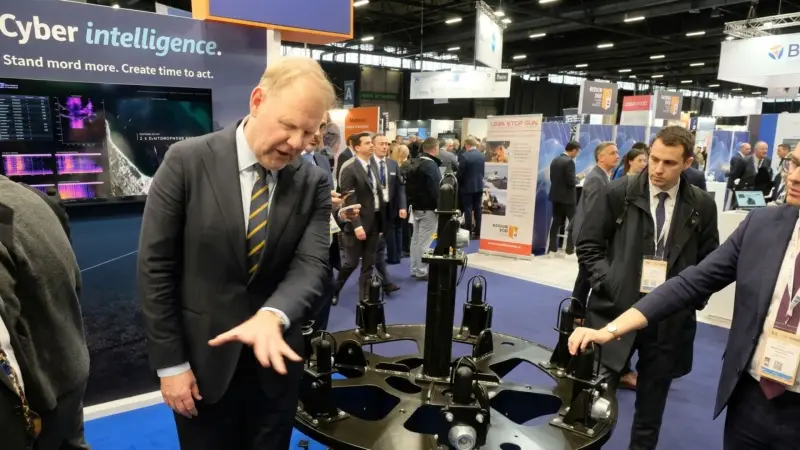
Optics11 is a Dutch defense technology company with a pitch that's simple to state and hard to build: use light in an optical fiber to hear what's happening underwater. Its CEO, Paul Heiden, says the company already serves between five and ten naval customers and has about 35 paid evaluations planned for 2026. Dozens of navies are now in discussions. My read is that this is the part of the story worth paying attention to, more than any single detection claim.

How fiber-optic underwater sensing differs from conventional sonar
Conventional naval sonar relies heavily on piezoelectric sensors, which convert pressure changes into electrical signals at discrete points. Optics11's approach works differently. A fiber stretched along the seabed, or towed behind a vessel, becomes a continuous sensing line. Passing acoustic waves slightly strain the fiber, and an interrogator unit reads those tiny changes in the returning light. The result is a dense stream of measurements along the full length of the cable rather than readings from a handful of fixed points.
That density is both the advantage and the headache. Heiden says the systems produce substantially more acoustic information than piezoelectric arrays, and the sheer volume is what makes the company's claims possible. Heiden put the detection range at roughly 100 kilometers, or about 66 miles, for identifying an oil tanker through underwater acoustic monitoring. Treat that as a vendor figure: it depends on seabed conditions, noise floors and the target's acoustic signature, none of which are detailed in the reporting. But it points to why fiber-based systems are drawing attention. Long, continuous baselines are hard to achieve with point sensors.
The company sells two main products. OptiBarrier is aimed at fixed surveillance, the kind of seabed installation that would watch a choke point or approach route. OptiArray is a towed sensor arrangement, which gives mobile platforms a way to listen while moving. Both fit into the anti-submarine and maritime traffic monitoring roles the company is targeting.
Where the company sits in the naval supply chain
Optics11 isn't building a complete naval combat system on its own. It's positioning itself as a sensing component inside larger programs. The company is developing a towed sensor system for the Royal Netherlands Navy's future Orka-class submarines, which France's Naval Group is supplying. Its existing industry relationships include Saab, Rheinmetall, Fincantieri, Thales and Exail. It also works alongside Ocean Infinity, which Britain selected for its Atlantic Bastion underwater surveillance initiative.
Evaluations are ongoing with forces in Germany, Sweden, the United Kingdom, Belgium and France. For a company of this size, that's a practical way to grow. Navies tend to test sensing technology in their own waters and against their own threat scenarios before committing to procurement, and each evaluation both validates the hardware and generates the data needed to refine it. Teams in this position typically find that the sales cycle is slow, the test programs are expensive, and the first large contract matters far more than the early interest.
The software problem nobody budgets for
The more unusual part of the story is the software. Optics11 initially expected to work with an existing partner for signal processing. Heiden says that didn't work out: "Our data density is so high that we couldn't derive any value from third-party sonar processing software." So the company built its own processing stack.
That decision has a cost profile worth noting. AI tools reduced the number of developers the company needed, which Heiden says brought the team to about 10 specialists instead of the 60 to 80 previously anticipated. The savings, he argues, let Optics11 put money into acoustic specialists who understand how underwater sound propagates across different seabed types. That's a telling trade-off. In sensing businesses, the scarce skill is often the physics of the environment, not the code that reads the sensor output. A dense fiber dataset is only useful if someone can tell a tanker from a whale, a storm, or a seismic event.
Funding, secrecy and the path to profitability
The financing picture is busy. Optics11 raised about €100 million over the past 15 months, including €25 million in venture debt from the European Investment Bank. The Royal Netherlands Navy has backed the company for at least eight years, with millions of euros in subsidies, technical guidance and opportunities to test on submarines. That kind of early anchor customer is common in defense hardware, where a home navy can provide both money and a proving ground.
The company plans another funding round in 2027 and may seek a valuation above $1 billion, even though it isn't profitable yet. It expects positive cash flow in 2028, and expansion plans include new offices and recruiting across Southeast Asia and the Middle East. Those are the company's own projections, and they hinge on converting evaluations into contracts on schedule. Defense timelines have a habit of slipping, so the 2028 target is a number to watch rather than a settled fact.
Secrecy is the other thread. Heiden says the most important developments are protected as confidential business information rather than patents. "You can't publish this, you can't patent it, so it all has to be kept secret," he said, adding that the company is getting substantial help from the Dutch state to keep the technology protected. A patent requires public disclosure, which would reveal the very signal-processing methods that give the system its edge. For a sensing company, that's a sound logic. It also means outside engineers can't easily verify performance claims, so buyers will have to rely on trials.
What to watch next
My read is that three things will decide whether Optics11 moves from promising to established. The first is how the roughly 35 planned paid evaluations for 2026 turn out, especially whether they convert into production orders. The second is whether the Orka towed-sensor work proceeds on schedule, since that would be a concrete, public proof point. The third is whether secret-by-design software can scale across different seabed conditions without a growing specialist team.
The broader question is whether fiber-based acoustic sensing becomes a standard layer in underwater surveillance or stays a niche complement to sonar. Long continuous sensing lines are a credible answer to some problems that point sensors handle poorly. Whether that holds up in the field, across varied seabeds and noise conditions, is still open.