Earth-2 Models Bring Satellite-Driven Nowcasting to European Energy and Insurance Teams
NVIDIA's StormScope EU nowcasts European cloud cover every 10 minutes from satellite data, and early adopters are testing it for solar, insurance and air quality.
A global forecast can show a storm forming over the Atlantic, but it rarely tells a solar operator whether a cloud bank will cross a specific array in the next half hour. That gap between the regional picture and the local decision is where NVIDIA's latest Earth-2 release is aimed. The open models are built for the second problem, and the early users are energy producers, insurers and transport operators who need answers at the scale of a single site.
Why the local question is hard
Coarse global models are good at synoptic patterns, the large-scale movement of air masses that drives weather across continents. They are much less useful when the question is whether a particular field will be shaded in twenty minutes. Teams in this position typically bridge the gap with a patchwork of satellite feeds, radar, in-house station data and a forecaster's judgment, and each of those inputs arrives on its own schedule. The result is often a forecast that is accurate on average and slow to react when conditions change quickly.
Earth-2 takes a different route. It's a family of AI models and tools that developers can fine-tune on their own data, and it runs on NVIDIA computing. The models cover global prediction, detailed regional forecasts and environmental research, so a team can pick the component that matches its time horizon and resolution rather than adopting one monolithic system.
StormScope EU and the satellite pipeline
StormScope EU is the newest addition. It's a regional version of the StormScope model, aimed at short-term forecasting, and it was trained on European weather and climate data. Its input is satellite imagery from EUMETSAT, and its output is the evolution of cloud conditions across 16 Meteosat channels, updated at 10-minute intervals. Nowcasting models that work from satellite observations sidestep some of the lag that comes from solving physics equations forward from a全 analysis, which is why this class of model tends to be the one operators reach for when the horizon is under a few hours.
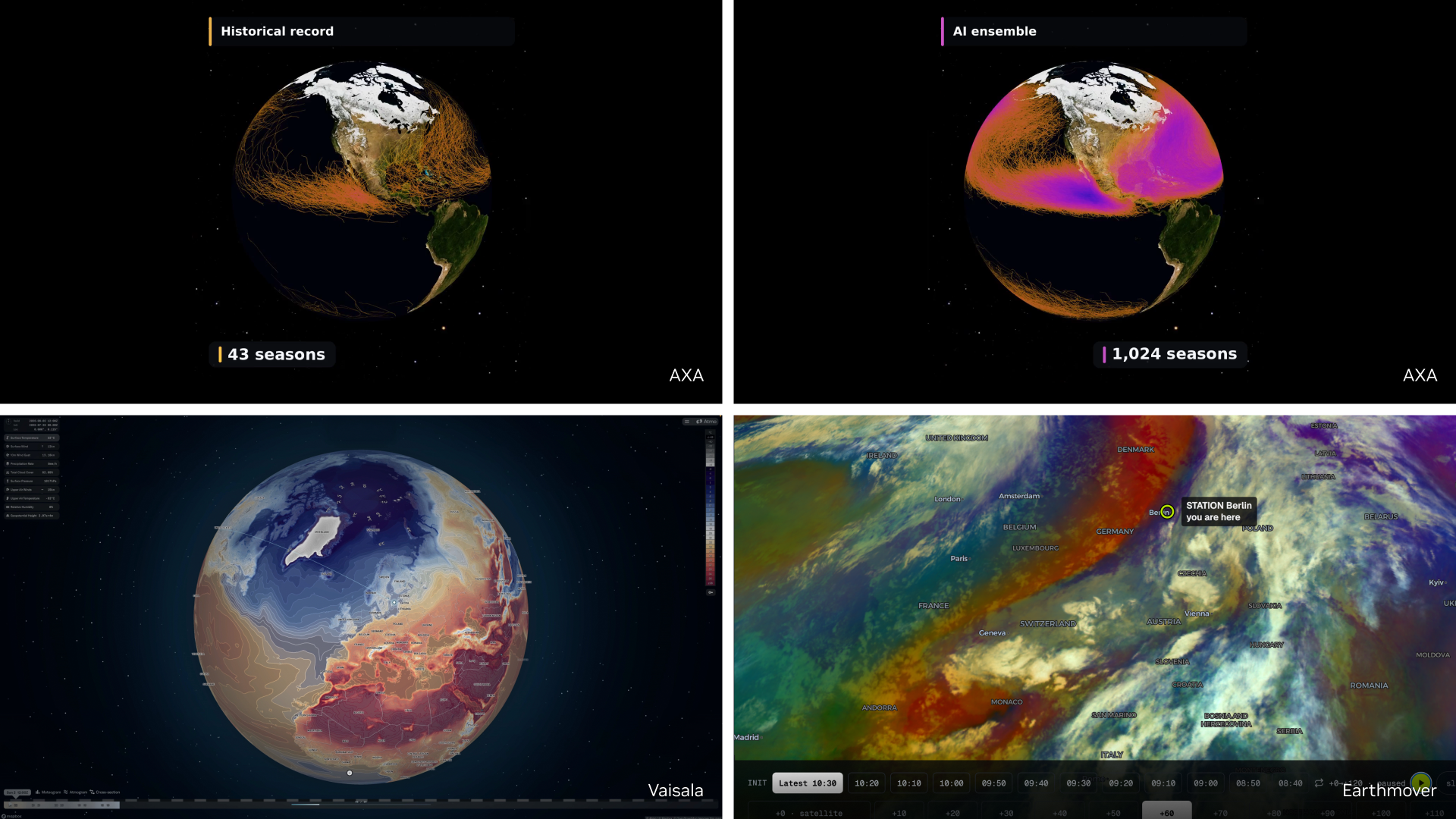
At GTC Berlin, NVIDIA is showing a live StormScope EU pipeline in an interactive demo built with Earthmover. The demo runs forecasts through Earth2Studio, and Earthmover's data platform manages and serves the output. Each time a new satellite observation arrives, the predictions refresh, so the displayed state tracks the sky at roughly 10-minute cadence. Earthmover publishes the results as map tiles, which means a visitor can pan across Europe and inspect predictions without downloading full datasets. That design choice matters beyond the demo. Teams that want to put nowcasts in front of dispatchers, traders or field crews generally need a serving layer that handles frequent updates without forcing every client to pull gigabytes of gridded data.
Combining models and training your own
The more interesting part for developers is composition. StormScope handles the short-term forecast, while CorrDiff can add local detail to coarser weather fields. A workflow might start with a broad-scale prediction, pass it through a downscaling step to recover fine structure over a region of interest, and then layer in the nowcast for the next few hours. The stack is modular enough that a team can swap in its own observations at any point.
The same architectures can also be retrained for new environmental problems. Air-quality modeling is the example the source highlights, and it's a sensible one, since pollutant dispersion depends on the same atmospheric transport and boundary-layer behavior that weather models already capture. Training and customization run through NVIDIA PhysicsNeMo, an open source framework, so teams can bring proprietary datasets and domain-specific knowledge into the process. Whether that's a practical path depends on having enough labeled data for the target variable and the compute to train it, which are the constraints that usually decide how far a project gets.
Who is building on it
AXA is using FourCastNet 3 to study regional cyclone risk beyond what the historical record contains. The analysis runs across more than 1,000 simulated seasons, which lets the team explore combinations of storm behavior that a few decades of observations would never show. The stated aim is to inform risk assessments and help customers direct prevention efforts. Simulation-based risk work of this kind is a natural fit for generative weather models, because the value lies in sampling plausible outcomes rather than predicting one specific season. You can read AXA's hurricane-risk case study on NVIDIA's developer blog for more on the method.
Vaisala Xweather is pairing Earth-2 with its own observations, lightning data and forecasting expertise. Its customers span public-sector agencies, energy, maritime, transportation and insurance, and the company is adapting StormScope using lightning data to extend short-term lead time. Warnings will reach users through its software-as-a-service products and AI-assistant integrations. Lightning is a useful signal for convective development, since it often precedes heavy rain and gusts, so adding it to a satellite-driven model is a logical extension rather than a cosmetic one. A short demonstration video from Vaisala Xweather accompanies the announcement.
Video courtesy of Vaisala Xweather.
University of Manchester researchers adapted CorrDiff for U.K. air-quality modeling. They trained the model on the NVIDIA-powered Isambard-AI supercomputer, then ran it locally on NVIDIA DGX Spark systems. The workflow is a useful illustration of the split that many research groups are now adopting: heavy training on large shared infrastructure, followed by inference on hardware a single lab can own. Manchester's account is covered in NVIDIA's blog on UK air-pollution research.
TotalEnergies is testing StormScope-based solar-radiation nowcasts at two photovoltaic sites and building models that provide weather information at subhourly intervals. The question it's exploring is whether finer-grained forecasts can help anticipate swings in solar output, which matter for grid balancing and for the economics of selling power on short notice. Solar output is sensitive to cloud edges that move faster than many forecast products update, so a 10-minute refresh cycle is directly relevant to that problem.
Space42 built SARDiff4Height using CorrDiff and PhysicsNeMo. The system estimates surface heights from a single radar image and outputs uncertainty maps alongside the estimates. The uncertainty layer is the detail I'd flag for anyone evaluating this class of tool. A height estimate with no confidence field is hard to act on, and the maps tell analysts where to slow down and check the output before relying on it.
What to watch
The open question for most adopters isn't whether these models can produce plausible fields. It's how they hold up under distribution shift, when a rare convective event or an unusual aerosol episode falls outside the training data. Satellite-driven nowcasts also depend on the continuity of the input feed, and any team building a production service will need fallback logic for when observations are late or missing. The demo's 10-minute loop is a good test case for those questions, because it makes latency and update reliability visible rather than hidden behind a static forecast.
For developers, the practical starting point is the Earth-2 documentation and the Earth2Studio forecasting examples, which let you run the pipeline on your own inputs before committing to a deployment plan. If you're evaluating these models for energy, insurance or environmental work, test the uncertainty outputs as carefully as the point forecasts, and measure how the system behaves at the edges of its training domain.