European Retailers Put Open Models and Digital Twins Into Production
Shopify, Zooplus, L'Oréal and Otto Group are putting open models and digital twins into production, with cost and accuracy numbers to match.
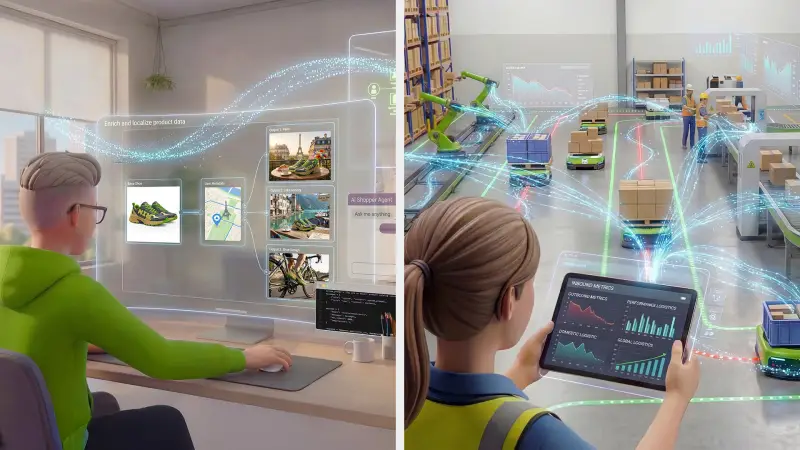
The most useful number in this roundup isn't a benchmark score. It's the 90% cut in serving costs that Shopify reports for a post-trained open model. When a model matches or beats a leading frontier system on a company's own test and runs seven times faster at a tenth of the serving cost, the economics of a feature change. That's the pattern across these European deployments: retailers and their technology vendors are using open models and simulation tools to make specific workloads cheaper, faster or more accurate, rather than chasing a general-purpose assistant.
Open Models Where the Cost Curve Matters
Shopify's work is the clearest example. Its engineers post-train open models to reach frontier-level accuracy on narrow tasks, using NVIDIA Megatron Bridge for faster fine-tuning and NVIDIA NeMo RL for reinforcement learning. The model that matters most in production is NVIDIA Nemotron 3.5 Lightning, which powers the GraphQL subagent inside Sidekick, Shopify's AI assistant for merchants. That subagent pulls store data for several Sidekick features, including Sidekick Pulse, which analyzes a merchant's store and suggests improvements.
On Shopify's internal benchmark, the post-trained model beats a leading frontier model on accuracy, cuts serving costs by 90% and returns responses 7x faster. The company also reports that vLLM-based inference optimization software, named in the materials as NVIDIA CCluster, delivered 4.5x faster performance and up to 12x lower inference cost across five more workloads: catalog enrichment, a merchant assistant, e-commerce shopping simulation, product taxonomy classification, and merchant and buyer recommendations.
Here's the thing: those are internal numbers on internal tests. The benchmark isn't public, so the accuracy claim is hard to verify independently. But the design pattern is worth noting. A narrow subagent with a well-defined job, fine-tuned and served on your own terms, is a different cost structure from routing every request to the largest hosted model.
Product Discovery and Catalog Data
Zooplus, Europe's leading online pet retailer, worked with Infosys and NVIDIA to rebuild its product discovery stack for agent-driven shopping. A production-ready prototype, deployed inside the company's AWS environment, reached 86% search accuracy. It combines NVIDIA Nemotron Retriever for semantic search with the NVIDIA Blueprint for retail catalog enrichment, which generates search-ready product attributes. Semantic retrieval paired with generated metadata is a common route for catalogs with thin or inconsistent product data, and that's where most of the search gains tend to come from.
Photoroom's results with Vestiaire Collective point in a similar direction, but on the listing side. Photoroom's Image Editing API now standardizes every primary image at the point of listing, processing about 40,000 images a day across 70 countries. Listings that went through the pipeline sold at a 5% higher rate of liquidity and drew 3% to 7% more unique views per product page. The pipeline runs on NVIDIA GPUs with TensorRT and Triton Inference Server, and the materials note that NVIDIA Dynamo Snapshot can help absorb demand spikes. Those liquidity figures are reported without a published methodology, so treat them as directional until a controlled comparison appears.
Mirakl, a software company for intelligent commerce, runs open models on NVIDIA GPUs, both on its own infrastructure and through European cloud providers such as Scaleway. The company frames this as a way to keep its technology sovereign, avoid vendor lock-in and still meet customer expectations for speed and scale. Its Catalog Transformer pairs fine-tuned open models with proprietary services and has onboarded more than 70 million products, turning messy supplier data into structured catalogs. For platforms that depend on third-party sellers, that cleanup work is often the bottleneck, not the search model itself.
Generating Images Without Breaking the Product
Omi's ProductDrop takes a different angle on generative content. It anchors every generated image to an approved digital twin of the product, so brands can scale creative output across full catalogs without introducing product errors. L'Oréal is using this approach within its CreAItech program, combining Omi's digital twins with generated brand environments. Omi runs TRELLIS 3D asset generation on NVIDIA RTX PRO 6000 Blackwell Server Edition GPUs, which the company says speeds up inference 10x and cuts pipeline latency 4x.
The research side of L'Oréal's work is less visual. The company is using NVIDIA ALCHEMI to shorten ingredient discovery from months of experimentation to hours of computational screening. It's also testing CurieOS, the science and engineering operating system from Orbital Industries, which runs OrbMol-v2, an open source molecular simulation model. According to the materials, OrbMol-v2 is five times faster than comparable models and delivers 21% lower error than the next-best model of its kind. The workflow is meant to identify the most promising ingredient combinations for solubilizing UV filters before anything goes to the lab. That's a screening step, not a replacement for lab validation, and the materials don't claim otherwise.
Simulating Warehouses and Stores Before Building Them
Physical AI is where the simulation argument gets concrete. Otto Group expanded its autonomous warehouse under human supervision initiative, built with Reply on NVIDIA Omniverse libraries and running on Google Cloud, to its largest fulfillment center in Haldensleben, Germany. The new capabilities let logistics teams design, test and optimize warehouse operations entirely in simulation before any physical change is made. When the cost of a layout mistake is measured in conveyor rebuilds, that's a practical gain.
ALLSIDES launched its 3D Digital Twin Factory, an automated pipeline that converts physical objects into SimReady 3D digital twins in minutes. The company cites sub-millimeter geometric accuracy, measured physical properties and fully relightable materials that hold up under any lighting. Those twins are meant to support simulated store layouts and product tracking from shelf to checkout, regardless of ambient light. The platform is built on NVIDIA CUDA, OptiX and TensorRT, and the materials say it already serves adidas, Amazon, Nike, Zalando and Zara.
CATCHES brings the same logic to fashion fit. Its RealFit deployment with AMIRI, the luxury label, reported a 55% lift in conversion, 80% more add-to-cart actions and 56% higher gross sales, all after seasonal adjustment against like-for-like styles. The company has since launched PredictiveFit, which extends physics-based virtual try-on to other retailers, plus CASI, a personal fashion agent that shops, styles and sizes for customers over WhatsApp. CASI is powered by open weight models including NVIDIA Nemotron 3, and it's built on Omniverse and the Newton Physics Engine. Returns are the cost that fit tools are meant to reduce, so the gross sales figure is the one to watch as more retailers test it.
Blueprints for Store and Inventory Teams
Nebius used GTC Berlin to show three NVIDIA Blueprints for retail, all in early access and running on Nebius infrastructure. The first, Agent Harness for Employee Productivity, is an agentic assistant that brings scheduling, task management, inventory alerts and operational insights together for store managers. The second, Inventory Simulation and Optimization, models demand scenarios and tests replenishment strategies so retailers can cut overstock and stockouts before committing stock in the real world. The third, Agentic Finetuning Flywheel, runs a loop in which agentic workflows generate training data, fine-tune open source models and feed real-world performance back into the next cycle.
The flywheel is the design to scrutinize. Self-improving data loops can compound quality, but they also compound errors if the feedback signal is weak. Teams adopting this pattern will need their own evaluation sets and a clear way to catch regressions. That's where I'd expect the hard engineering to land.
Taken together, the pattern is clear. The strongest results here come from narrow tasks with measurable outcomes: a subagent's accuracy and serving cost, a search metric, an image pipeline's throughput, a warehouse layout tested in simulation. Open models make it possible to tune and host those workloads yourself, and simulation lets teams test expensive decisions before they're made. The open questions are the ones the vendors' own numbers leave unanswered: independent benchmarks, controlled comparisons for sales lifts, and how well these systems hold up outside their launch customers.


