SpaceX's Kessel Rack Swaps NVLink Cables for an 84-Layer Midplane
SpaceX reportedly plans a custom Vera Rubin NVL72 variant, Kessel, that replaces NVLink cables with an 84-layer PCB midplane for ground and orbital use.
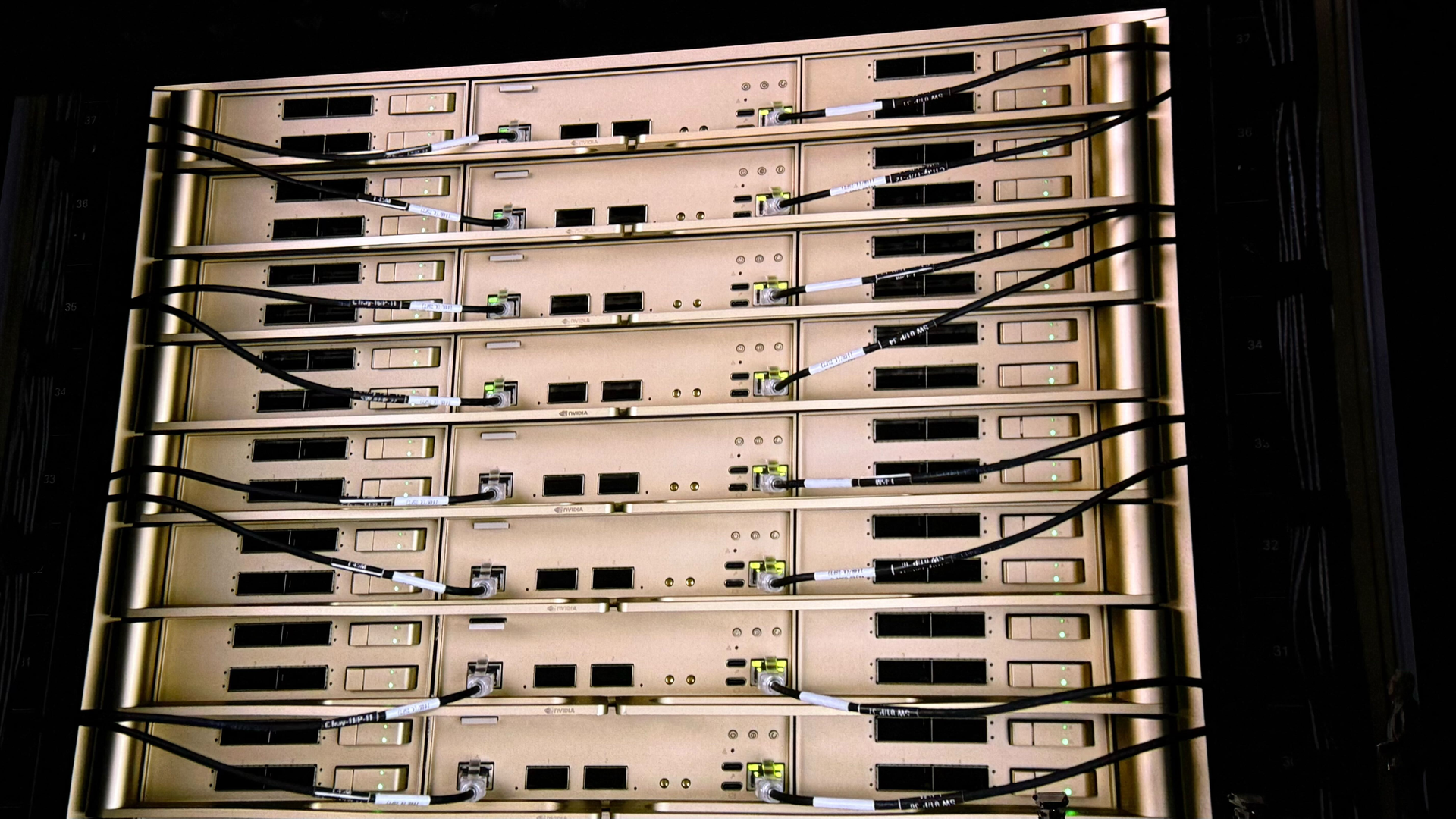
The interesting part of Kessel isn't the GPU count. It's the decision to throw out the cable harness. According to SemiAnalysis, SpaceX (working with xAI) is developing a modified version of Nvidia's Vera Rubin NVL72 rack that swaps the conventional NVLink cable assemblies for a very large printed circuit board. If that holds up, it's a meaningful change to how a hyperscale-class AI rack gets built, and it's aimed at both terrestrial and orbital data centers.
What Kessel keeps and what it changes
Kessel keeps the basic shape of the Vera Rubin NVL72. That means 36 Vera CPUs, 72 Rubin GPU packages spread across 18 compute trays, and nine NVLink switch trays. The change is physical. Rather than running NVLink through internal cable cartridges, the design places compute and switch trays back-to-back around a passive PCB midplane. The electrical connections live in the board itself.
SemiAnalysis draws a comparison to Nvidia's Kyber design, which packs 576 AI GPUs into 144 packages and also depends on a PCB-based interconnect instead of cable assemblies. Kessel is effectively a smaller relative of that idea, and the analysts say it's intended to work in both terrestrial and orbital deployments. That dual target matters more than it first looks, and I'll come back to it.
The midplane is the hard part
The 84-layer board is the detail that will get the most attention from hardware engineers. It uses ultra-low-loss M10 copper-clad laminate, which is the material that keeps signal integrity intact at high speeds. Kyber's backplane, by comparison, uses a considerably more complex 156-layer board built on M9 laminate. So Kessel roughly halves the layer count while moving to a more advanced material. That trade is worth unpacking. Fewer layers generally means a simpler stackup, fewer lamination steps, and a better shot at acceptable yields. Premium laminate pushes the other way, because M10 costs more per square meter and is harder to process cleanly. Here's the thing: an 84-layer board is still far beyond what most people picture when they hear "server motherboard." High-end server boards typically sit around 15 to 20 layers, and even server development boards rarely exceed 20 by much. Going to 84 is a different class of manufacturing problem. Yield is the real risk. On a board with that many internal layers, a defect in one buried layer can make the entire assembly scrap. A bad cable is a cheap replacement. A bad midplane can cost a large fraction of a rack's worth of parts. That makes the economics of Kessel depend on process maturity, which is hard to judge from outside the manufacturing chain.
Cables out doesn't automatically mean cheaper
It's tempting to read "eliminating numerous high-speed cable connections" as a cost cut. My read is that it's more of a trade. Removing cable assemblies simplifies assembly, reduces the number of mating points that can fail, and makes field service more predictable in principle. But the savings have to cover a midplane that is expensive to fabricate, expensive in material, and sensitive to defects. The source analysis is clear that the economics aren't settled. Whether Kessel pays off depends on whether the gains from simpler assembly and cheaper sourcing outweigh the cost of that board.
Buying parts instead of buying racks
The more consequential shift may be commercial rather than electrical. Nvidia has been moving toward selling more complete units, including assembled compute boards such as its L10 trays for the Vera Rubin generation. SemiAnalysis reports that SpaceX plans to buy AI accelerators, CPUs, switches, and networking components directly from Nvidia, while sourcing the rest from third-party suppliers. SpaceX/xAI will still buy Nvidia hardware, but it would be assembling more of the system itself. That has real advantages. A buyer that controls the PCB vendor, the component suppliers, and the assembly partners can tune hardware to its own facilities and its own failure data. For orbital hardware, where repair access is limited or nonexistent, that kind of tuning matters a lot. The buyer also takes on responsibility for system design, validation, manufacturing quality, and supply-chain management. Large hyperscalers have been building that capability for years, so SpaceX is following an established pattern, just at a more aggressive pace. One open question stands out. The report notes that sourcing memory during current shortages could be hard, and that concern applies to any buyer trying to assemble its own racks. Owning more of the bill of materials means owning more of the bottleneck risk, too.
What this means for Nvidia
For Nvidia, the arithmetic cuts both ways. Selling CPU and GPU packages directly, rather than full compute-board assemblies, could shrink the revenue it captures per rack. But the same model might encourage other large customers to build Nvidia-based systems of their own, and that could mean more Nvidia silicon deployed overall. That matters because custom silicon from hyperscalers is gaining ground, and Nvidia has a clear interest in keeping its platform the default even for buyers who want more control. The catch is that Kessel only helps that argument if it works better than what Nvidia builds itself. A customer willing to take on an 84-layer midplane and its yield risk will want clear performance, serviceability, or cost advantages in return. If Kessel delivers those, it becomes a template. If the yields disappoint, it becomes a cautionary tale about how much integration risk a buyer can absorb.
Watch the yield and laminate-sourcing details first. Those will show whether a midplane-based rack is a practical design for a single well-funded buyer, or something that stays confined to one-off projects. Either way, the decision to replace cables with a board is a clear signal that rack architecture is becoming a place where large AI operators want to set their own terms.