Box's Nvidia-Built Retrieval Engine Targets the Context Gap for Enterprise Agents
Box Content Retrieval, built on Nvidia Nemotron embedding models, claims 20% better search accuracy and up to 90% fewer tokens for enterprise AI agents.
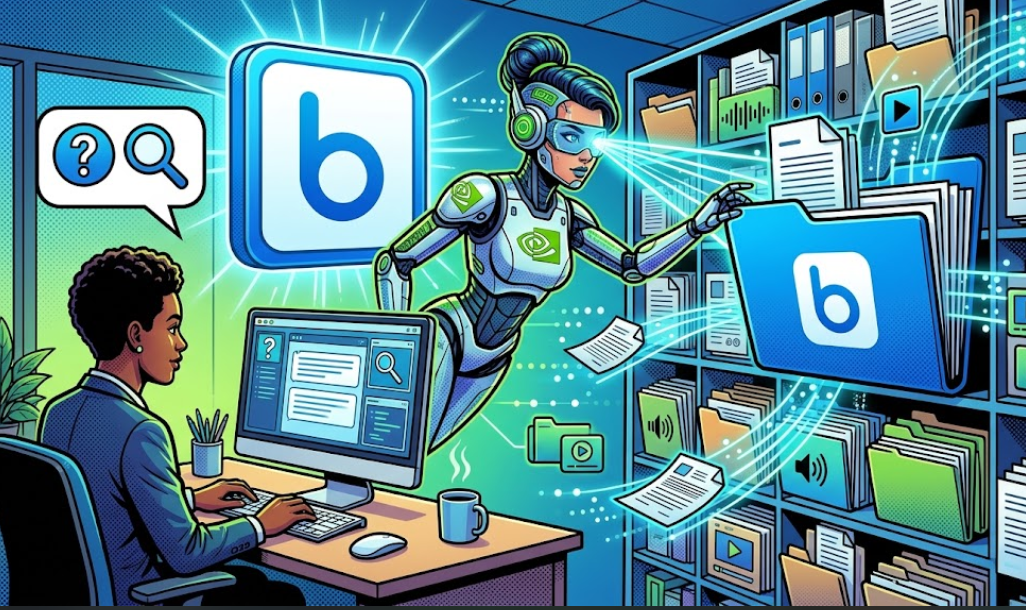
Most enterprise agent projects don't fail because the model can't reason. They fail because the model can't find the right material, or finds it and isn't allowed to use it. Box used its annual customer conference, BoxWorks 2026, to take a direct swing at that problem, unveiling a retrieval engine built on Nvidia's AI models alongside an orchestration tool and new threat detection features.
The context problem is a data problem
Box chief executive Aaron Levie put the issue plainly: an autonomous agent is only as useful as the context it can reach. Without that context, agents make mistakes, and when they make mistakes, enterprises stop letting them work unsupervised. That's the adoption brake Box is trying to release.
Levie's point is that the context agents need rarely sits in clean, structured databases. It lives in contracts, software documentation, policy manuals, internal email, customer communication records and research archives. Much of it is scanned, image-based, or recorded as audio and video. Companies know this, and they're wary of pointing autonomous agents at that material without guardrails. An agent that reads something it shouldn't, or pulls sensitive text into a response, is a bigger problem than a slow answer.
What Box Content Retrieval does
Box Content Retrieval is a retrieval engine that converts messy enterprise content into a structured knowledge base agents can query and reason over. It's built on Nvidia's Nemotron Retriever embedding models, which generate an index across unstructured formats, including scanned documents, images, audio and video. The indexing relies on multimodal and hybrid search, so a query can match on meaning as well as on keywords, which matters for content that wasn't written with a search engine in mind.
Box reports three headline numbers. Search accuracy improves by 20%. Token consumption drops by up to 90%, which translates directly into lower inference costs for any workload that stuffs retrieved text into a prompt. And agents find the context they need roughly four times faster, which Box ties to response times for worker questions. Box hasn't published the benchmark methodology behind these figures in the material I've seen, so treat them as vendor-reported until independent tests appear. The token reduction is the one I'd check first, because it depends heavily on document mix and query type.
The permissions piece may matter more than the speed gains. Box says each agent inherits the native file permissions attached to every piece of content, so an agent can't surface a file the requesting user couldn't open. That's the design pattern most enterprise teams are asking for, because bolting access control onto a retrieval layer after the fact tends to be where leaks happen.
Open-weight models and the cost argument
The expanded collaboration with Nvidia also brings Nvidia's open-weight models into Box AI, including the new Nemotron 3 Ultra large language model. Box's argument is that open-weight models can be run at considerably lower prices than proprietary models from providers such as Anthropic and OpenAI. That's a meaningful claim for high-volume document workflows, where per-query cost decides whether a pilot becomes production.
Levie framed the approach as complementary rather than a replacement for closed models. "Open weight is an important part of our vision, complementing closed models while driving innovation and broader adoption across the industry," he said. Box's model selection, then, is a routing decision: use the model that fits each task and price point, not a single default.
Box describes two use cases. Financial analysts could query loan applications while keeping strict data-access boundaries. Legal teams could find contract precedents by matching conceptual meaning instead of exact phrasing, which matters when the same clause appears in different wording across hundreds of agreements.
Box Architect and agent workflows
Box isn't relying on Nvidia alone for orchestration. Box Architect, arriving in beta later this year, lets business users describe agentic processes in natural language, then build, test and deploy them. It connects to native Box tools including Extract, Automate, Apps, Forms, Doc Gen and Sign, and it offers a choice of open and closed models.
Box's examples are concrete. A law firm could build a contract review workflow that compares incoming agreements against its previously approved playbooks and routes high-risk clauses straight to an attorney. A bank could chain Forms, Extract and Doc Gen with Sign to handle client onboarding, from collecting applications to verifying identity documents to generating and executing the agreement.
Alan Pelz-Sharpe of Deep Analysis argued that this is where the value shows up. "While legacy approaches require brittle point-to-point configurations for extraction and execution, an integrated agentic design layer dynamically orchestrates content understanding, process steps and analytical visualization within a single governed ecosystem," he said. The skeptical reading is that natural-language workflow builders have a history of working well in demos and getting harder once edge cases pile up. Beta testing will show whether Box Architect holds up on messy real-world processes.
Watching the agents
Box is also adding detection aimed at agents that go wrong, whether through misconfiguration or misuse. The new capabilities are designed to flag, in real time, an agent that starts exfiltrating data in bulk, deleting large numbers of files or taking over user accounts. Administrators can restrict which files each agent reaches using classification-based policies, limit which third-party tools an agent can call through MCP guardrails, and set thresholds that trigger review when an agent's behavior exceeds predefined limits.
Holger Mueller of Constellation Research read the broader move as a sign that data is becoming the center of AI architecture. "Documents are a treasure trove for AI in general and context specifically, and enterprises are very keen to tap into them so they can develop better AI applications," he said. "This confirms the theory that data has to move to the compute in the AI era."
Availability and what to watch
The Nvidia Nemotron models in Box AI and the agent security controls are available now for Enterprise Advanced and Shield customers. Box Content Retrieval and the advanced threat detection capabilities are scheduled for general availability early next year, for the same subscription tiers. Box Architect enters beta later this year.
My read: the retrieval layer is the piece to evaluate first. If the 20% accuracy and 90% token figures hold up on your own corpus, the cost math changes for document-heavy agents. The permission inheritance is the feature that will decide whether security teams sign off. And the open-weight pricing story will be tested the moment a team compares total cost per resolved task, not per token. Those are the numbers to pull before the early-next-year rollout.


