Google's Agentic Data Cloud Adds Cross-Cloud Querying and Self-Learning Context for AI Agents
Google's Agentic Data Cloud adds cross-cloud Lakehouse access, self-learning business context and agent-ready developer tools for autonomous AI workloads.
Autonomous agents don't need a dashboard. They need to reach data wherever it sits, understand what it means, and do that without copying everything into one warehouse first. That's the bet behind Google Cloud's updated Agentic Data Cloud, and this round of changes shows how far the company is pushing it.
Querying data where it lives
The platform launched earlier this year at Google Cloud Next as a "system of action" for AI agents. It's positioned as a replacement for the brittle extract, transform and load pipelines that have fed legacy applications for years. The core idea is simple: instead of making customers consolidate everything in a central warehouse, let agents access data in place.
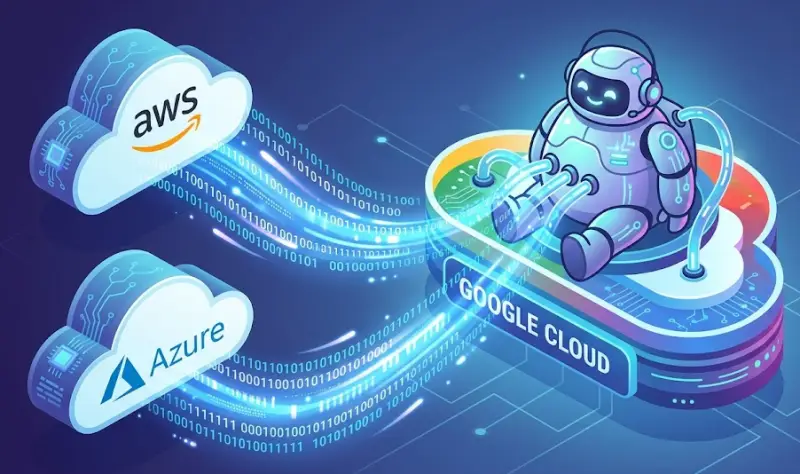
The flagship addition is borderless Lakehouse, a variant of the cross-border Lakehouse product Google also showed at Cloud Next. It's built on the open-source Apache Iceberg table format. Its new caching capabilities target multicloud setups involving Amazon Web Services and Microsoft Azure. Customers can query data held in those clouds over a secure private link without paying egress fees. Retrieved data blocks are cached within Google Cloud, so subsequent queries run faster.
There's also a new AlloyDB integration that lets users run standard PostgreSQL queries against external Iceberg tables without copying data. That's the practical bridge between live transactional records and historical lakehouse data, and it's the piece I'd look at first if your operational and analytical systems don't talk to each other cleanly.
Grounding agents with self-learning context
Hallucination is the failure mode everyone building agents keeps running into. Google's answer runs through the Knowledge Catalog, which acts as a map of business meaning. It tells agents how an organization defines its terms and where its data behaves in unexpected ways. A new self-learning enrichment capability, now in preview, continuously scans unstructured data in Google Workspace, Jira, SharePoint and GitHub. It converts operational knowledge into Open Knowledge Format context sets that ground agents in how the business actually works.
Google says early adopters saw agents become roughly four times more accurate, while token consumption fell by up to 75%. Those are the company's figures from early users, so test them against your own workloads before planning around them. The token reduction matters more than it first appears. An agent that needs less context to reach a correct answer costs less to run at scale.
Knowledge Catalog is now enabled by default in the Gemini application. It resolves business metric definitions and access controls before a prompt is translated into SQL. Teams can also ground agents in semantic models for BigQuery, Snowflake, SAP, Looker and dbt. Chandrasekaran put the principle plainly: "Agents are only as accurate as the business context they're grounded in." Net revenue calculated for finance and customer churn calculated for operations both follow the same governed formulas teams already rely on.
Autonomous work for engineers and analysts
Gemini is getting autonomous machine learning capabilities aimed at both technical and business users. Data engineers can describe a business outcome in natural language, and Gemini generates the PySpark code, runs the notebooks and repairs pipeline errors along the way. Business users can request operational reports directly in Gemini.
The reporting piece has a detail worth noticing. Gemini builds and saves the query using operational reporting skills integrated with BigQuery and Knowledge Catalog. After that, teams run reports on demand without incurring token costs, and they get the same verified answer each time. That's a sensible split: spend model effort once to construct the query, then rerun the saved artifact cheaply.
Developer tooling and high-concurrency infrastructure
The Data Agent Kit is now generally available. It brings Model Context Protocol tooling into development environments such as VS Code, Claude Code and Antigravity. Developers can state business intent in natural language and have agents create, fine-tune and test the matching data pipelines.
On the infrastructure side, Google is targeting what it calls high-concurrency agent interactions, where thousands of agents query the same database at once. AlloyDB Express moves into broader preview, offering sub-two-second provisioning for rapid prototyping. PostgreSQL for agents in AlloyDB provides an isolated workload environment that can handle three million queries per second. The useful question for most teams is whether their agent fleets actually produce that access pattern. Many prototypes won't, but production rollouts with many agents sharing one database might.
Graph analytics and forecasting models
BigQuery Graph is now generally available, bringing petabyte-scale graph analytics into relational database tables with zero ETL. Previews of the TimesFM 3.0 forecasting model and the TabFM predictive analytics model round out the release. Both are described as zero-shot foundation models, meaning they aim to make predictions without task-specific training. They're in preview, so evaluate them on your own data before relying on them.
What to watch
My read is that the most consequential piece here is the Knowledge Catalog. It's a bet that grounding agents in business context matters more than raw model capability for enterprise work. Three things will decide whether that bet pays off. First, do the 4x accuracy and 75% token figures hold outside early-adopter settings? Second, how does egress-free cross-cloud access perform on latency-sensitive queries? Third, does caching introduce consistency issues when source data changes quickly? Those answers will shape whether this becomes the default way agents touch enterprise data.


