AMD Says Zen 6 Wasn't Built for Agentic AI, and Its Argument Is About Range
AMD's Zen 6 Venice CPUs weren't designed for agentic AI, executives say. Their pitch is that agent workloads need a range of CPUs, not one SKU.

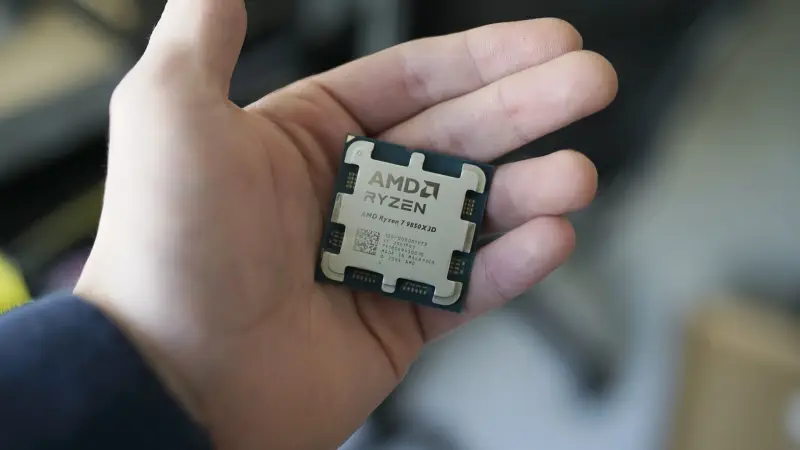
AMD's executives are drawing a clear line between their Zen 6 server chips and the "agentic" branding that Nvidia and Arm have put on their newest data center CPUs. Mike Clark, AMD's chief Zen architect, and Madhu Rangarajan, a corporate vice president, both said the company didn't anticipate the agentic wave when Zen 6 development began. The codename for this generation is Venice, and the argument is less about marketing than about how long silicon takes to design.
Why the timing argument holds up
CPU development runs on multi-year cycles. Architecture decisions, microarchitecture tradeoffs and tape-out schedules get locked well before the software trends that will use the chip are obvious. The agentic push around CPUs picked up roughly around March, which is far too late to have shaped a design that was already in progress.
That's the core of AMD's rebuttal. Nvidia says its Vera CPU was "purpose-built" for agentic AI, and Arm describes its AGI CPU as "designed for the demands of agentic AI." Both claims may be true in the sense that the products were positioned around that use case. But it's hard to believe that any data center CPU was conceived from scratch for workloads that only recently got a name. My read is that AMD is right about the chronology, and that the more interesting question is what the chips can actually do once agents are running.
AMD's counter: a full portfolio, not a single SKU
Rangarajan put it bluntly. "We think that the EPYC 9006 CPU is the best CPU for the agentic era, and spoiler alert, we didn't magically know four years ago that agentic was going to be a thing and purpose-built something for agentic," he said. His follow-up gets at the real pitch: "an agentic workflow is a diverse set of tasks… and in order to execute those tasks well, you need compute that is able to handle a diverse set of workloads with a full portfolio."
Clark took a similar line when introducing the Zen 6 microarchitecture. He said he wasn't going to pretend the team foresaw agentic computing, but that the group did strongly believe the CPU would keep a place in the AI software stack. Once agentic workloads took off, AMD could deploy existing silicon against them.
That framing matters because it turns the debate from "who designed for agents" into "what kind of CPU does an agent fleet need." AMD's answer is a spread of parts. Nvidia and Arm have leaned toward a single chip aimed at the agentic host role. AMD is arguing that the same mix of tasks that makes general-purpose computing broad will make agentic computing broad too.
What the testing shows
There are performance areas where Vera looks strong for agentic workloads, and the earlier Vera testing reflects that. Still, AMD's argument for variety gets some support from how the Venice parts behave at opposite ends of the lineup.
The dense EPYC 9996, with 256 cores and 512 threads, delivers peak throughput, which suits environments that run many agents concurrently. The frequency-optimized EPYC 9686F, by contrast, competes closely with Vera in the role of an AI host node. Two chips with different priorities, both relevant to the same class of workload, is exactly the situation AMD is describing.
AMD also previewed two more ranges for next year. Venice-X targets HPC workloads with 3D-stacked cache, and Verano aims squarely at Vera's role as an AI host node, with an LPDDR5X memory system. If those products arrive as described, AMD would have a direct answer to Nvidia's approach across several memory and cache configurations rather than one.
Agentic workloads don't have a single CPU profile
Agentic AI is still being defined, and that's the real reason a single "agentic CPU" is hard to specify. In our early testing approach for agentic workloads, the demands on CPU and memory depend on what each agent does, and in a data center they depend on how many sandboxed agents run at once.
The differences are easy to see in practice. A coding agent tends to invoke more tools that load the CPU heavily than a web-browsing agent does. An agent that queries a database may depend mostly on memory performance. Some of those characteristics, memory bandwidth and latency in particular, can't be fixed by swapping one SKU for another. Still, the spread of workloads supports the case for offering several CPUs tuned for different tradeoffs.
At the most basic level, an agentic loop lets a language model understand the functions you've defined, then pass arguments to them so they execute. In principle, the set of possible workloads is as wide as the set of functions a developer can write in Python or Rust. That's the reason "it depends" is the accurate answer, and the reason AMD's portfolio pitch has more substance than the usual marketing line.
What to watch
The next useful signal won't be the marketing names. It will be whether agentic benchmarks settle on common, reproducible definitions of throughput per agent, memory sensitivity and tool-call overhead. Once those exist, buyers can compare Venice, Vera and Arm's AGI CPU on the metrics that matter for their own agent stacks. Until then, expect each vendor to pick the benchmark that flatters its design, and expect the CPU-versus-GPU question for agent hosts to remain open.