Steam Shows Average Framerates From Real Players Before You Buy
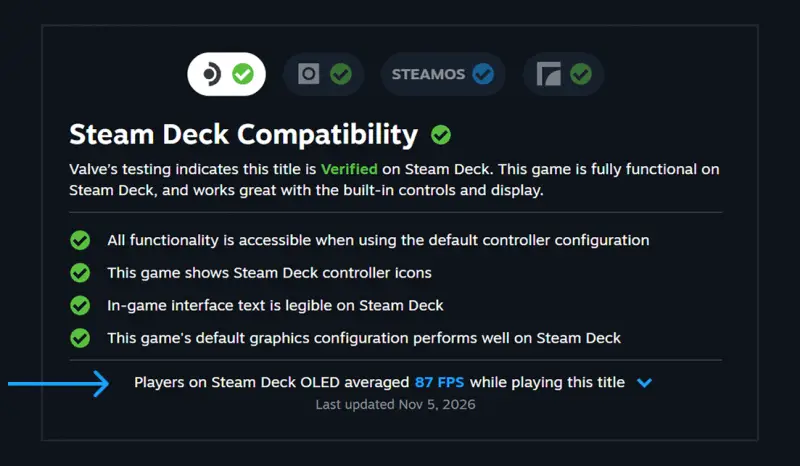
Steam is adding opt-in framerate data to game pages, starting with Steam Deck. Shoppers can see average FPS from matching hardware before they buy.

Valve is pulling real-world performance numbers into the purchase decision. Steam will show the average framerate that other players get on the same hardware, so you can check whether a game runs well on your setup before you pay for it. The first rollout covers the Steam Deck, and Valve says it plans to extend the feature to more hardware. That's a more useful signal than most of what the store offers today, which is mostly a list of minimum and recommended specs.
The data comes from players who opt in to share it. Valve captures performance while a game runs on a Steam Deck and then shows an average to other users, anonymously. Players who don't opt in aren't part of the sample, so the figure reflects the people willing to contribute, not every Deck owner.
Why the Steam Deck comes first
The Deck is the easiest place to start because the hardware is fixed. Every unit has the same APU, the same display and the same memory configuration, which removes most of the variables that make PC performance hard to predict. If you're asking whether a game runs on your Deck, a shared average from other Decks is directly relevant.
That matters for the Steam Deck Verified program, which requires a certain level of performance. Games that fall short can be marked "Unsupported," but that label is a blunt instrument. Plenty of players will tolerate 40 FPS in a slower adventure game, while others won't accept anything under 60 in a shooter. Valve's framing here is that there's no single standard for "playable," so it's handing the decision back to the buyer and giving them the data to make it.
What the number actually measures
This is where the feature needs careful reading. Games expose a lot of settings, and a single average can hide a lot of them. Valve acknowledges that, and it's making a few deliberate choices for this early trial.
First, the data is filtered to Decks running the default frame limit. Second, Valve doesn't try to account for custom in-game settings. Third, the company says it has excluded the distorting effects of vertical sync when it looked at the results. Valve's position is that, despite those gaps, the framerate data "consolidates around relatively narrow ranges." That's a claim about the spread of results rather than a guarantee for any individual player, and it's worth keeping in mind if your settings differ from the defaults.
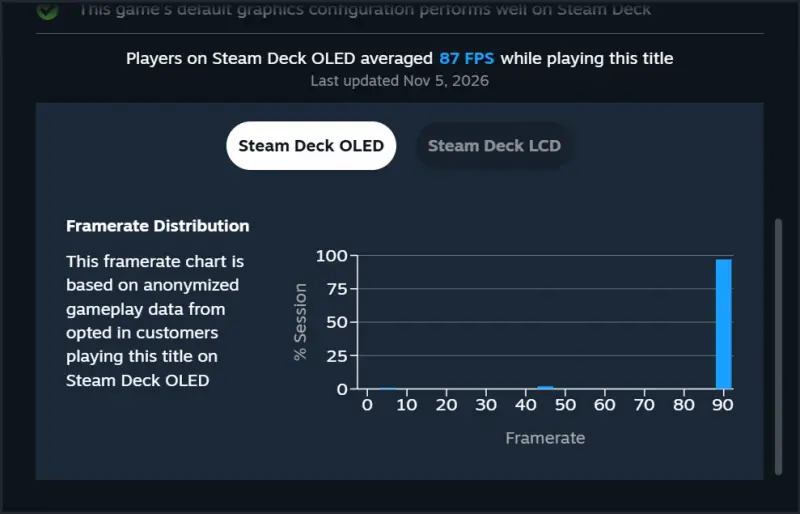
The histogram behind the average is the more informative view. An average of 45 FPS could mean most players sit near 45, or it could mean a cluster at 30 balanced against another at 60. The distribution tells you which of those you're looking at. Valve is making that breakdown available, which is the right call for a feature whose headline number is easy to misread.
How opt-in works and what comes next
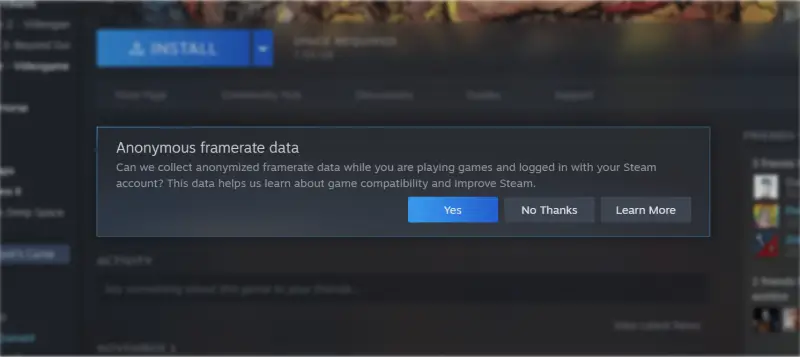
Players who want to contribute will see a prompt in the library inviting them to share their game performance data. For now, the feature is available through the Steam Client Beta. Valve says it's coming to all users "in the future," but hasn't given a date.
Valve describes the Deck rollout as "a stepping stone toward providing framerate data for more devices than just Steam Deck." That points toward Steam Machine and Steam Frame, the company's own hardware, and presumably toward ordinary PCs. The PC case is much harder. A gaming desktop might mix a dozen GPU and CPU combinations, different RAM capacities, driver versions and resolutions. Valve hasn't said whether it will group results by graphics card, by a CPU and GPU pairing, or by some broader hardware profile. Each choice trades precision against sample size. A GPU-only bucket fills quickly but ignores the CPU. A tight combination produces cleaner comparisons but may have too few reports to be useful.
Teams that ship games on Steam will want to watch how this affects how buyers read their store pages. If a title's average sits well below its Verified expectations, the number will be visible to shoppers. Developers who tune performance modes and publish clear settings guidance may find that their players have better expectations before they buy. And for the feature to matter, enough people have to opt in. Review hardware fields have been available for a while, and few players fill them out. A feature that depends on opt-in data is only as good as its participation rate, and that's the open question I'd watch most closely as the beta widens.
My read is that this is a sensible step. It doesn't pretend there's one correct framerate, and it lets the buyer see the spread instead of a single verdict. The real test will come when the PC version arrives and the hardware matrix gets messy.