NVIDIA's Open Source 6G Tools Show Up in Robotics, Radio and Energy Research
Researchers using NVIDIA's open source Aerial and Sionna tools report gains in robot response, signal reception, base station power use and simulation speed.
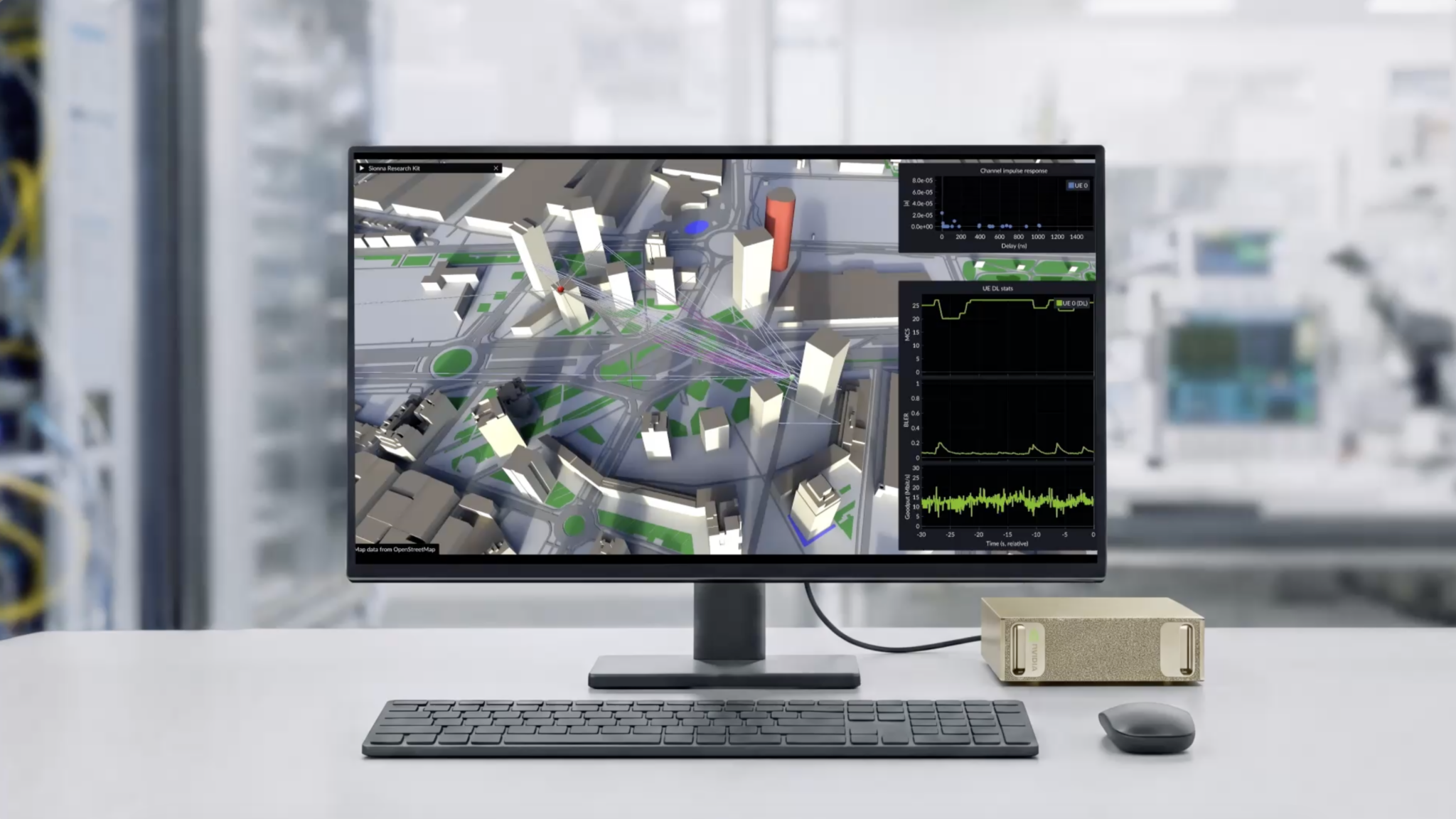
A year after NVIDIA open sourced its Aerial wireless software, the more interesting question is what people are building with it. The answer is a set of projects that treat the radio link as part of the decision loop, not just a pipe. Robots, receivers, base stations and simulators are all getting tuned with AI, and the open tools are what let separate labs test those ideas against each other.
The adoption numbers give a sense of the reach. Developer use of NVIDIA AI Aerial and NVIDIA Sionna has grown 10x over the past year, the company's open source 5G and 6G tools have passed 1 million downloads, and more than 8,000 research and academic institutions worldwide are using these platforms. Those figures describe activity, not outcomes, but they explain why the early results are starting to look comparable across groups.
When the Wireless Link Sits Inside the Robot's Reaction Time
A robot picking up an object has to perceive its surroundings and act before they change. If the AI making that call runs on a nearby server or in the cloud, the wireless connection stops being a background detail and becomes part of the response time. That's the problem King's College London's team was working on.
Their approach uses goal-oriented semantic communications. Rather than streaming full camera frames, the robot sends compact descriptions: which objects are present, where they are and how they relate to each other. The idea is to send only what the task needs, which matters most in dynamic settings like warehouses and workplaces.
The team connected a camera-equipped robot arm to an NVIDIA Jetson AGX Orin running NVIDIA Sionna, which supports both software-defined 5G and edge AI processing. In fruit-packing and cube-stacking experiments with deliberately introduced faults, the method cut task completion time by up to 52.6% and improved task success compared with sending periodic images. The system also handled problems better. It detected dropped objects, recovered from failed actions and, in configurations using a digital twin, checked planned movements for possible collisions before the robot moved.
My read: the time savings come mostly from sending less, not from a faster link. That's a design choice that could travel well beyond this lab setup, but the experiments were run on specific tasks with introduced faults, so the 52.6% figure belongs to that setup.
Teaching Receivers to Decode Messy Signals
Reception is where wireless systems often break down quietly. Interference and shifting radio conditions make signals harder to decode, which triggers errors and retransmissions. For someone relying on live drone footage to understand a fire scene or a search area, those delays matter. Better decoding means a clearer, more current picture.
AI receivers attack this by learning to recover information from incoming signals more effectively than fixed algorithms. SoftBank integrated a neural receiver into NVIDIA Aerial CUDA-Accelerated RAN (ACAR) and tested it with a commercial 5G smartphone. Under controlled interference, the neural receiver delivered higher uplink throughput than a conventional receiver at all 15 tested settings, with a maximum gain of roughly 60%. Testing against a commercial handset, rather than only a lab rig, is a useful signal about how close this is to real equipment.
ETH Zurich took a different angle. Using NVIDIA Aerial Testbed, its researchers found that tuning neural receivers with local measurements, instead of relying on pretrained versions, reduced block error rates by more than one-third compared with selected pretrained models. That points to a practical tension: a receiver that generalizes broadly may lose out to one adapted to the specific site it serves. Teams will need to decide where that adaptation happens and how often it has to be repeated as conditions change.
Turning Capacity Off Without Dropping Users
As 6G connects more devices and supports more AI workloads, energy becomes a design constraint in its own right. Networks have to be provisioned for peak demand, but that peak is often temporary. A stadium needs full capacity during a match and much less when the crowd leaves.
The University of Leeds built a system that forecasts network demand 10 minutes ahead and uses those forecasts to decide when base stations can sleep. Before powering a station down, the system checks that neighboring active stations can keep serving the affected devices. It also watches for changes that would require restoring capacity quickly.
The team tested this on a portable 5G "network-in-a-box" powered by an NVIDIA DGX Spark, paired with a digital twin for checking decisions against real wireless equipment. They reported a 45.6% reduction in RAN power consumption relative to a full-power baseline while maintaining device connectivity. The hard part of this problem is the safety check: a sleep decision is only good if the network can wake up in time. Leeds built that verification step into the loop rather than treating it as an afterthought.
Simulating Before Building
Before any network goes live, researchers need to know how it behaves when hundreds of devices compete for connections or when interference builds up. Simulation lets teams test designs before committing to expensive hardware and field trials. The catch is that realistic simulations can take hours, which caps how many ideas a team can explore in a given week.
The Centre Tecnològic de Telecomunicacions de Catalunya (CTTC) is working on that bottleneck. It is bringing GPU-accelerated radio channel models, running on ACAR, into its open source 5G-LENA network simulator. Those channel models calculate how signals travel between antennas and devices, and that calculation gets heavier as simulated networks grow.
In an early evaluation, runtime dropped from approximately three hours to 10 to 20 minutes, depending on the integration, while the statistical behavior and network performance stayed as expected. Faster runs don't just save time. They let researchers compare more designs, push into harder scenarios and discard weak ideas sooner. Whether those early numbers hold across larger and more varied simulations is the open question, and the team's evaluation is still early.
What to Watch Next
The four projects share a pattern. Each one puts AI inside a part of the network that used to run on fixed rules or static assumptions, and each one checks its decisions against either a digital twin or real hardware before trusting them. That combination is what makes the work useful to engineers, not just the headline gains.
For teams evaluating these tools, the practical starting points are concrete. NVIDIA AI Aerial and NVIDIA Sionna are both available on GitHub, and NVIDIA's 6G developer sessions at GTC Washington, D.C., are where several of these groups plan to show more work. The next useful signal will be whether results like these get reproduced by teams that didn't build the original testbeds.
NVIDIA AI Aerial and NVIDIA Sionna are available on GitHub.