AMD's Epyc 6 Pushes Core Density and Clock Speed for AI Agent Workloads
AMD's Venice-generation Epyc 6 lineup pairs 256-core density with 5.3 GHz parts, aimed at running large numbers of AI agents on CPUs.
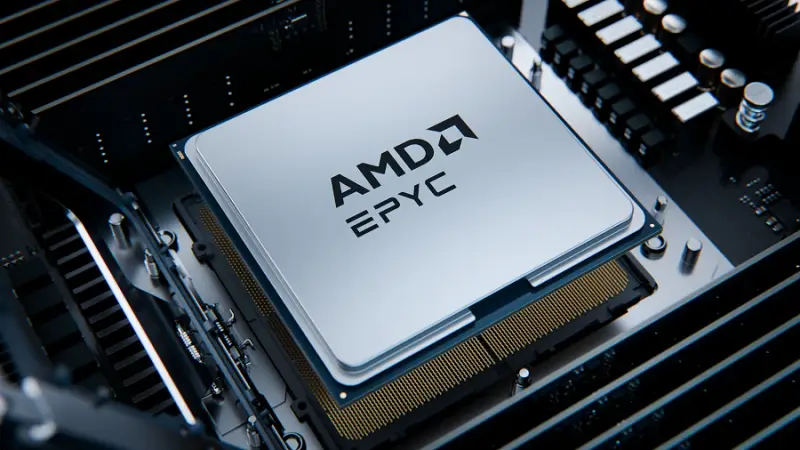
AMD's new Epyc 6 series, codenamed Venice, is less about chasing a single benchmark than about changing what a server CPU is expected to do. AI agents run their models on GPUs, but a lot of the actual work happens elsewhere: calling tools, querying databases, parsing results and shuttling data between steps. That work lands on the CPU, and AMD is betting that it deserves its own silicon strategy.
Two families for two kinds of jobs
The lineup has 10 processors split into two groups. One group uses a large number of relatively slow cores. The other uses fewer cores running at higher frequencies. That split is the most useful thing to understand about the launch, because the two families target different parts of an agent's workload.
The two fastest-clocked chips have a 4.05 GHz base frequency and can boost to 5.3 GHz under demanding loads. Each has 96 cores and a 384-megabyte cache. The two densest parts go the other way, with 256 cores at a 2.55 GHz base. Each core handles two threads, giving 512 threads per chip, which is the configuration AMD is pitching for hosting large numbers of agents at once.
Density matters because some large language model setups spin up hundreds of agents to tackle a complex task. A chip with 512 hardware threads can keep many of those tool-calling processes resident without constant context switching. Frequency matters for the opposite reason. Latency-sensitive components, such as a single database instance serving an agent's queries, often run faster on one fast core than on several slower ones.
Why frequency can be the cheaper option
This is where the economics get interesting. Many enterprise databases and other commercial software are licensed per core. If a database needs a certain amount of processing power, running it on one high-frequency core can cost less than running it on two slower cores that deliver the same throughput. Teams that have already been through per-core licensing audits will recognize the pattern: a lower core count can cut the software bill even when the hardware line item looks higher.
That makes the high-frequency SKUs a plausible fit for the tool layer of an agent stack, while the dense parts handle the fan-out of many concurrent agents. Whether that split pays off depends on each organization's licensing terms and workload mix, so it's worth modeling against actual invoices rather than list prices.
Zen 6 and the two-nanometer bet
The Epyc 6 series is built on a new core architecture called Zen 6. AMD says its instructions-per-clock figure is 31% higher than its previous design when running AI workloads. IPC is a blunt metric, and a single percentage tied to "AI workloads" doesn't say which workloads, so I'd treat it as a directional claim until independent testing arrives.
Part of the gain comes from manufacturing. AMD is using Taiwan Semiconductor Manufacturing Co.'s latest two-nanometer node for the Zen 6 cores. Process advances usually help with density and power, and the architecture changes add to the performance story on top of that.
The architecture comes in two editions. Standard Zen 6 is tuned for clock speed, while Zen 6c is a scaled-down core meant for high core-count parts. Zen 6c adds an enhanced out-of-order execution mechanism that the standard core lacks. In plain terms, the processor can start some calculations before their results are needed, which keeps execution units busy and hides stalls. That feature matters more in a dense design where many threads compete for the same resources.
AI-specific data formats and instructions
Zen 6 also adds support aimed at inference. The core is compatible with the FP16 data format, which uses half the bits of standard single-precision floats. Smaller values mean smaller memory footprints and less data movement for the same operations, which can matter when a CPU is handling model-adjacent computation. Zen 6 also improves support for VNNI-INT8, an instruction approach that folds several INT8 multiply-accumulate operations into one instruction. It's a well-established technique for quantized inference on CPUs, and it trims the number of instructions a workload needs.
None of this makes the CPU a substitute for a GPU on large model inference. The more accurate read is that these features let the CPU handle the lighter, quantized, or auxiliary model work that surrounds an agent, without sending every small task to an accelerator.
Competitive claims
AMD says Epyc 6 can support up to 3.3 times as many agents per watt as Nvidia's Vera CPU. It also says the series significantly outperforms comparable Intel silicon, though the company hasn't attached a specific figure to that comparison in the material available. Both claims are vendor-reported, and "agents per watt" depends heavily on how an agent is defined, what tools it calls and how much memory each one holds. Buyers should ask for the workload profile, the test configuration and the power measurement method before putting weight on any ratio.
Where the chips are showing up
AMD says several major data center suppliers have started shipping servers built on Epyc 6. The processors also power a pair of Microsoft Azure instances, one aimed at AI inference and one for chip design software. That second instance is a useful signal: it shows the platform being offered for both inference and an engineering workload that's CPU-heavy by nature.
In a statement, Dan McNamara, senior vice president and general manager of AMD's Compute and Enterprise AI unit, said, "AI is significantly expanding the role of the CPU across every layer of the data center. With 6th Gen AMD EPYC, customers can standardize on the proven x86 foundation while choosing a workload-optimized solution to run more agents." The x86 point is significant for enterprises. Keeping the instruction set familiar means existing software stacks, tooling and operational skills carry over, which often matters more to a purchasing team than a headline throughput number.
What to watch
My read is that the real test is not the 512-thread headline but how these chips behave under mixed agent workloads with real tool latency, memory pressure and concurrent database calls. Independent benchmarks that report p99 latency and throughput per license, not just peak numbers, will tell buyers far more than the vendor's per-watt figures. Watch also how quickly the Zen 6c dense parts show up in cloud instances and how the high-frequency SKUs price against licensed software. Those two factors will decide whether the Epyc 6 split between density and frequency becomes a standard design pattern for agent infrastructure or stays a neat idea on a product slide.