AMD's EPYC Embedded 9006 Brings Zen 6 Cores to Chip Test and Network Gear
AMD's EPYC Embedded 9006 SP7 chips bring up to 256 Zen 6 cores to chip test rigs, firewalls and storage, with PCIe Gen 6 and fast DDR5 memory.
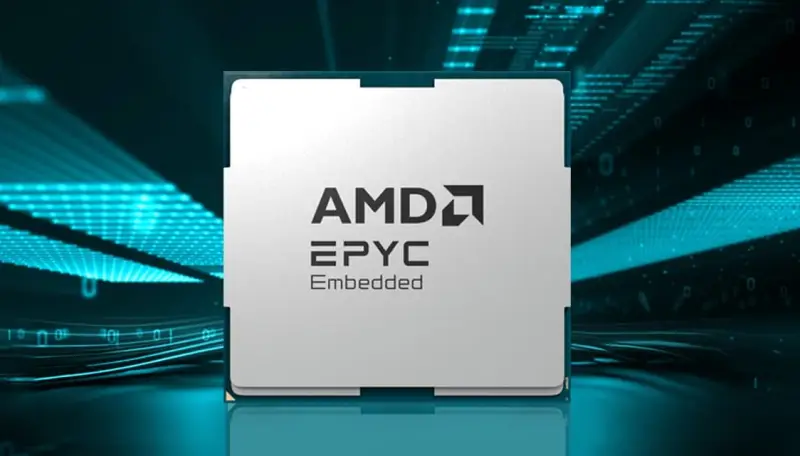
AMD's new 6th Gen EPYC Embedded 9006 Series SP7 processors are aimed at a part of the stack that rarely gets attention: the machines that test chips, secure networks and move data inside factories and appliances. The headline spec is a single socket with up to 256 cores and 512 threads, built on the Zen 6 core architecture. That puts data center-class compute into embedded boxes that were never designed for it.
Why test equipment is the bottleneck
Automated test equipment, or ATE, sits at the end of the semiconductor line as high-speed quality control. Each rig runs electrical parametric tests, functional stress tests and signal validation, often across dozens of silicon dies at once. The point is to catch defects and performance problems before a design reaches mass production.
The problem AMD is describing is simple. As chips get faster and more complex, the tests get heavier, and the controllers orchestrating them run out of parallel compute. Adding more test sites is expensive, and a controller that can't keep up leaves expensive tester time idle. That's the friction AMD is pointing at, and it gets sharper as AI accelerator designs push more data through every validation step.
Here's the thing: the same squeeze shows up in network security and storage. Firewalls handling 400G and 800G links have to evaluate growing rule sets without adding latency, and storage nodes need headroom for compression and RAID calculations. Embedded platforms that were sized for last generation's traffic start to look under-provisioned quickly.
What the numbers say
Compared with AMD's previous 5th Gen EPYC Embedded 9005 series, the company claims 1.8 times the throughput, 1.5 times the networking bandwidth and 2.7 times the memory bandwidth. Those are vendor figures, and the workload behind each one isn't broken out in the announcement, so treat them as directional until independent test results arrive. Still, the memory bandwidth gain is the one that matters most for ATE, where controllers constantly shuttle measurement data.
The I/O story is just as dense. The chips offer up to 96 lanes of PCIe Gen 6 running at 64 GT/s, which doubles the per-lane rate of Gen 5. They also support CXL 3.1 for flexible memory expansion and provide 16 DDR5 memory channels. The memory speed claim is the most eye-catching: multiplexed rank DIMMs (MRDIMMs) at up to 12,800 MT/s. AMD notes that this figure refers to the effective transfer rate between the memory controller and the module. It compares with the 6,400 to 8,000 MT/s range typical of high-end server DDR5 today.
For buyers, the practical question is what those lanes and channels let them attach. A single socket with that much I/O can host fast NICs, accelerators and large memory pools in one box, which could simplify designs that currently chain several smaller machines together. Whether that consolidation saves money depends on the system vendor's pricing and cooling, neither of which AMD has detailed here.
Security built into the boot chain
Test systems often hold proprietary chip designs and touch firmware that controls expensive hardware, so AMD has put a lot of the announcement into security. The EPYC Embedded 9006 chips use the company's Root of Trust technology to establish an immutable boot chain. Firmware signing is protected with post-quantum cryptography, which AMD positions as a hedge against future quantum attacks on today's signatures. Post-quantum schemes are still new in production silicon, so the real test will be how they hold up in deployed fleets over time.
The chips also add a new AMD Security Processor (ASP) that handles runtime trust execution, virtual machine encryption and authorized diagnostic debugging. The last item matters in a lab setting: engineers need to debug silicon, but that access shouldn't become a backdoor. AMD says the ASP gates debugging behind authorization.
Perhaps most notable is the integration of Caliptra, an open-source, vendor-agnostic silicon root of trust. Caliptra supports remote attestation, which lets a verifier check device identity and detect firmware tampering. Because it's open and not tied to one vendor, it can slot into heterogeneous fleets where test rigs come from several suppliers. That's a practical advantage for chip makers who run tools from many sources.
Availability and what to watch
AMD says volume production is already underway and that the processors will begin shipping to customers later this month. Buyers can choose from configurations ranging from 64 to 256 cores, and the first 128-core part launches on Nov. 15. The company hasn't published pricing or power envelopes for each SKU in the announcement, and those will matter a great deal for embedded designs with fixed thermal budgets.
My read is that the most useful next step is independent testing of ATE controller workloads, not synthetic throughput. The claim that matters for a test floor is how many dies a controller can orchestrate in parallel at a given power draw. If the 2.7 times memory bandwidth gain holds under that load, the bottleneck AMD describes could move a generation further out. If it doesn't, customers will still have a denser socket to work with, just not the leap the headline suggests.