AMD's Data Center Surge Puts CPUs Back at the Center of AI Demand
AMD's Q3 revenue hit $13.38B, up 45%, with data center now 64% of sales as agentic AI drives demand for CPUs and Helios rack systems.
AMD's third-quarter numbers beat Wall Street on almost every line, and the reason is a shift that few people expected two years ago. Agentic AI workloads are pulling demand back toward CPUs, the chips AMD has sold for decades, and the data center business is now carrying the company.
The quarter in numbers
AMD reported adjusted earnings of $2.09 per share, excluding certain costs such as stock compensation. Analysts had expected $1.95. Revenue rose 45% from a year earlier to $13.38 billion, above the $13.09 billion consensus. Net income reached $3.47 billion, up 77% from $1.96 billion a year before. Shares rose more than 5% in late trading.
The mix matters more than the headline. Data center accounted for 64% of revenue, up from 47% a year ago, and segment sales nearly doubled year over year. That's a company that has spent years chasing Nvidia's share of AI accelerators now generating most of its money from server silicon.
Why CPUs are back in favor
For a while, the AI story was all about GPUs. Agentic applications change that math. Autonomous agents that plan, call tools and loop through multistep tasks spend much of their time on orchestration and general-purpose logic, and that work runs more efficiently on CPUs than on GPUs. Meta Platforms' Muse was cited as one example of this kind of workload. The result is renewed demand for AMD's EPYC server processors, which is what the company is describing when it talks about accelerating AI growth.
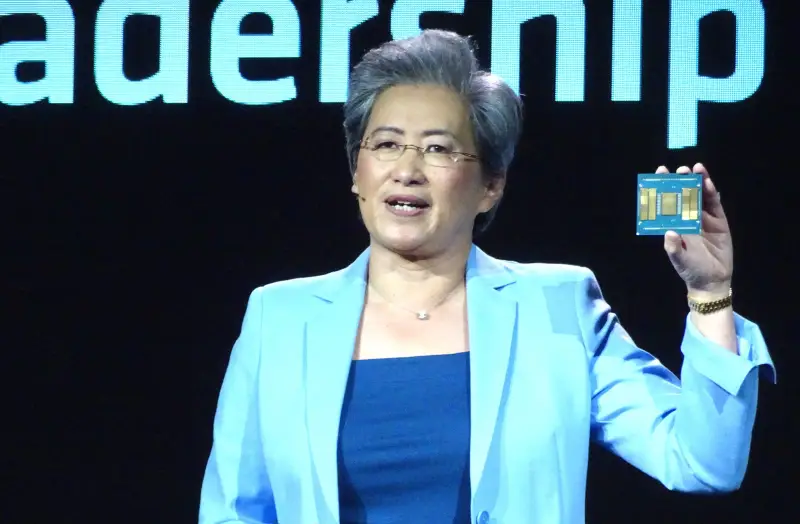
Chief Executive Lisa Su put it plainly on the conference call with analysts: "Adoption is just starting and we expect demand to grow sharply as agents are deployed more broadly and take on more complex work." AMD now expects server revenue to double year over year in fiscal 2027, and it says AI growth should run faster than the forecast it gave only three months ago.
GPUs and Helios still matter
The CPU story doesn't crowd out AMD's accelerators. The company sells Instinct GPUs in rack-scale systems called Helios, and Su said Anthropic, OpenAI, Microsoft, Oracle and Meta are all deploying Helios systems in their data centers. Meta said its first Helios racks are already running, and AMD invested $1 billion in Meta's latest equity offering. AMD has also committed $5 billion to Anthropic, which recently made its long-awaited IPO prospectus public.
Those are large, concentrated relationships. They give AMD volume and reference customers, but they also tie a meaningful share of growth to a small group of AI labs and hyperscalers whose own spending plans can shift quickly.
Supply is the constraint to watch
Supply has been the bottleneck for AI hardware across the industry, and AMD is trying to show it has the inputs lined up. After a trip to Taiwan, where Su met Taiwan Semiconductor Manufacturing Co. and supply chain partners, the company said it plans to increase supply substantially next year. "We have worked across our supply chain to secure the wafers, substrates, advanced packaging, memory and other key components needed to support much higher growth next year," she said.
That contrasts with Intel, which reported strong data center growth of its own days earlier but saw its stock fall more than 30% on weak guidance and doubts about its ability to meet demand. Intel's problems are also tied to the PC market, which is where AMD is weaker.
The PC and gaming drag
Client and gaming remains the soft spot. Global PC shipments fell 4% in the second quarter from a year earlier, according to Counterpoint Research, as higher memory prices discouraged buyers. AMD's PC and console chip revenue within that segment dropped 8% to $3.7 billion, and gaming revenue fell 40%. Strength in data center is what keeps the overall picture positive for now.
Guidance and acquisitions
For the current quarter, AMD is targeting about $17 billion in revenue at the midpoint of its range, against a Street estimate of $16.2 billion. It expects gross margin of 55%, a hair below the 55.3% consensus, so the company is growing without a margin cushion to spare.
AMD was also active on deals. It agreed to buy World Labs, the San Francisco AI lab founded by Fei-Fei Li, for $8.2 billion in an all-stock transaction. World Labs builds world models that simulate 3D environments for training robots and other physical AI systems. Earlier, AMD acquired Taalas, a startup making model-specific integrated circuits, which are chips customized to run one AI model more efficiently. That fits AMD's push into inference. The company also invested in Stability AI, which raised $76 million in August.
What I'd watch next
Investors are asking whether AI spending will pay off, and AMD's numbers are a reasonable test case. Analyst Jacob Bourne of eMarketer framed it as a test of AMD's own execution and the broader AI trade. His point that demand "is not going to fall off a cliff" is a fair read, but the real questions are narrower. Can AMD deliver the supply it's promising? Will agent workloads keep favoring CPUs as they scale? And how much of the Helios ramp depends on a handful of customers? Those answers will show up in the next few quarters of server revenue, not in one strong report.