Marvell Bets $115 Billion on Lumentum's Optical Lasers for AI Networks
Marvell will buy Lumentum for $115 billion, adding indium phosphide lasers and co-packaged optics to its AI networking stack as data center links move toward light.
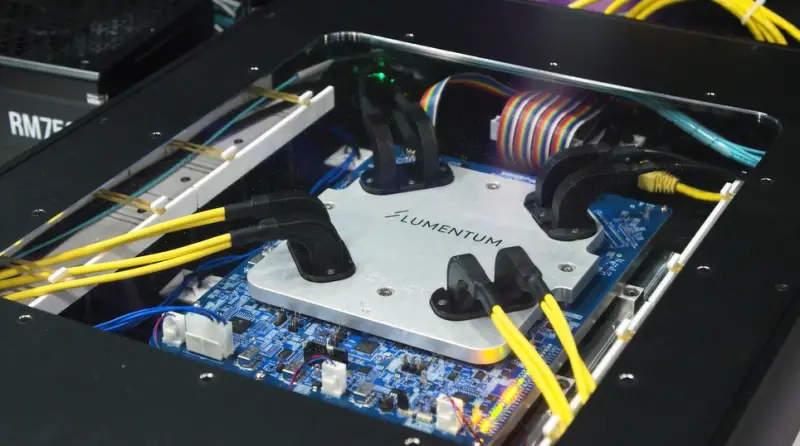
Marvell's plan to acquire Lumentum for $115 billion is less about buying a fast-growing company and more about owning a part of the stack that AI data centers increasingly depend on. Marvell designs networking silicon and custom chips. Lumentum makes the lasers, amplifiers and light-handling components that move data between machines. Put those together and Marvell gets a direct say in how the optical layer gets built.
The price and the market's reaction
Lumentum shareholders would receive 4.5 Marvell shares for each Lumentum share, which works out to about $1,132 per share. That's a 23.9% premium over Lumentum's last unaffected stock price. Here's the thing, though: the market didn't cheer. Marvell's shares dropped almost 13% and Lumentum's fell almost 19%.
The sell-off points to a familiar worry. Investors have been paying up for AI infrastructure growth, and they're increasingly asking how long that growth lasts. A deal this large, struck at a premium, puts that question in sharp relief. Buyers are effectively betting that the demand for optical connectivity has years left to run, and the market is not yet convinced.
Why Marvell wants the optical layer
Many of Marvell's networking products send data over fiber-optic cables, and Lumentum supplies components that go into the devices built around those links. Owning that supplier gives Marvell more control over its supply chain. It also means the company can push upstream component design closer to what its own systems need, rather than adapting to parts it doesn't control. For a company whose products depend on tight timing and power budgets, that kind of alignment can matter as much as raw performance.
What Lumentum actually sells
At the core of Lumentum's business are lasers built on indium phosphide, a semiconductor that produces light more efficiently than silicon does. Its product family includes modulated lasers, which connect servers to a data center's optical network, and continuous wave lasers, which power longer-range links. The two types serve different distances and different jobs inside the same facility, which is why a single supplier covering both is useful to a networking vendor.
Lumentum also makes single-mode optical amplifiers. These boost laser signals traveling through long-haul carrier networks, helping keep transmission errors down over distance. On the sensing side, it uses indium gallium arsenide to build analog photodetectors, which let operators monitor optical networks for faults. And it sells optical circuit switches that steer traffic with tiny mirrors. Because those switches keep signals in the optical domain, they avoid converting data to electrical form and back, which saves power. That's a meaningful advantage as power becomes one of the main constraints on AI cluster design.
The co-packaged optics bet
The most strategically interesting piece may be Lumentum's laser for co-packaged optics, or CPO. Lumentum debuted that product last year. CPO chips let servers connect to a data center's network without the transceiver modules that are usually required for that job. Fewer modules mean less power, less cost and fewer points of failure, which is why CPO has become a focus for Marvell's growth plans.
Marvell's chip design business can help customers fold CPO modules into their custom AI accelerators. Marvell has described that architecture publicly. Owning the laser source that feeds those modules would let Marvell control a piece of the design that, until now, it has had to source from outside. My read is that this is the clearest rationale for the deal. The optical light source is a bottleneck, and Marvell would rather own it than wait for it.
The industrial lasers question
Lumentum also makes high-power lasers used in industrial cutting and welding equipment, which would give Marvell a foothold in a market it doesn't serve today. It's unclear what happens to that business after the deal. Acquirers often spin off newly absorbed units that don't fit their core focus, and an industrial laser line is an obvious candidate. Until the companies say more, that part of Lumentum's portfolio remains an open question.
Timeline, leadership and targets
Marvell expects to close the acquisition in the first half of 2028. Matt Murphy, Marvell's chief executive, will lead the combined company. Lumentum CEO Michael Hurlston will join Marvell's board along with two of Lumentum's directors. Murphy framed the goal as bringing together "two leaders with highly complementary technologies, exceptional talent and specialized manufacturing capabilities" to shape the next era of AI connectivity.
On the numbers, Marvell expects the deal to be accretive to adjusted earnings per share within a year of closing. Over the longer term, it targets annual run-rate cost savings above $1 billion and faster revenue growth. Marvell estimates that the combined business expands Lumentum's total addressable market to $550 billion. Those are Marvell's own projections, and they depend on AI infrastructure spending continuing at a pace that the market is currently questioning.
What to watch
Three things will tell you whether this works. First, whether Marvell's CPO roadmap leans on Lumentum's lasers in a way that shows up in product design. Second, how the company handles the industrial laser business. Third, whether AI infrastructure demand holds up long enough to justify a price this high. The next two years will be mostly about integration, but the real test is whether optical components become a point of differentiation for custom AI silicon rather than a commodity input.


