Extreme Networks Wants Its Network to Run AI, Not Just Be Run by It
Extreme Networks is turning idle access point and switch compute into on-premises AI infrastructure. Its Agent ONE and Exchange zones aim to shift networking toward AI that runs on the network.
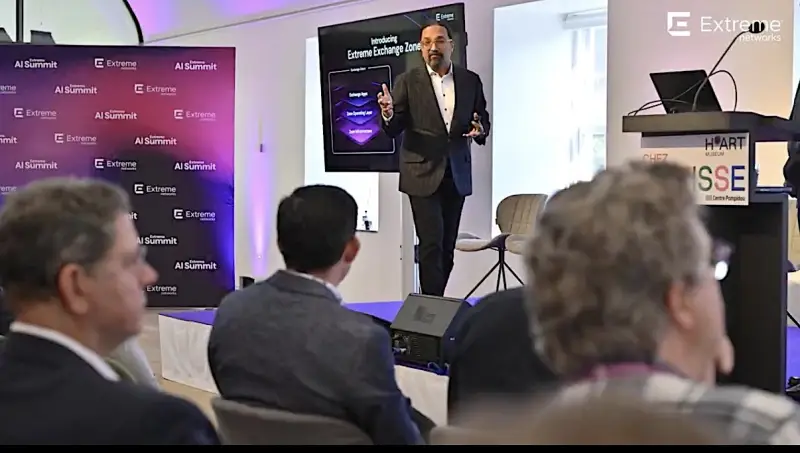
Most AI-and-networking pitches run in one direction: AI examines the network and helps the team operate it. Extreme Networks used its recent AI Summit in Amsterdam to argue for the reverse, where the network also hosts AI workloads and uses telemetry that most organizations currently discard. That's a more interesting claim than another AIOps dashboard, and it changes what a network team is for.
Early numbers from Agent ONE Coworker
Extreme's first announcement was a progress report on Agent ONE Coworker, an ambient AI agent built into Extreme Platform ONE. The company says customers saved about 1,000 hours of troubleshooting in the first month. Forty-one percent of Platform ONE customers used the agent for daily tasks, and users responded to 98% of critical "nudges," the proactive alerts the agent raises after running its own preliminary investigation. Engagement reached roughly ten times that of Extreme's first-generation conversational assistant.
Those are vendor-reported figures from an early window, so I'd treat them as directional. Still, the nudge model is the more important detail. An agent that does the first pass on a problem and then surfaces a finding is a different product from a chatbot waiting for someone to ask the right question.
Why the first wave fell short
Extreme's CTO and president of AI platforms, Nabil Bukhari, called the chatbot approach a design flaw. "Conversational AI requires the user to have the question and the context, and you will be surprised how difficult that is when it comes to technology domains," he said. In focus groups, administrators asked AI assistants how many devices they had, even though the answer was already on the dashboard. The problem wasn't the model's intelligence. It was that the user had to know what to ask.
Bukhari's framing is that the direction has flipped: "Instead of you prompting AI, AI prompts you." Whether that holds up at scale depends on how well the proactive alerts are ranked and how much noise they generate. Engagement numbers help, but they don't yet show how many nudges were ignored or how many were wrong.
What a real deployment looks like
The most concrete evidence came from Hill College. CIO Kevin Rocha described a wireless outage affecting a building that houses HR, finance and enrollment. "Agent ONE Coworker told me exactly where to look: One access point needed attention, and several more were due for firmware upgrades. We resolved the issue in about 20 minutes rather than an entire morning," he said. He added that Platform ONE is "like having two or three more network engineers on staff."
That's the realistic value case for most enterprises. The agent doesn't replace the network team. It gives a small group the reach of a larger one. Bukhari was also candid about the gap that remains. Fifty-eight percent of support cases opened by Agent ONE arrive with all the evidence support needs. "Fifty-eight is pretty good, but 58 is still 58 and not 100," he said.
Exchange zones: compute already on the ceiling
The bigger announcement is Extreme Exchange zones, previewed for the first half of 2027. A zone pairs an Extreme Universal Compute Platform, or a customer-owned server, with spare capacity from access points and switches already installed at a site. Applications from the Exchange marketplace run locally on open-weight models by default. Cloud inference is used only when a rule allows it, and every instance is logged. The autonomous Operator tier is also slated for the first half of 2027.
The hardware argument is simple. Higher-end access points have four to eight cores and typically use only one. Organizations already buy and power that silicon, and it sits idle. In a healthcare demo, a fall-detection application combined camera feeds, Wi-Fi location data and paging to route an alert to the nearest responder, and it ran entirely on access points. A second demo used Seattle Seahawks game data to predict gate congestion and found that some fans faced a seven- to eight-minute walk to the nearest pro shop.
Bukhari's point is that these workloads depend on dense, real-time telemetry about location, movement and behavior. "This is not a network management use case. These use cases are impossible without that rich, real-time telemetry." Cloud platforms typically discard much of that data because moving it is expensive. Keeping it local changes the economics, and it puts the return in operations, facilities and customer experience rather than in network budgets. That gives network leaders something they rarely have: a revenue narrative.
Guardrails and where governance lives
Operator mode is gated. Each of the 268 tools can be set to auto-authorize, ask first or never run. Four baseline rules apply everywhere: do no harm to the network, never expose a credential, never act outside your role, and never act in another tenant. Every task produces a full audit trace.
The design choice I found most useful is that governance sits within Exchange rather than Platform ONE. "You can't govern something from within," Bukhari said. "That is how you get rogue agents." If the system running an agent also controls its permissions, you don't have a control plane. You have an honor system. Andrew Grill, who opened the summit, put the stakes plainly: "When a chatbot gets it wrong, you might have a bad paragraph. If an agent gets it wrong, you have a bad Tuesday." His test for any deployment is blunt: "If your agent does something wrong at 2 in the morning, whose phone rings?"
Pricing and the open questions
Extreme plans consumption-based pricing measured in "agent actions." Zones will ship in 2027, and the demo applications were built with design partners. Because the model depends on a real application catalog, Extreme is pairing it with a free, invitation-only forward-deployed engineering program. Grill noted that most organizations haven't priced their current tasks, which makes it hard to judge whether per-action pricing is a good deal. That's the gap I'd worry about most. Without a baseline, buyers can't tell whether an agent action is cheap or expensive.
Several technical questions remain open. How do workloads get prioritized when RF demand spikes and access point compute is needed for radio work? Which model sizes realistically fit on an access point? And how well does the 58% evidence-completeness figure improve as the system matures? Extreme's answers so far are reasonable but not yet tested at scale.
Sovereignty as an adoption driver
The customer panel offered the most useful perspective. Jonathan Monk, CIO of the Institute of Cancer Research in London, manages roughly 9 petabytes of data, yet performance isn't his main reason for building sovereign AI. "When we ask people in our organization what's the biggest thing that holds them back from using AI, it's that I'm not sure if I'm allowed to," he said.
Andrew Beynon, chief enterprise architect at partner ARO, tied that uncertainty to shadow AI. His goal is "to make the journey for legitimate adoption of AI easier than the move to illegitimate adoption." Monk described the aim as building "paved roads." Much of the industry treats data residency as overhead. These customers treat it as the thing that lets teams start. David O'Neill, director of IT operations at Liverpool Football Club, offered a measured view: "While AI is an answer, it's not necessarily the answer." Bukhari's follow-up is worth remembering: "Adoption is no longer the problem. It's the optimization of adoption." After AI-generated product specs grew to 200 pages, Extreme capped them at three.
What network teams should do now
Bring the network team into the AI plan. If it's left out, decisions about traffic, inference location and data residency get made without the people who understand them.
Separate governance from execution. Confirm that agent permissions, audit logs and the kill switch live outside the system the agent runs on.
Inventory the telemetry you discard. List the location and occupancy data your network already generates, and identify which business units would use it.
Test the edge-compute math. Ask how workloads are prioritized during RF demand spikes and which model sizes realistically fit on your access points.
Price today's work first. Without a baseline cost for current tasks, consumption-based AI pricing is impossible to evaluate.
My read
Extreme can't outspend its larger rivals, so it's betting on speed and focus as a pure-play networking company. The Agent ONE figures suggest that bet is paying off on the operations side. Exchange zones are the bolder idea. Turning installed access points and switches into a distributed, centrally governed inference fabric is more ambitious than anything I've seen from the bigger vendors. It's also unproven, and 2027 is a long way off in AI time. As Beynon put it, "today's knowledge has got an expiry date."
Still, the direction is right. The network has been critical infrastructure for decades, yet most organizations only talk about it after something breaks. AI makes the network the system that connects data, compute and people, and possibly the one that runs the AI as well. Network teams that see that early will have a much bigger say in where their organizations go next.