RTX Spark Laptops Arrive With Local Speech Models, Agent GPU Controls and Path-Traced Games
RTX Spark laptops from six makers start at $2,599, pairing a 128GB unified-memory superchip with new local speech, agent and gaming updates.
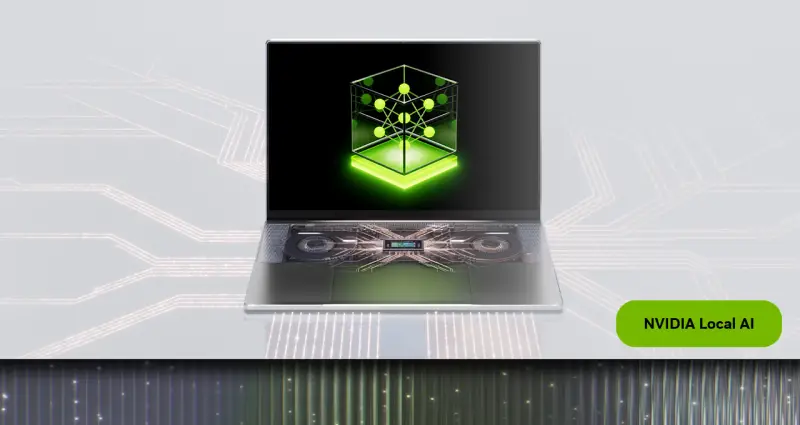
The most interesting part of NVIDIA's RTX Spark rollout isn't the spec sheet. It's that a thin Windows laptop can now run open speech models, agent workloads and path-traced games from the same memory pool. The hardware is available now from ASUS, Dell, HP, Lenovo, Microsoft and MSI, and the software updates arriving alongside it show what NVIDIA wants developers to build on.
What's inside the RTX Spark superchip
Each RTX Spark system combines an NVIDIA Blackwell RTX GPU and an NVIDIA Grace CPU in a single superchip. It offers up to 128GB of unified memory and up to 1 petaflop of FP4 AI performance. The pitch is that CUDA, RTX graphics and a personal AI workstation-class machine fit inside a laptop meant to go anywhere.
Unified memory is the detail that matters for developers. The GPU, CPU and AI models all draw from one pool, so a model that would normally need to be shuttled between system RAM and VRAM stays put. That's what lets a laptop take on work that used to require a desktop workstation, even on battery.
Nemotron 3.5 Transcribe: one model for audio jobs
The most substantive release here is NVIDIA Nemotron 3.5 Transcribe, an open-weight speech model available today on Hugging Face. Usually, a meeting pipeline stacks separate models for transcription, speaker labels and translation. This one handles all three from a single promptable interface, and it can answer questions about the audio too. It covers 40 languages, including seven Indic languages.
Control happens through plain-language prompts. Asking it to transcribe a recording and label each speaker, translate the audio into English, or list the decisions made in a meeting all run through the same model. Prompts can also carry product names and formatting rules, which matters for specialized vocabulary in healthcare, financial services and customer support.
On accuracy, NVIDIA says the model ranks No. 1 on the Hugging Face Open ASR leaderboard and No. 2 among open-weight models on Artificial Analysis. It does this with about 4.3 billion active parameters, which NVIDIA says is 80% fewer than the top open-weight model on that ranking. That efficiency is the practical hook: it makes high-quality transcription realistic on a laptop rather than only in a data center.
Quantized versions are coming soon for local runs on RTX Spark and DGX Spark, Jetson AGX Thor, or scaled-up Blackwell data center GPUs. NVFP4 builds are slated to deploy through NeMo-Speech.cpp or vLLM. Because the weights are open, teams choose where audio gets processed, which is often the deciding question for sensitive recordings. More detail is in the NVIDIA technical blog.
Sharing the GPU between agents and apps
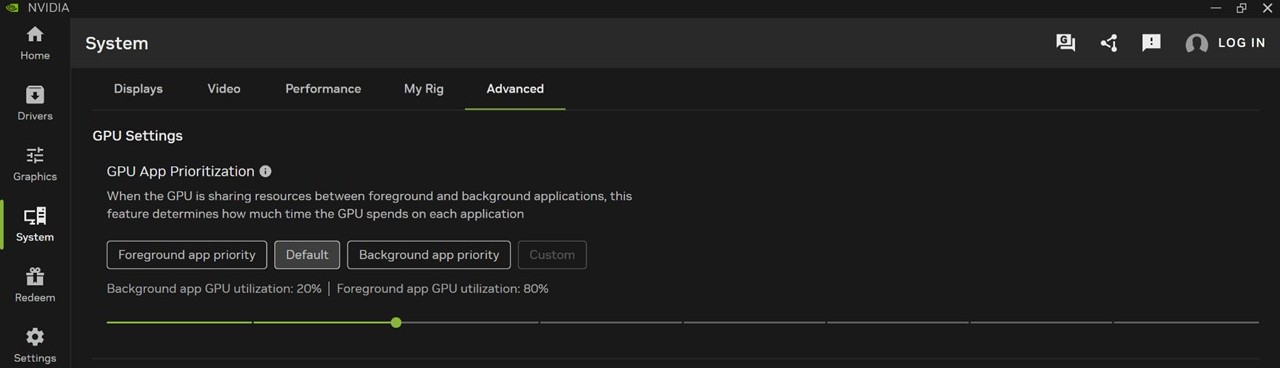
Long-running agents and interactive apps now compete for the same GPU compute. A new resource management control in the NVIDIA App lets users decide where that compute goes. They can prioritize the foreground app for responsiveness, or shift resources to a background agent so it finishes sooner.
The setting lives under System > Advanced in the NVIDIA App, and it requires hardware-accelerated GPU scheduling enabled in Windows Settings. My read is that this is less a headline feature than a sign of where local AI usage is heading: laptops that run agents continuously will need a scheduler that understands the user's priorities at that moment.
Liquid AI's LFM3 family
Liquid AI's LFM3 is a generation of Liquid Foundation Models aimed at specialized tasks. The family covers text, vision, audio, omni and decision models, all built on a shared backbone, with base and post-trained versions released as open weights. The headline efficiency claim is that a new 1.7-billion-parameter base model outperforms the previous 2.6-billion-parameter base model.
The use cases are concrete: triaging inboxes and managing calendars through agents such as Hermes Agent, Pi and OpenClaw; reading documents and app screens; transcribing and translating speech; answering spoken questions about handwritten math; and routing support tickets or voice requests. Developers can run LFM3 on RTX Spark with native support through llama.cpp and vLLM, and fine-tune the models locally.
Phantom Blade Zero adds ray tracing and DLSS 4.5
S-GAME's action role-playing game Phantom Blade Zero launches Oct. 28 at 7 p.m. PT on Steam and the Epic Games Store. You play as Soul, a swordsman framed for his master's murder who travels the martial world to uncover the conspiracy behind it.
NVIDIA worked with S-GAME on the ray-traced effects. On RTX Spark laptops and GeForce RTX PCs, ray tracing adds more accurate bounced light, sharper reflections and realistic shadows on foliage and terrain. DLSS Dynamic Multi Frame Generation can apply up to 6x frame generation, or adjust the multiplier on the fly to hit a target frame rate. For a laptop, that dynamic adjustment is probably the more useful piece, since thermal and power limits shift during long sessions. More is on GeForce.com.
RTX Remix 1.6 moves into Minecraft
RTX Remix, NVIDIA's modding platform for remastering classic games with path tracing and DLSS, reached version 1.6 last week. The biggest change is that it now works with Minecraft. Creators and players can render Minecraft Java Edition 1.21.1 through RTX Remix with DLSS-accelerated path tracing, which brings realistic lighting and materials to builds.
The update also adds DLSS 5 with 3D-Guided Neural Rendering, up to 6x Multi Frame Generation, native RTX Spark support and agent-assisted workflows. Those upgrades arrive today for Portal with RTX and the Half-Life 2 RTX demo. Both gain DLSS 3D-Guided Neural Rendering, a new Performance Mode for Frame Generation and options that speed up path tracing. More detail is in the RTX Remix blog.
On the modding side, a redesigned ComfyUI workflow generates physically based materials directly inside RTX Remix. It needs no API setup, supports batch processing for full projects and includes presets for less technical creators. NVIDIA agent skills also let compatible AI agents work with RTX Remix directly, which could cut the time spent on repetitive remastering tasks.
Laptop designs and who they're for
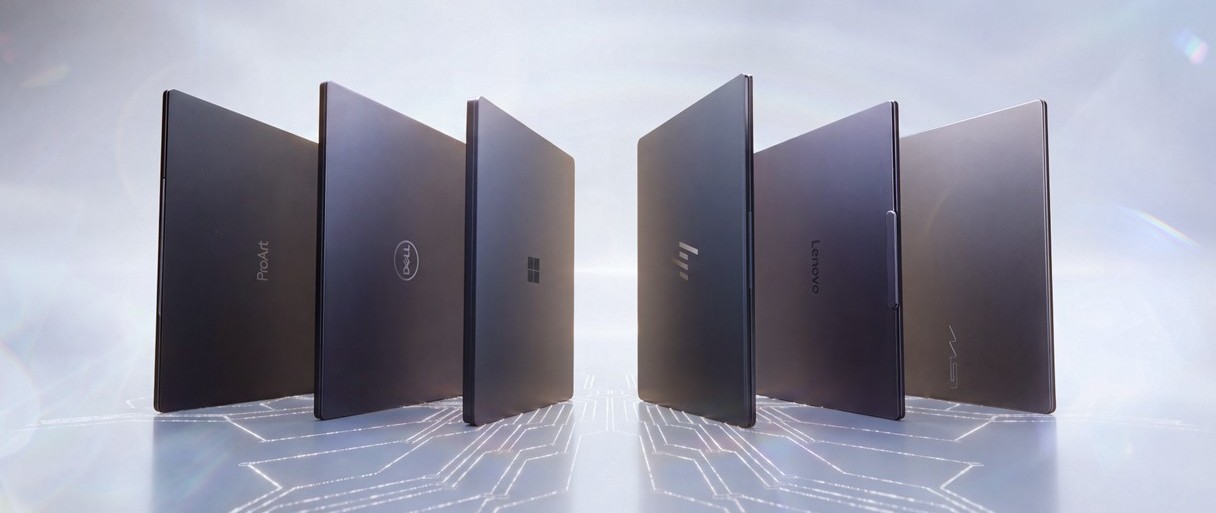
RTX Spark laptops come in several screen sizes, colors and formats, including touchscreen, pen-enabled and two-in-one convertible models. The thinnest are 14mm and as light as three pounds, with all-day battery life claimed. Packing the GPU, CPU and memory onto one power-efficient superchip is what makes those dimensions possible.
The three audiences NVIDIA names each get a different angle:
- AI developers can run models and agents locally on CUDA, the same platform used for cloud AI, with a path to deploy across more than 150 million NVIDIA RTX AI PCs and NVIDIA GPUs in the cloud.
- Creators can edit camera-native 4:2:2 video and render 3D scenes up to 90GB. Adobe Photoshop and Premiere offer native RTX Spark support through beta releases.
- Gamers get hundreds of compatible titles, with DLSS, ray tracing, Reflex and G-SYNC aimed at sharper visuals and smoother input response.
Pricing starts at $2,599, and 128GB configurations are on shelves. The RTX Spark product page lists available models.
Smaller releases worth a look
 Microducks learn to walk with help from RTX Spark: At the GTC Berlin keynote, Jensen Huang showed AI agents on RTX Spark helping train Hugging Face's Microduck robot. Hermes Agent and Nemotron 3.5 Bolt plan an obstacle course, Astra builds the 3D assets, NVIDIA Isaac Lab trains the navigation policy, and RTX Spark validates it in NVIDIA Isaac Sim. The demo and playbook are available.
 NVIDIA Nemotron 3.5 Bolt E4B 4GB is now available. It handles natural conversations and multistep agent tasks in as little as 4GB of memory, powering local voice assistants, game characters and embedded interfaces. It supports llama.cpp, vLLM, Ollama, Unsloth and LM Studio, and works with Hermes and OpenClaw. For heavier agent work, Nemotron 3.5 Bolt 74B-A9B 24GB targets local agents on RTX Spark.
 Black Forest Labs' FLUX 3 Image Klein is a 5.6-billion-parameter open-weights model for generating and editing images locally. NVIDIA-optimized versions run on RTX GPUs with as little as 8GB of VRAM. Developers can also fine-tune it on RTX Spark with a NeMo AutoModel recipe to match specific creative workflows.
 NVIDIA DGX Spark 64GB is now available from manufacturers. Built on the GB10 Grace Blackwell Superchip, it pairs 64GB of unified memory with DGX OS and the NVIDIA AI software stack for agent development, inference and fine-tuning. Purchase options are listed here.
The thread through all of this is memory and scheduling. A laptop that runs a transcription model, a 4GB agent and a path-traced game without juggling where data lives is a different kind of tool, and the software now being shipped is what decides whether that potential gets used. The next thing to watch is the quantized Transcribe builds and how the GPU scheduling controls behave once agents run for hours.


