Agents Join the Search for Extraterrestrial Signals at the Allen Telescope Array
Breakthrough Listen and the SETI Institute are using AI agents to steer telescopes and process terabits of radio data while observations run.
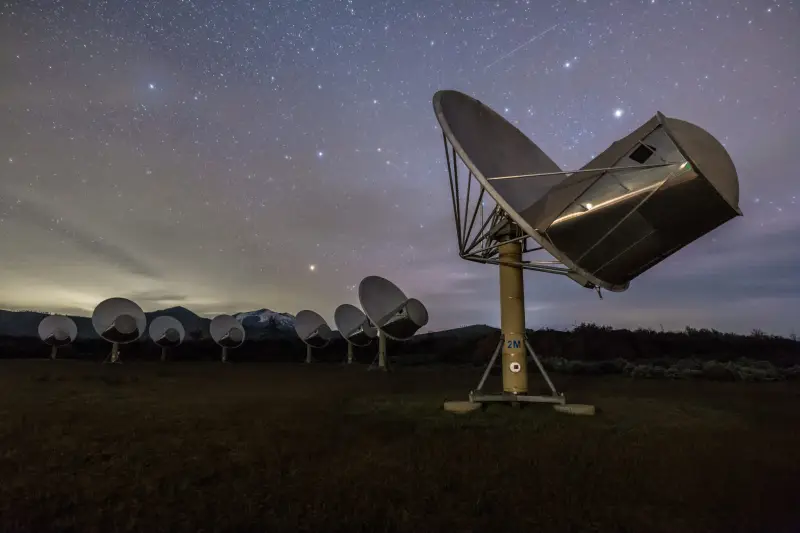
Here's the part that's easy to miss: the search for extraterrestrial intelligence is starting to look less like scanning the sky and more like a conversation between software systems. Breakthrough Listen and the SETI Institute are adding agentic AI to their daily observing work, so that AI agents operated by humans are the ones listening for signals that might come from machines built by someone else.
That framing sounds like science fiction, but the engineering underneath is concrete. Some scientists have suggested that any extraterrestrial civilizations could be far older than ours, potentially by billions of years, and that they might have developed technologies well beyond human capability, including forms of AI. If that's true, a signal from such a civilization may not look like anything a human engineer would design. The bet here is that software trained to look for patterns, and to adjust its own instruments, is better suited to finding the unexpected.
Agents at the Telescope
At the Allen Telescope Array in Northern California, agents can now steer the instrument, enhance and correct incoming data, and apply AI models to the live data stream. All of that happens from a single natural language request. A researcher doesn't need to script each step or switch between separate control tools.
The hardware foundation is the NVIDIA Holoscan platform, which handles the very large sensor data streams that the telescope produces. That gives the agents live data to act on rather than archived recordings they'd review after the fact. For a search like this, the difference matters. A signal that shows up at 2 a.m. and is only noticed the following week has lost most of its value as a lead.
The agent layer is what turns the pieces into a workflow. Agents can point the antennae, calibrate and focus the instrument to get a cleaner signal, catch and fix data errors, and then produce a plot of the result. The team says this compresses work that would otherwise take humans weeks or years into a matter of hours. I'd read that claim as a statement about iteration speed: the number of hypotheses a team can test in a single observing session goes up sharply when the instrument can reconfigure itself in response to what it's seeing.
Terabits a Second, Processed in Flight
Radio telescopes produce data faster than most storage systems can absorb it. The traditional response has been to record everything and analyze it later, which means the interesting moments can be buried under weeks of material. The design here reverses that order. Processing happens while the observation is still running.
DAQIRI, a library within the Holoscan platform, moves terabits per second of sensor data directly into GPU memory. Instead of filling hard drives with raw output, the system works on the data in flight. CyberEther, a signal-processing framework developed at the SETI Institute, does the computation, using NVIDIA CUDA-X libraries including cuFFT and cuBLAS. Fourier transforms and dense linear algebra are the workhorses of radio signal processing, so GPU acceleration of those operations is where most of the throughput gain comes from.
Coordinating all of this is Nexus, a web-based observatory orchestrator that serves as the agent harness. It gives agents one source of truth for instrument state, compute resources and processing pipelines. Researchers can watch packet loss, read live spectrograms, and rewrite signal-processing blocks, all by prompting in natural language. The system reportedly handles 2.4 terabits per second on NVIDIA RTX PRO 6000 Blackwell GPUs, with inference running on premises, next to the instrument rather than in a remote data center.
That on-premises detail deserves more attention than it usually gets. When an agent needs to make a decision within seconds, sending data off-site and waiting for a response adds latency and a dependency on network conditions. Running inference beside the antennae keeps the decision loop short and the data where the observation is happening.
From Demo to Detection
The pipeline has already produced a concrete result: the first real-time AI detection of a pulsar, a rapidly spinning stellar remnant, in the Crab Nebula. Pulsar detection is a useful benchmark for a system like this because pulsars are known signals. If the pipeline can find something that's already known, reliably and in real time, that's evidence it can be trusted to flag things that aren't.
Looking ahead, the team is evaluating open models, including NVIDIA Nemotron, for two situations. The first is where data locality and turnaround time matter most, which is exactly the on-site inference case. The second is observatories that might someday operate offline, with the far side of the moon mentioned as one possibility. Open models matter in that setting because they can be hosted and run without depending on a continuous connection to a cloud service.
The Translation Problem
Andrew Siemion, Bernard M. Oliver chair for SETI at the SETI Institute and principal investigator of Breakthrough Listen, put the core idea plainly: "As our new agentic observatories reach out into the universe, what they find may have much more in common with themselves than with the humans who created them. But this isn't something to fear. Rather, it's a breakthrough in translation."
My read is that the phrase "translation" is the important word. The concern in SETI has always been that an alien signal might be unrecognizable to human expectations. Agents that can reconfigure instruments and rewrite their own processing blocks are a way to close that gap, because they can test unfamiliar structures without waiting for a researcher to redesign the pipeline by hand. That's a more useful goal than trying to predict what an extraterrestrial signal will look like.
Still, there are open questions worth tracking. Agents that act on live data need clear logs and human oversight, or a false positive can send a team chasing noise for days. Benchmarks for detection sensitivity, and how often the system flags interference from terrestrial sources, will matter as much as raw throughput. The pulsar result is a strong first data point, but the harder test is whether the same agents can keep their precision when the target is something nobody has seen before. That's the result to watch for.