NVIDIA Cosmos Adds Data, Training and Simulation Tools for World Models
NVIDIA expands Cosmos with new data blueprints, framework recipes and Nano simulation models aimed at building and testing physical AI world models.
NVIDIA's latest Cosmos update is less about a single new model and more about the pipeline around one. The company has added data curation tools, training and optimization recipes, and simulation checkpoints, which together cover the path from raw footage to a deployed world model. For teams building physical AI systems, that end-to-end coverage matters more than any one benchmark number.
NVIDIA says Cosmos now ranks in the top five on six open-model leaderboards. Treat that as the company's claim about its own models, but the bigger point holds regardless: the platform is trying to offer frontier open models together with the data, training and optimization tooling needed to scale training data, adapt models, test behavior and tune performance before anything reaches a robot or a camera network.
Data Comes First, and It's Usually the Bottleneck
World models start with multimodal, multisensory data, and that's where most teams stall. Collecting enough footage of rare or dangerous conditions is slow and expensive, and labeling it is worse. NVIDIA's answer is Cosmos Data Factory, a set of tools and skills for labeling, curating, augmenting and evaluating data at scale. Cosmos Curator, the GPU-accelerated tool for video datasets, now handles multimodal, multisensory inputs and processing blocks.
On top of that sit five cloud-native blueprints, available through GitHub and on Microsoft Azure, Nebius and CoreWeave:
- Autonomous Vehicle Dataset Generation: curates and labels driving data, then adds synthetic examples of hard-to-capture scenarios.
- Image Attribute Augmentation: varies object appearance to improve image search.
- Event Video Generation: turns still images into synthetic videos of rare or unsafe events.
- Defect Image Generation: produces printed circuit board, metal and glass defect images for inspection models.
- Video Data Augmentation: changes weather and lighting in existing footage while keeping scene structure intact.
The blueprints are most useful where real-world examples are scarce by definition. You can't easily stage a near-miss on a highway or a dangerous industrial event, but you can generate plausible versions and check whether a detector learns from them. Changing weather and lighting on footage you already have is a cheaper form of coverage expansion, and it's a common reason teams end up with datasets that look more diverse than their collection process was.
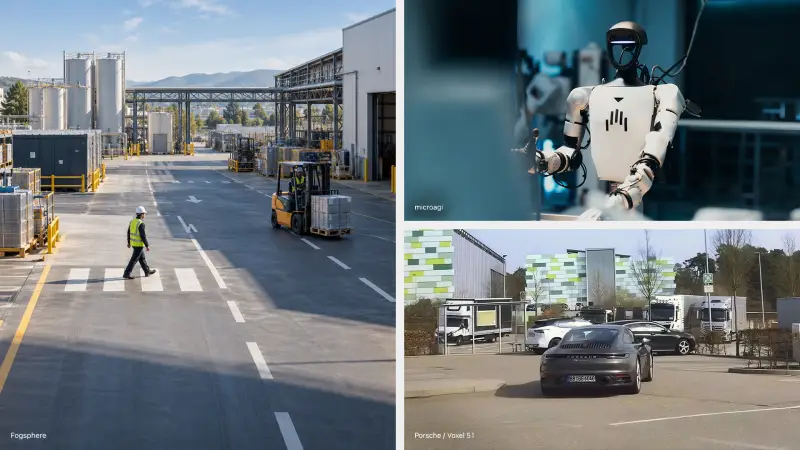
Early customer examples show how this plays out. Porsche is building a shared autonomous vehicle data flywheel across Volkswagen Group brands, using Cosmos Data Factory through Voxel51 on Microsoft Azure. NVIDIA says this is expected to reduce repeated physical test drives by up to 90% and shorten development cycle times by up to 85%. Those are expectations rather than measured results, and they come from a single program, so I'd read them as a direction, not a guarantee.
ANYbotics offers a more granular case. It generated more than 1,500 synthetic video clips with Cosmos Data Factory blueprints, curated real-world data and validated outputs through Encord's platform. The goal was to train industrial inspection robots to recognize liquid spills and other changes between facility visits. Pairing synthetic generation with a separate validation step is the pattern I'd expect to see most often, because synthetic data is only useful if someone checks that it resembles what the robot will actually encounter.
Computer vision company Ultralytics took a narrower approach. It retrained its YOLO model with real images plus targeted synthetic defects generated with Cosmos Data Factory, and reported improvements in defect localization and recall. The lesson there is about targeting: synthetic data helped where the real dataset was weakest, rather than replacing it wholesale.
Training, Adapting and Shrinking Models
Once the data is ready, developers can train an architecture from scratch or start from a pretrained model. NVIDIA extended Cosmos Framework's training, optimization and deployment tools and recipes into agent skills, and brought them to more open models alongside Cosmos 3. The framework is open and modular, and the company frames the goal as shortening the distance between experimentation and deployment.
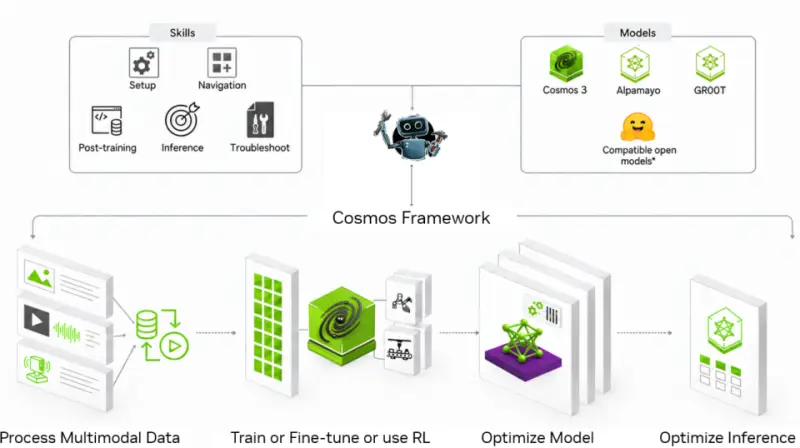
Developers and agents can now adapt open models including GR00T, Alpamayo, Qwen, Pi0.5 and other compatible Hugging Face models. The workflow covers fine-tuning and reinforcement learning, then distillation and quantization for optimization, and finally high-performance inference. The "agent skills" framing is worth watching: it suggests an automated model-builder that chains these steps, though how much of that loop works without hand-tuning will depend on the specific model and task.
MicroAGI, a robotics research lab, offers one concrete data point. It post-trained Cosmos 3 on videos of humans manipulating objects to build a world model for egocentric manipulation. It then distilled a 32-billion-parameter reasoner into an 8-billion-parameter Nano model, which NVIDIA says came with no loss in accuracy. For robotics teams, that gap between a research-scale reasoner and something that fits on deployment hardware is often where projects get stuck.
Developers can also label data and post-train Cosmos 3 on Roboflow for specific environments, then deploy the resulting models to Roboflow-hosted infrastructure or on-premises NVIDIA GPUs. The on-prem option matters for factories and warehouses, where latency, data residency and network reliability tend to rule out purely cloud-based inference.
Testing Policies Before the Robot Moves
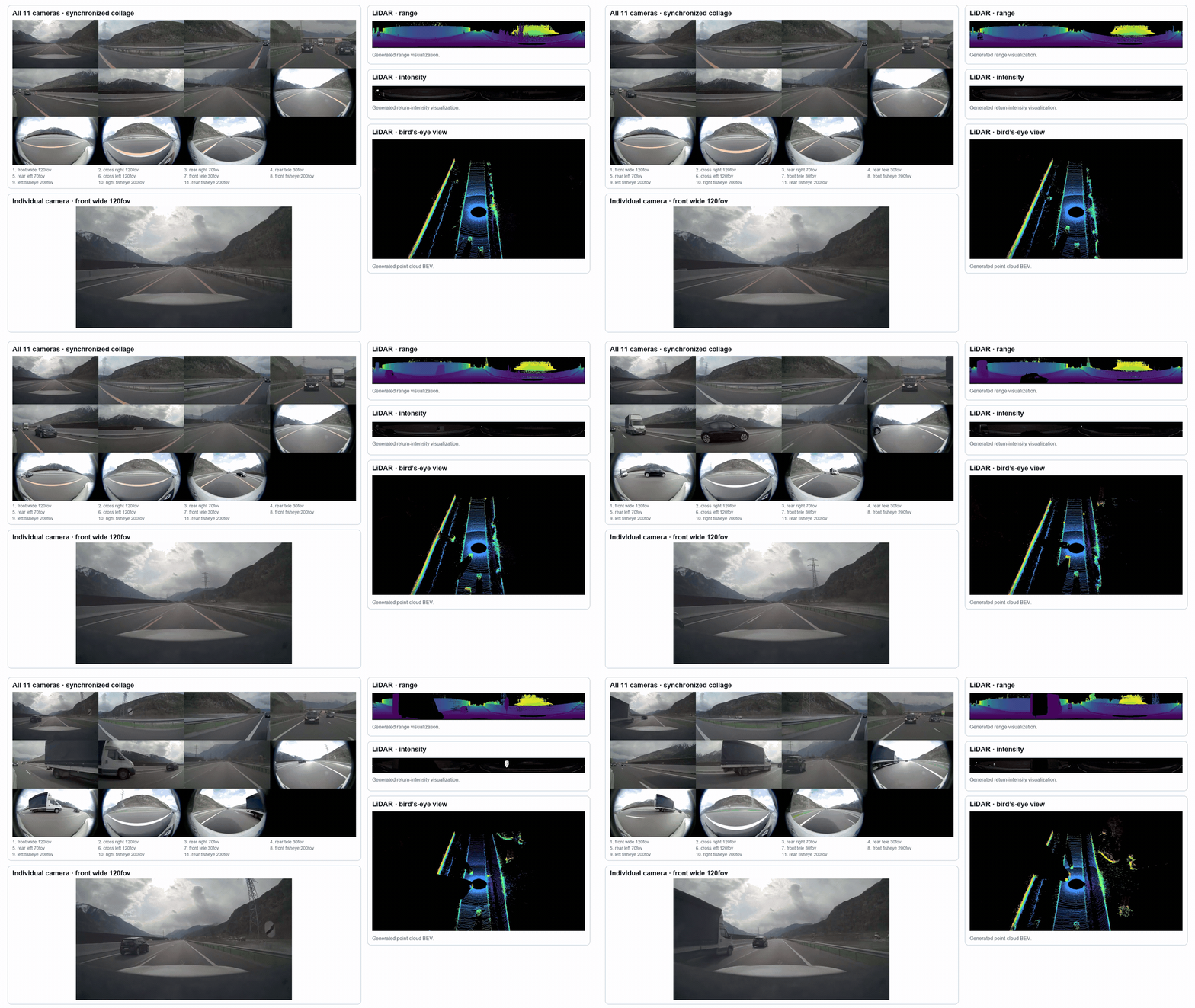
The simulation side is arguably the most technically interesting part of this release. New Cosmos 3 Nano model variants for simulation are meant to let developers test autonomous policies in repeatable, multiview, multisensor scenarios that are hard to capture in the real world. Accompanying code lets teams adapt these models to train and evaluate their own policies for autonomous vehicles and bimanual robots in interactive simulation before real-world testing.
Repeatability is the real value here. A world model that generates a rainy intersection on demand lets you run the same edge case against successive policy versions, which is hard to do with physical test drives. The open question, and the one I'd push on in any evaluation, is fidelity. Simulated sensor behavior, such as LiDAR returns or camera artifacts, has to match the hardware closely enough that a policy passing in simulation actually behaves the same way on the road or the floor. NVIDIA's materials describe the capability but don't include a sim-to-real transfer study, so teams will need their own measurements.
On the deployment side, updated Cosmos 3 NIM microservices deliver up to 2x faster inference with no quality loss in validated configurations, according to NVIDIA. Continuous video analysis enables sub-second alerts. Speed claims are only as good as the configurations they were validated on, so check those before extrapolating to your own hardware and model size.
For vision AI teams, the Metropolis Blueprint for video search and summarization 3.3 is built on Cosmos NIM microservices. NVIDIA says it helps teams monitor 40% more video streams on the same GPU. That's a throughput claim, and it's most meaningful for operators whose costs scale with stream count.
ADNOC offers a production example. It uses Fogsphere's MistIQ agentic platform, built with Cosmos and the Metropolis VSS Blueprint, to detect safety hazards in real time across 65 sites. Fogsphere also uses Cosmos Data Factory to generate synthetic training data for rare events, which lets the system improve detection without staging dangerous situations on site. That last point is probably the clearest illustration of why synthetic generation exists in the first place.
NVIDIA describes the stack as fully modular and open: Cosmos Data Factory for datasets, Cosmos Framework for training and adaptation, and Cosmos NIM microservices for deployment. Whether that modularity holds up in practice depends on how cleanly the pieces integrate with existing data platforms and MLOps tooling, and on the licensing terms for the specific open models involved, which teams should read closely before committing.
The thing to watch next is validation. Synthetic data, simulated policy testing and distilled models all shift risk from collection and hardware into evaluation. The teams getting value from this stack appear to be the ones measuring whether generated data and simulated results predict real-world behavior, and that measurement work is still largely left to each adopter.


