NYT Connections Game #1251: Red Herrings, Hidden Groups and Answers
NYT Connections #1251 splits into internet verbs, media attention terms, things that are towed and BRAIN ____ phrases. Hints, answers and the red herrings.
Game #1251 is a good example of why Connections punishes fast pattern-matching. The grid looks like it has a water theme, and that instinct is exactly what the puzzle wants you to act on. The real structure is less obvious, and it sits in four groups that don't overlap in the way the early picks suggest.
Hints before the answers
If you want to solve it yourself, start with the yellow group. Its clue is "online activities," and that points to words describing how people move around the web. Green is the trickiest to pin down from the clue alone: "put yourself out there" suggests self-promotion, but the category is really about the kind of attention a person or product receives in the news. Blue asks for things that need to be pulled, which turns the grid into a list of vehicles and their cargo. Purple is the most open-ended, with the clue "begin with a clever organ," which means the first word of each answer is a body part, and the phrases are built around the word BRAIN.
The answers
Here's the full breakdown for today's puzzle:
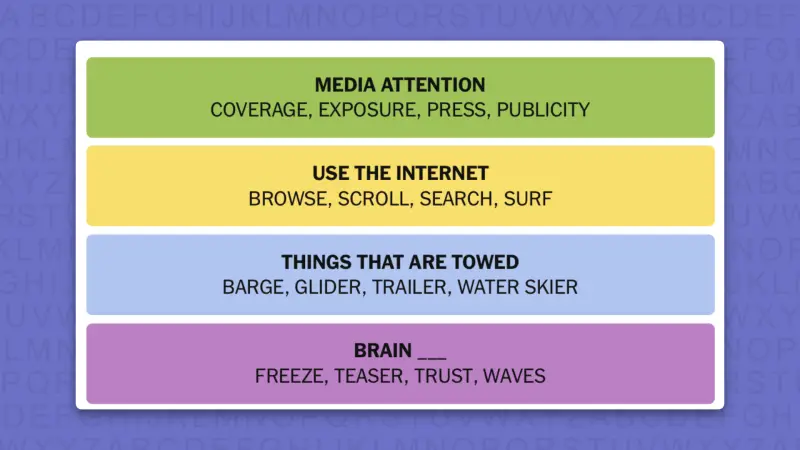
- Yellow, USE THE INTERNET: BROWSE, SCROLL, SEARCH, SURF
- Green, MEDIA ATTENTION: COVERAGE, EXPOSURE, PRESS, PUBLICITY
- Blue, THINGS THAT ARE TOWED: BARGE, GLIDER, TRAILER, WATER SKIER
- Purple, BRAIN ____: FREEZE, TEASER, TRUST, WAVES
The difficulty rating for this one lands at hard, and the mistakes are worth studying because they follow a pattern you'll see in many Connections grids.
Where the red herrings sit
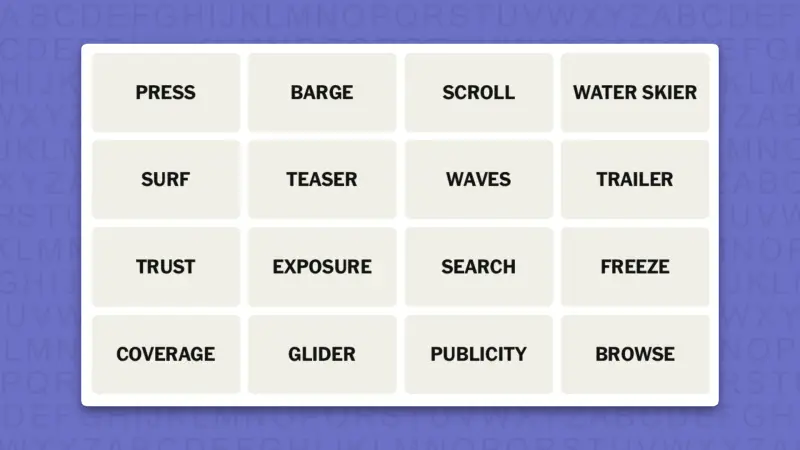
The water cluster is the biggest trap. SURF, WAVES, FREEZE and BARGE all feel like they belong together under a marine or beach heading, and that's exactly why the puzzle includes them. SURF belongs to the internet group, WAVES is a brain phrase, FREEZE is a brain phrase, and BARGE is a towed object. Grouping them together is a reasonable guess that happens to be wrong on every count.
The second trap is less obvious. SCROLL, TRAILER, TEASER and PRESS share a loose feeling of promotion and online ads, which is the kind of association a solver's brain produces quickly. Only PRESS and TEASER survive the sorting process. SCROLL goes to the internet group, and TRAILER goes to the towed group. Once you notice that a word can be claimed by several categories, the grid starts to look less like a list and more like a set of overlapping constraints.
The third trap is subtler still. WAVES fits the brain group, but it also feels plausible in a list of things that move through the water. That overlap is why a late swap can cost you a mistake even when you're close to the finish. Connections rewards the solver who checks each candidate against all four groups before committing.
What the mistakes teach you
Three errors is a common outcome on a hard grid, and it isn't a sign of poor play. What tends to go wrong is that the first strong theme you find takes over the whole board. Once a solver commits to water, every word gets read through that lens. The fix is to pause when a group seems too neat and ask whether each word has a second meaning that fits somewhere else. "Brain freeze," "brain teaser," "brain trust" and "brain waves" are all real phrases, and the puzzle leans on them precisely because they're so familiar.
Another useful habit is to lock in the groups that are unambiguous first. In this grid, the towed items are easier to confirm once you accept that TRAILER and BARGE have no real home elsewhere. Clearing those out narrows what remains and makes the harder groups easier to see.
Yesterday's puzzle and the wider format
Game #1250, from the day before, ran on a different set of tricks. Its yellow group leaned on exclamations like "good heavens" and "holy smokes," while its purple group played on best picture winners, with words like ROCKY and GLADIATOR hiding inside longer phrases. The pattern across both days is the same: the puzzle hides a second category inside a word that looks like it belongs to the first.
The format itself is simple to describe and harder to master. Each group has a difficulty level, from green as the easiest to purple as the hardest. You can make up to four mistakes, and the last group can often be solved by elimination. Those rules give you room to experiment, but they also make it tempting to guess quickly. The game is free to play through the NYT Games site on desktop or mobile.
My read is that Connections works best as a test of how flexible your categories are. The solvers who do well tend to hold their first theory loosely and treat each word as having several possible homes until the grid forces a choice. Watch for the next puzzle to test that habit with a set of words that look just as tidy and just as misleading.