Jensen Huang's Affair Probe Puts Nvidia's Leadership in Question
Nvidia's board is investigating CEO Jensen Huang after he admitted an affair, raising questions about succession and who controls AI chip supply.
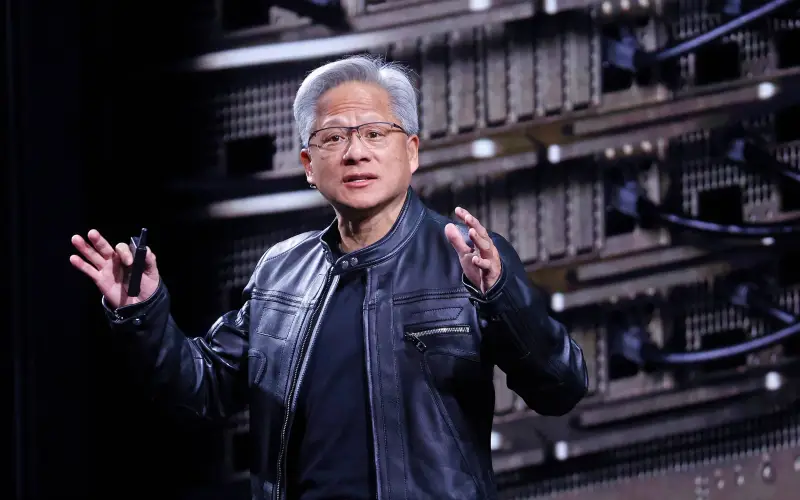
Few executives have shaped the AI era as directly as Jensen Huang. He turned the chip boom into a fortune, built a close working relationship with President Donald Trump, and became one of the most visible voices on US–China technology relations. Now his position looks fragile, and the reason is personal rather than commercial.
Huang has acknowledged an affair with Alice Huang, an executive at a Singapore-based company. US intelligence services have concluded that she was a Chinese intelligence asset. That conclusion turns a private matter into a question about corporate governance, industrial strategy and the security of the most valuable supply chain in AI.
A board review with an open ending
Nvidia's board of directors has said it will investigate the matter. In its statement, the company said Huang "fully supports the review and has committed to cooperating with it." A corporate filing adds some context on his position: Huang earned $36 million last year, held about 3.5 percent of Nvidia as of March, and serves as an at-will employee who can be dismissed at any time without severance.
How the review ends, and what it means for Huang's future, is unknown. Still, the incident puts his role in doubt. Harvard Business School professor David Yoffie, who tracks the chip industry, expects the board's work to focus mainly on whether Huang broke any company policies. That's a narrower question than whether he remains the right person to run the company, and boards often treat those two questions differently. Nvidia shares fell more than 4 percent on Monday, even as broader market indices rose, which suggests investors are pricing in at least some uncertainty.
Why one person carries so much weight
Nvidia, which Huang co-founded in 1993, supplies roughly 90 percent of the chips used to train frontier AI models, according to one market analysis. With those chips still in short supply, the person who allocates them effectively decides which parts of AI get built first. Yoffie puts it bluntly: "He's the person who decides who gets the chips and who doesn't."
The influence extends beyond supply. Nvidia has bankrolled much of the infrastructure buildout, investing billions in companies that buy its hardware, including OpenAI and Anthropic. That makes Nvidia both supplier and investor to its own customers, and it makes the CEO a central node in deals that reach well beyond his company. Yoffie's example is pointed: if Elon Musk wants a new data center built, he can call Huang.
Inside Nvidia, Huang is famously hands-on. He tracks small operational details, answers emails from any of the company's roughly 60,000 employees, and raises his voice to make a point, according to current and former staff. Publicly, he has been a steady presence on cable television and at tech conferences, where he has worked to ease worries about an AI market bubble and to promote his company's position. That visibility is part of what makes his leadership hard to replicate.
And there's no obvious successor. Nvidia has no other executive whose profile comes close to Huang's, and no clear heir apparent. Yoffie's concern is practical: "We have no idea who would replace him," he says. "You put someone new into that position, if you're a customer, who knows what that's going to mean."
Load-bearing, and uncomfortably so
Ryan Fedasiuk, a senior fellow at the Foundation for American Innovation, argues that Huang has become load-bearing for the US AI industry, given his influence and his closeness to the president. He sees the tension clearly. "On the one hand, Huang is irreplaceable. He built Nvidia into the juggernaut it is today, and he was the visionary behind the GPU, which has sustained the intelligence revolution," Fedasiuk says. But he also insists the company has to matter more than any one person. "He has to be replaceable as the CEO of the world's largest company, at $4 trillion in capex."
That framing matters because it separates the man from the institution. Companies that depend heavily on a founder often discover the dependence only when the founder becomes a liability. Nvidia's customers now have a live example of that risk, and the company has to show that its chip roadmap and allocation decisions don't rest entirely on one person's judgment.
China, export controls and credibility
The Chinese intelligence angle also complicates Huang's public record. He has been outspoken against calls for tougher technology export controls on China, arguing against restrictions. Fedasiuk says the affair makes that position look far more fragile, and that Huang's credibility on the topic could be permanently damaged. He also raises the question of whether China may have gained sensitive information about US AI companies or about strategy on China.
The policy backdrop is already shifting. The first Trump administration and the Biden administration both imposed controls meant to limit China's access to Nvidia's chips and to the equipment needed to manufacture advanced semiconductors. In Trump's second term, those controls were loosened, allowing China access to older generations of Nvidia chips. The reasoning was that making China dependent on US technology was the better path.
Sam Bresnick, a research fellow at Georgetown University's Center for Security and Emerging Technology, thinks the episode will speed up tighter oversight regardless. "There was going to be more of an impetus to control what chips are getting sent to China anyway," he says. He expects closer scrutiny of chip shipments and of the Commerce Department's handling of them.
Here's the thing: the investigation may settle the question of Huang's job, but the bigger issue is structural. Nvidia's dominance has made one executive the de facto gatekeeper of AI compute, and that concentration is now visible to customers, regulators and rivals alike. Watch whether the company names a clearer line of succession or changes how it governs chip allocation. Either move would say more about where Nvidia is heading than the investigation's findings alone.