Physical and Agentic AI Reach City Operations, From Madrid to Lekki
NVIDIA-based physical and agentic AI is moving into city services, traffic systems and industrial digital twins. Here's what's deployed, what's planned and what to watch.
Most cities already sit on far more data than they can use. Cameras, traffic sensors and operational logs pile up, and the hard part is turning that stream into decisions about maintenance, planning and public services. Physical AI and agentic AI are being pitched as the bridge. What's new is that the examples are now running in production or scheduled for it, across several continents, and they share a common pattern: the compute sits close to the city, and the data stays under the control of the people who own it.
The pattern matters more than any single deployment. A city department, a neighboring municipality or a local developer can build on the same shared infrastructure rather than each buying and managing its own GPU stack. For many municipal teams, that changes the economics. You don't necessarily need a large capital outlay to start. Depending on the workload, a few RTX workstations or a small GPU system may be enough to prototype and run early services.
Agents That Answer Residents and Watch Traffic
The clearest near-term use is the service desk. In Spain, NVIDIA Nemotron is one of several models behind resident-service agents built by 1MillionBot. The stack combines open source ALIA models, trained at the Barcelona Supercomputing Center, with Nemotron and other models. The agents handle municipal procedures, appointment requests, urban-planning incidents and general service questions. The reported footprint covers Madrid Digital in the Comunidad de Madrid, Administració Oberta de Catalunya and more than 150 deployments across Spain. Mixing open regional models with commercial open models is a sensible hedge here, since it keeps the model choice swappable as language coverage and licensing terms change.
In the San Francisco Bay Area, LiveX is building what it calls an AI City concept around conversational hosts. These systems take in a person's request, answer it and act on it. They're designed to be tailored to local languages and service needs in airports, hospitals, event venues and other public spaces. The stack pairs NVIDIA Cosmos world models and Nemotron open models with Omniverse and Metropolis libraries running on NVIDIA RTX PRO GPUs.
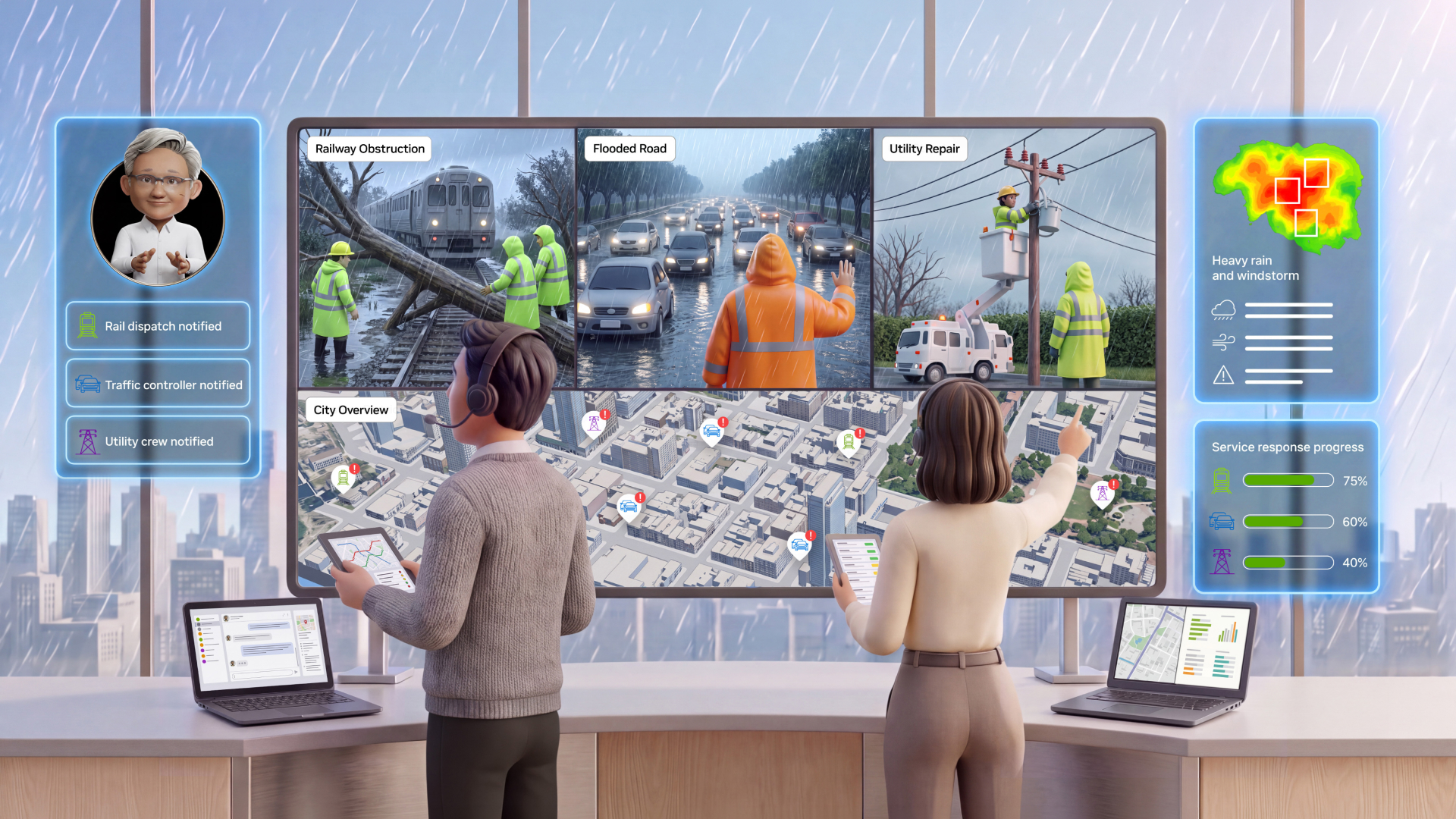
Vision is where the operational payoff gets concrete. Vision agents can read existing camera feeds and turn them into insight on mobility and safety, and they can help teams coordinate responses across city services. The idea isn't new, but the shift is from pixel-level detection to summarizing events and routing them to the right team. That's a harder problem than it sounds, because a summary is only as good as the detection beneath it, and error rates in crowded or low-light scenes are where these systems usually show their limits.
In Wrocław, Poland, K2K is building shared AI infrastructure on NVIDIA accelerated computing, Cosmos world reasoning models and the NVIDIA Metropolis Blueprint for video search and summarization (VSS). The goal is to turn camera streams into actionable intelligence for mobility, safety and event response. The notable design choice is reuse: a single infrastructure base serves several city functions, instead of one pipeline per department.
Malaysia offers a fuller example of that model. ITMAX packages infrastructure and agentic applications into long-term managed services for cities, starting with traffic management in Kuala Lumpur. Its SamurAI V2 vision agents are built with reference to Cosmos, Nemotron and the Metropolis VSS blueprint, and are scaling on NVIDIA RTX PRO 6000 GPUs to support more than 17,000 cameras by 2027. Before changing live signals, ITMAX runs signal-timing tests in TeraSim, an open source traffic simulation platform from Laplace Intelligence. The company reports peak-hour corridor travel-time reductions of up to 26%. That's an upper bound, and it's worth reading it as the best case from a specific corridor rather than a typical city-wide figure.
Digital Twins Move Closer to Daily Operations
Digital twins have been a planning tool for years. What's changing is that they're being wired into live operations. City twins can speed up infrastructure planning and reduce disruption to residents during works. They can also run as real-time simulations that help decision-makers test options before they act.
Industrial sites are further along this curve. At Dangote's Lekki refinery in Nigeria, Honeywell's Forge Plant Cognition uses Nemotron-powered agents to make sense of operational data. A digital twin of the plant and its processes, built with Omniverse libraries, is planned to support simulation and operator training. The platform runs on Dell PowerEdge servers with NVIDIA RTX PRO accelerators. The stated goals are finding bottlenecks, anticipating equipment and process problems, and tuning plant performance. Refineries are a useful test case because the cost of a wrong recommendation is physical and immediate, which forces the agent layer to be checked against the twin before anyone trusts it on the floor.
Urban planning is getting the same treatment. In Taiwan, Linker Vision and Dutch architecture firm MVRDV are using Omniverse and Nemotron to build environmental, social and governance agents that assess the impact of different urban-planning scenarios. In one example, a 15-year projection of an urban forest canopy runs in about 10 minutes. That shortens design iteration from two weeks per cycle to under an hour. Speed like that changes how many options a team can actually compare, and it moves the bottleneck from running the model to deciding which assumptions to believe.
Ports, Research Labs and the Shared-Infrastructure Bet
The infrastructure question is where this gets interesting for technology leaders. At Morocco's Tanger Med port, Cires Technologies is expanding a sovereign AI factory for planned applications in worker safety, congestion analysis, cargo routing and port operations. The company is also trying to build an ecosystem of application providers that can develop local models and applications for ports and cities. That's a bet that the value sits less in any one model and more in the platform that lets local developers ship domain-specific tools on top of it.
The Barcelona Supercomputing Center's AI Factory Accelerator Programme follows the same logic from the research side. It gives startups access to sovereign computing, technical support and training, and supports work in agriculture, medical imaging, knowledge access and speech services. For a city trying to grow its own AI capacity, that kind of pipeline from research compute to startup product is often more useful than another pilot.
Here's the thing: the common thread across these deployments is that the hard problems are rarely the model itself. They're data access across siloed systems, privacy handling for camera and resident data, evaluation of agents that take actions, and long-term operating costs once a pilot becomes a managed service. Several of the examples above explicitly describe managed or multi-department designs, which suggests the operators have already run into those issues. The open questions are how agent accuracy holds up over years of operation, how cities audit what an agent did and why, and how portable these stacks are if a city wants to change vendors.
Those questions will get a public airing at the Smart City Expo World Congress, running November 3 to 5 in Barcelona. NVIDIA Vice President of EMEA Paolo Guglielmini will give a keynote on AI factories and intelligent cities, followed by a panel moderated by Charbel Aoun, NVIDIA's director of smart city and spaces for EMEA. If the next wave of deployments is measured by reuse across departments, rather than the number of pilots, that's the conversation to follow.