Westchester Scanner Glitch Turns Into Fuel for Fraud Claims
A programming fault that rejected scanned paper sheets in Westchester County, New York, set off a fast wave of fraud claims on X. Officials said no counts were miscalculated.
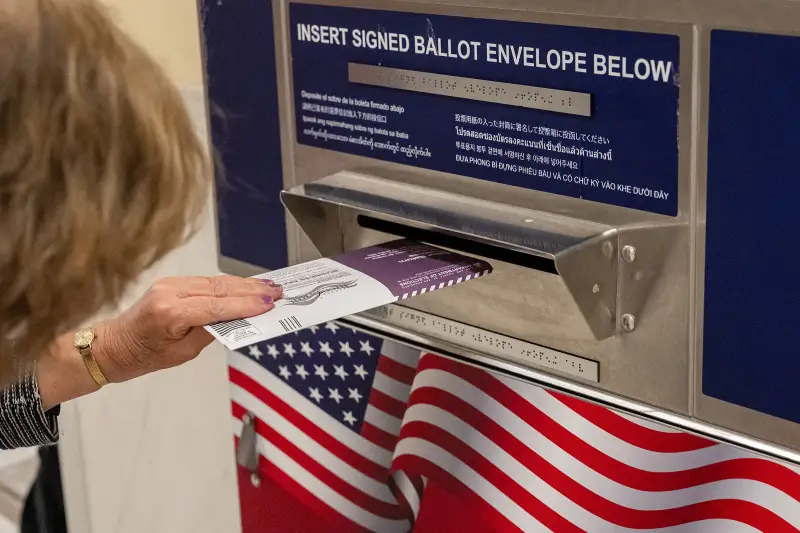
A malfunction that officials traced to outdated programming became a test case for how quickly a local technical problem can turn into a national fraud narrative. Within minutes of reports that ballot scanners in Westchester County, New York, weren't working, some of the most-followed accounts on the right had framed it as deliberate sabotage. The machines had problems. The sabotage claim had no supporting evidence, and it arrived before anyone had established what was wrong.
What actually broke
The timeline matters here, because the early version of events was wrong. Voting had been underway for only a few hours on Tuesday, and polls hadn't opened everywhere, when Republican strategist and pro-Trump influencer Joey Mannarino posted on X at 9:02 am Eastern that "MASSIVE AMOUNTS OF VOTER FRAUD" were being reported nationwide. He offered no evidence. That post set the tone for the morning before the day's actual problems were understood.
Those problems were mundane, and several were unrelated to each other. Severe flooding along Florida's Space Coast forced about 20 polling places to move. Bad weather over the weekend likely caused brief power outages in Arizona's Maricopa County, which led to the temporary closure of several locations. In Pennsylvania's Luzerne County, a scanner box was missing. And in Westchester, where the House race between incumbent Republican Mike Lawler and Democrat Cait Conley is closely watched, machines stopped accepting paper sheets early in the morning.
Westchester's administrative board first blamed "the thickness of the paper" in a statement issued two hours after polls opened. About twenty minutes later, county officials revised that language and cited a more general "issue involving paper" that the machines couldn't process. The change looks small, but it's the kind of shift that gets screenshotted and recast as a cover-up. It was really a sign that officials were still working out the cause.
The explanation came later in the day from New York State officials. Most machines in the county had outdated programming, which meant they couldn't recognize and process Tuesday's ballots. The problem caused rejections, not miscounts, according to the state. Officials said the immediate priority was restoring scanning capability to at least one machine at every polling location, with more coming online as the day went on. County executive Ken Jenkins said that once the machines were working again, he would bring together a cross-party team to review the decisions behind the failure and determine where accountability sits. He called the situation unacceptable.
How quickly the framing hardened
None of that stopped the amplification. The Republican National Committee posted on X that it was, alongside Democrats, seeking a joint court order requiring central tabulation of ballots at the county's administrative board. Representative Claudia Tenney of New York, who has backed efforts to challenge the results of the 2020 presidential contest, wrote that the Democrats in New York would "do anything and everything to cheat." Conservative broadcaster Mark Levin shared her post with his roughly 5 million followers.
Other voices went further. Katie Miller, whose husband Stephen Miller serves as deputy chief of staff for policy and homeland security adviser in the White House, cast the episode as the Left stealing the contest. Liz Harrington, a former spokesperson for Trump, called for voting machines to be banned outright and for people who used them to cheat to face consequences. Laura Loomer wrote that Democrats were already trying to steal the count in New York, and she tied the Maricopa outages to the same supposed pattern.
The posts followed a familiar script. Pro-Trump influencer Phillip Buchanan, known as Catturd, shared Lawler's message urging people to stay in line, then mocked the glitch as the sort of thing that always happens. He also pushed claims of "Democrat shenanigans" in Florida's Broward County, where technical difficulties were resolved quickly. MJ Ultra, a prominent pro-Trump QAnon account, declared Broward County "corrupted as hell." Rogan O'Handley, who posts as DC Draino, labeled the Westchester situation the "Maricopa Method of stealing." Kari Lake, the Trump nominee for ambassador to Jamaica, shared conspiracy theories about Westchester and called out so-called liberal shenanigans in Maricopa. Lake has previously and baselessly claimed that her 2022 Arizona gubernatorial race and her 2024 Senate bid were rigged.
Why this pattern keeps repeating
Here's the thing: malfunctions like these are common. Voting machine problems, along with bad weather and power outages, show up in most cycles. They usually trace back to mundane causes such as aging components, software versions or a single misconfigured device. That ordinariness is exactly what makes them useful to people who want a story. A glitch with no obvious cause leaves room for speculation, and an explanation that arrives hours later rarely catches up with the first wave of posts.
The University of Washington's Center for an Informed Public, which tracks online rumors about elections, found that posts about the malfunctioning Westchester machines, often framed conspiratorially, were arriving at roughly 150 per minute just after 10 am Eastern. That's a measure of how fast the signal moved, not of how many people believed it. Still, it shows the speed problem. Corrections typically travel more slowly than the initial claim, and the revised county statement was a small example of that gap.
Trump himself stayed largely off the subject. He spent much of the morning on Truth Social complaining that people had taken seriously his joking announcement about renaming the Lincoln Memorial Reflecting Pool. When he did post about Lawler's race, he didn't mention the scanner problems. The amplification came mostly from the accounts around him, not from the top of the movement.
The open question is whether the explanation will catch up with the story. The state has already said the fault was programming, not counting, and that every legitimate selection would be tallied. If the programming diagnosis holds and the county's review produces a clear account, that record will exist. Whether anyone who posted the sabotage claim will revisit it is a much less certain bet.