Ring Puts Cameras on Wheels and Wings With Indoor Drone and Business Patrol Robot
Ring Robotics debuts a $270 indoor camera drone for homes and a $1,000 patrol robot for businesses, both running its AI Pilot navigation software.
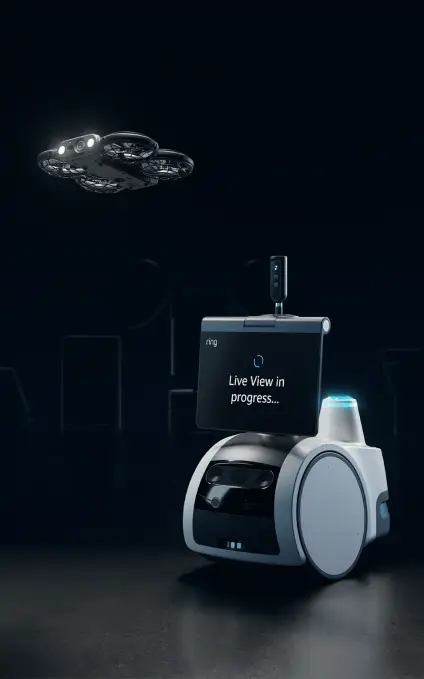
Ring is moving its cameras off the porch and into the building. The Amazon-owned company has launched a robotics division, Ring Robotics, and its first two products share a clear goal: keep watch over a space when nobody is standing in it. One is a flying camera for homes. The other is a wheeled robot for businesses. The hardware is the easy part to evaluate. The harder question is whether people will want a moving camera roaming their most private rooms on a schedule.
A drone that patrols the house
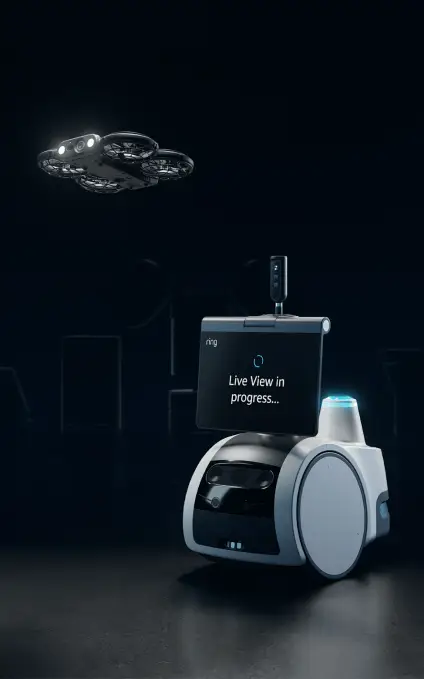
Ring calls the home device the Ring Drone Cam, which it describes as a "flying indoor security camera." It flies from room to room, checks on what's happening, and alerts the owner when something looks wrong. The more useful detail is how it ties into the rest of Ring's hardware. If a Ring alarm trips in one part of the home, such as the back door, the drone is supposed to fly there and investigate. When it isn't working, it waits in a docking bay.
The drone records in 2K and carries LED lights for night footage. Owners can control it through Amazon's Alexa Home Map, and it can be scheduled to patrol at set times. That scheduling feature is probably the one that will sell the most units. If you're away for a night or on vacation, the drone can keep checking the house while you're gone.
A patrol robot for storefronts and offices
The business product, Ring Rover Cam, works on the same principle at a larger scale. It can follow set routes at set times inside a store or office. It streams continuous 4K video to Ring's mobile app, and a trigger can start recording automatically when it detects a person. A periscope-style camera can be raised to look over obstacles like shelving or counters, which is a practical touch for a machine that sits near floor level.
Two-way audio is the feature I'd watch most closely. The remote operator can talk to whoever is inside, whether that's an employee who has stayed late or someone who shouldn't be there. Ring's pitch is pointed: the robot can sweep the floor after closing and investigate when a sensor trips at 2 a.m., sending everything to your phone. The model is less like a camera and more like a remote guard that can give instructions.
One AI stack, two bodies
Both devices run on AI Pilot, Ring's proprietary system. The company describes it as combining "specialized vision models, sensors, and cloud processing to see, think, and navigate autonomously." Both machines are meant to learn a floor plan by exploring the space on their own, without someone mapping it first. That's a real technical claim, and it's also where the questions start. Mapping an unfamiliar room, handling furniture that moves, and avoiding pets or people in motion are hard problems for indoor robots, and the announcement doesn't include accuracy figures or failure rates. Cloud processing also means navigation and video analysis depend on a working connection, which matters if the goal is to respond to a sensor trip in real time.
A troubled history for indoor security robots
Ring isn't the first company to try this. Amazon launched its own home robot, Astro, in 2021. It was originally marketed as a general domestic helper, then repurposed as an enterprise security product, a move that came later. Amazon discontinued the business version about seven months after it arrived. Astro's trajectory suggests that roaming security robots have struggled to find a buyer, and the reasons likely include price, value compared with fixed cameras, and the hassle of a device that needs space and maintenance. Ring's Rover is priced at $1,000, which puts it well above a typical set of fixed cameras, so the company will need to show clear value in the first few months.
The privacy problem gets harder
Ring has spent years defending its privacy record. Critics have argued that its camera network can feed into unofficial surveillance networks that police departments can access. A device that moves through a home or shop raises the stakes. A doorbell sees the porch. A drone sees the living room, the bedroom, and whoever is inside, including guests and children who never agreed to be recorded.
Ring says both devices include "privacy and security" protections. The company points to TAKE (Throw Away the Key Encryption), which it calls its "strongest default encryption yet." Encryption protects video in transit and at rest from anyone without the key, but it doesn't change who holds the footage. Ring cameras generally upload recordings to the cloud, and the announcement doesn't say whether these robots will offer local storage. That's the detail I'd check first. Local-only recording would address a large share of the privacy objections, and its absence would be the clearest signal of where Ring expects these devices to live.
What to watch
The Rover arrives on December 16 at $1,000. The drone follows next year, on January 27, at $270. Between those dates, a few things will shape how these products are judged. Watch whether local storage appears as an option. Watch how the human-detection trigger handles pets, employees moving around after hours, and shadows that look like intruders. And watch whether Ring publishes real navigation performance data, since mapping and obstacle handling will decide whether these machines feel like useful guards or expensive toys. For now, Ring has a clear pitch and a price, and the evidence will come from the first months of use.