Readwise Books Pairs an E-Book Store With Strava-Style Reading Stats
Readwise's new beta app sells e-books, tracks reading in detail, and opens its data through an API and MCP server. Here's what it does and where it's still unproven.
Readwise has spent its existence on the highlights and read-later side of reading. Now it's selling books too. Its new app, Readwise Books, combines an e-book store with a reading tracker, and it's aimed squarely at the position Amazon has held for years. The bet is that a reader who wants to buy, read, and log books might not need the Kindle hardware or the Goodreads account to stay in one place.
The company calls the app "a cross between Kindle and the Goodreads apps." That's a fair shorthand. What's less obvious is which half of that pitch carries the weight. My read is that the reading metrics are the differentiator, and the store is the thing that makes those metrics possible.
A store with a tracker attached
The storefront claims "millions" of e-books from the big five publishers and others. Availability starts in the U.S., with more countries promised. Print books are fulfilled through Bookshop.org's distributor, and some audiobooks are available too. So the catalog is broad, but it isn't the full global catalog yet, and anyone outside the U.S. should expect to wait.
The timing matters. Reading apps have multiplied, and most of them have competed with Goodreads on social and organizational features: book clubs, widgets, goal-setting, lists, habit tracking. Very few have tried to compete with Kindle on the buying side. Kindle still holds the lead by a wide margin, at an 83% share of the market when Kindle+ (formerly Kindle Unlimited) is counted. Amazon's advantage isn't only the catalog. It's the hardware, the sync, and the habit of opening the same app every night. A new store has to win on something Amazon doesn't prioritize, and Readwise has picked the analytics.
Measuring the reading, not just the finish line
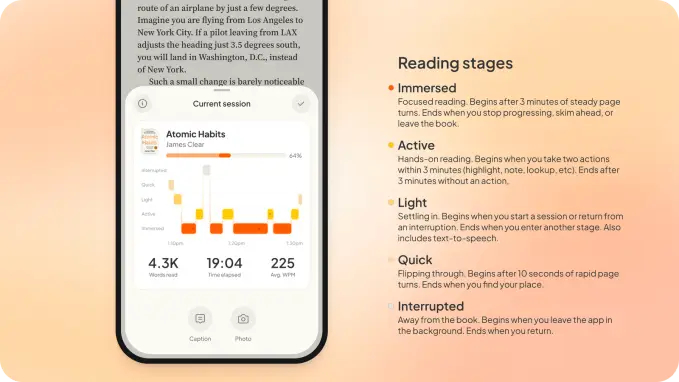
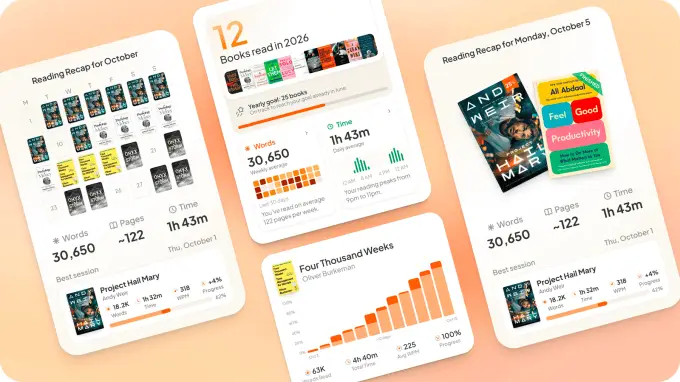
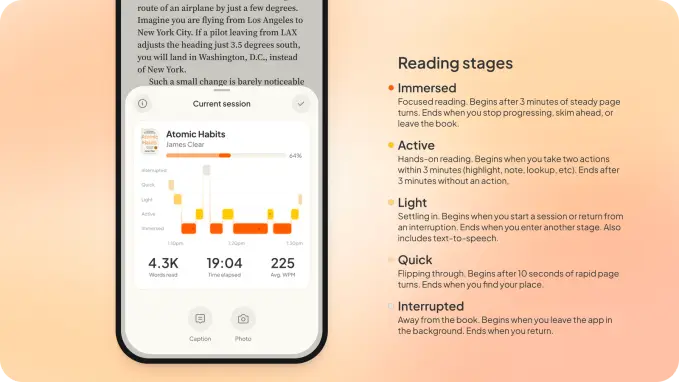
Goodreads mostly records when you started a book and whether you finished it. Readwise Books goes after the middle of the process. It tracks words read, pace, depth, immersion, and sessions, and it visualizes them over time. The company compares this to Strava, the exercise app whose appeal comes from turning effort into charts.
The comparison is apt in one way. Strava works because people enjoy seeing their own trend lines, and reading tracked at session level could produce the same small loop of feedback. The company's co-founders, Daniel Doyon and Tristan Homsi, make a psychological argument in their blog post: reading is often surrounded by guilt, and guilt doesn't change behavior much. Session tracking, they argue, makes the reading you're already doing visible, and "that which is measured is improved."
They also say the most consistent user feedback is that the app has led people to read more without relying on willpower tools like goal-setting, streaks, or scheduling. That's a claim worth testing rather than accepting. It comes from the company's own users, and the source doesn't provide figures or a methodology. Still, if it holds up, it points at something real: passive visibility might do more than the streak mechanics that most habit apps lean on.
The obvious question is how "depth" and "immersion" are calculated, and whether they reflect attention or just time with a book open. Those definitions will decide whether the charts are useful or merely pretty.
Tracking books you didn't buy here
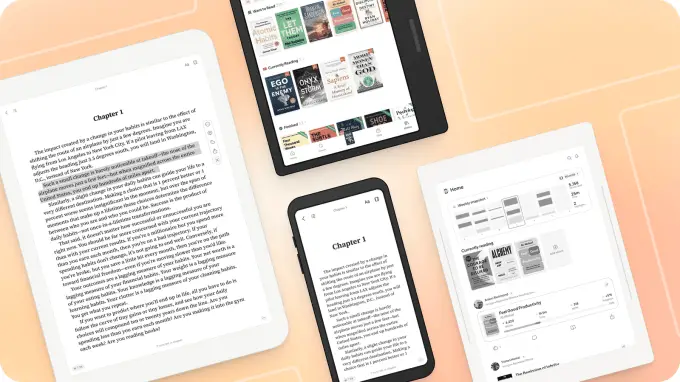
Kindle's biggest structural advantage is that it covers the whole chain, from device to purchase to log. Readwise doesn't sell e-readers, so it has to meet readers where they already are. The app supports purchased and uploaded e-books, and it offers several ways to track reading that happens outside its own ecosystem.
Those include session tracking through Kindle's browser-based Cloud Reader, and a feature that lets you photograph a physical book to log progress. You can also upload any DRM-free EPUB, the widely used format without copy protection. The app can read text aloud through text-to-speech. Each of these is a practical concession to the fact that most readers own books from several sources, and that a tracker that only works for one store will struggle to become a daily tool.
The trade-off is that tracking across sources depends on how cleanly each source exposes reading activity. A photo-based progress feature is a workaround, not a data feed, and the accuracy of cross-platform session data is the kind of detail that will show up quickly in user reviews.
Open data, and an AI layer that waits on publishers
Goodreads has been criticized for its relatively closed ecosystem. Readwise is going the other way. It offers a public API and a Model Context Protocol (MCP) server. In general terms, an MCP server lets AI agents query a service's data and take actions through a standard interface. For Readwise Books, that could mean an agent researching recommendations based on your reading history, generating a books page on a personal website from your Readwise data, or connecting a hackable e-reader to log sessions automatically. For developers and researchers who want to build on reading data rather than just view it, that openness is probably the most interesting part of the launch.
The AI features come with a condition. With publishers' permission, the app will offer session recaps, definitions and term lookups, word and phrase translation, and a location-aware way to ask questions about the passage you're reading. So far, only HarperCollins has opted in. That's a narrow start, and it means many of these features will depend on which publishers agree over time. Teams building on the app should assume that AI coverage will vary by title, not by user.
Pricing and access
The Readwise Books app is free to start, and some AI features will move behind a paywall later. Readwise's existing apps are priced at $7.99 per month each, or $9.99 per month for both. The app is in beta, and access requires an invite unless you already subscribe to Readwise. Those details matter for adoption: a free tier with a clear paid upgrade path is a common model, but the price of the AI features will determine whether the app stays a tracker people open casually or becomes a subscription they need to justify.
What to watch
Three things will tell us whether this works. The first is whether the metrics change behavior in a way that holds beyond the first few weeks, since novelty can make any dashboard feel motivating. The second is how many publishers opt into the AI features, because that sets the ceiling on what the app can do with a given book. The third is whether international availability arrives quickly enough to matter, since the store is U.S.-only at launch.
Readwise isn't going to dislodge Kindle's 83% share on its own. But it's testing a question the category has mostly avoided: whether reading data, opened up to developers and AI tools, can be the reason to switch. That's a more useful experiment than another set of badges and reading challenges.